
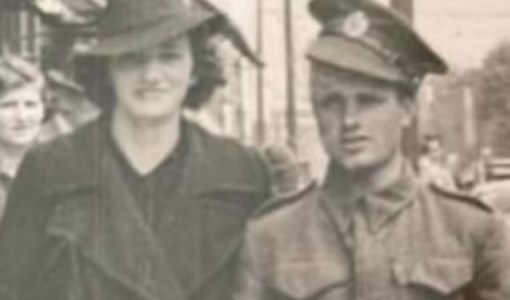
Killed in the Line of Duty Sapper Michael Lambert Service Number 2094019………..
Michael Lambert was born on 23 March 1919 in Clogheen, Tipperary, Ireland, the oldest of eleven children born to George Lambert and Catherine Daly. Interestingly his father is recorded as a Soldier on Michael’s birth record.

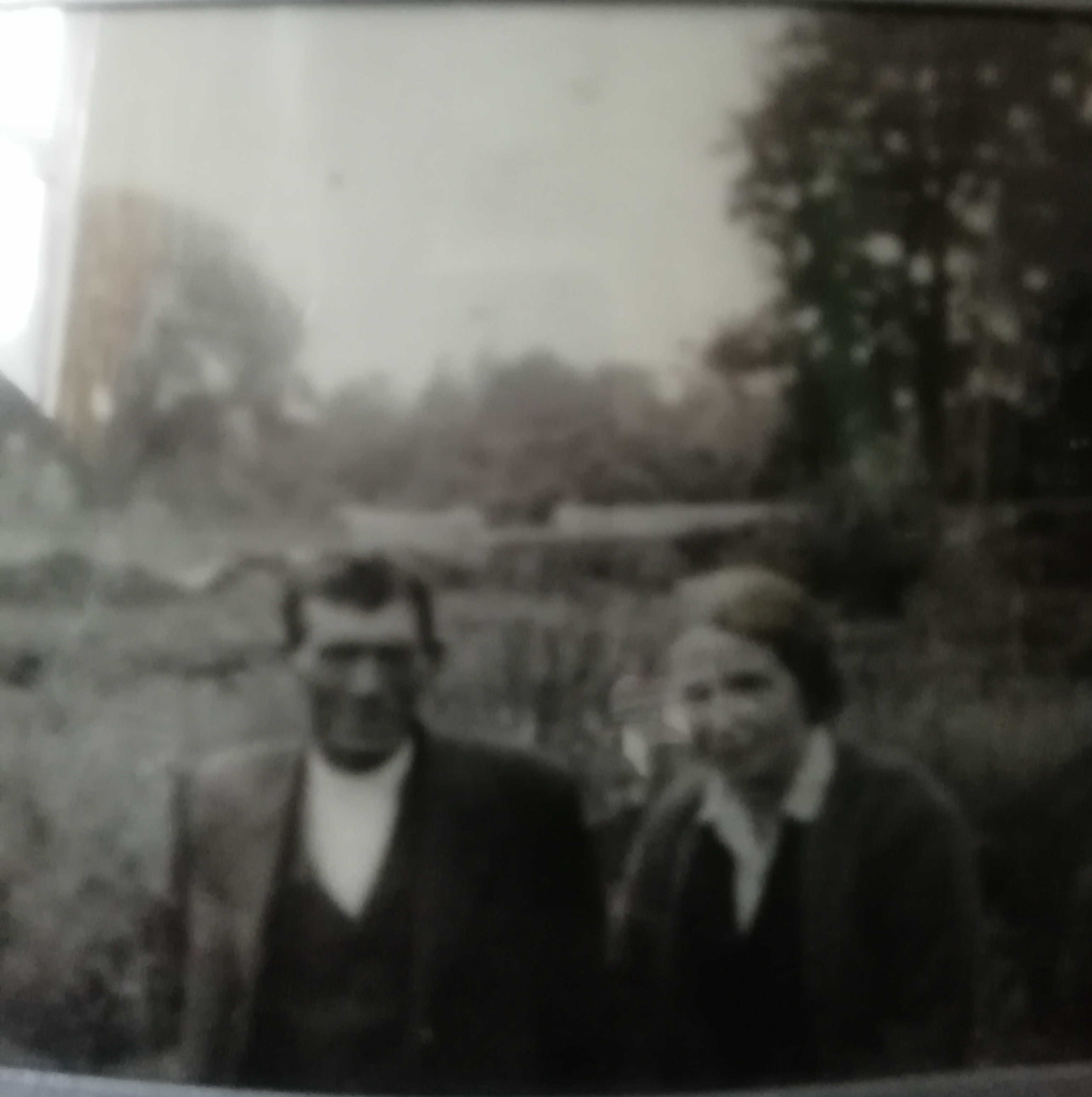
Michael’s father, George Lambert, was originally from a small village called Galbally which was sandwiched roughly half way between Limerick and Cork. His mother, Catherine Daly was from Clogheen a remote rural village in County Tipperary. Although it’s an extremely blurry image, I do have a picture of Michael’s parents, George and Catherine Lambert, which can be seen below. Like many of the pictures that we collect or inherit, sadly there is no date or location.
There is also another picture of George Lambert taken in 1953 just two years before he sadly died.

Michael’s father George Lambert had served on the Western Front during WW1 with the 2nd Battalion of the Royal Irish Regiment as well as serving with The Royal Engineers, a Regiment that Michael himself was to later join. George first went to the front line on 22 June 1915 and was the recipient of The Victory Medal, The British Medal as well as the 1915 Star. He achieved the Rank of Pioneer, the equivalent of a Sapper today and his unit was ‘Rocks and Quarries’. Little is known of the Rocks and Quarries Unit, or the Quarrymen as they were known, but what documents and information there is, can be found on the Long Long Trail website;
George was to leave Army Service on 7 April 1919, leaving behind one battlefield on the Western Front, only to find on his return, that Ireland was in turmoil. The Great War had just ended, just a few months before his son Michael’s birth and the Easter Rising had taken place in Dublin, just a few years before that. Young Michael was born into a country that was divided and troubled. In May 1921, Ireland was partitioned under British law by the Government of Ireland Act, which created Northern Ireland. A subsequent ceasefire began on 11 July 1921 which led to the signing of the Anglo-Irish Treaty on 6 December 1921 which created an Irish Free State in the 26 counties to the south, which was to become what we know today as the Irish Republic. To say these were difficult times for families living in Ireland at the time is an understatement.
Around this time, Ireland was a country of extremes, extreme poverty for many inhabitants, with around 36% of the residents in Dublin living in one room tenements. Whereas on the other end of the scale, 22% of the population were living in grand homes of ten rooms or more. The rate of illiteracy in Ireland was 8.3% in 1911 and varied widely across the country, with the lowest rate in Dublin. The infant mortality rate was 81.3 in Ireland in 1916, i.e., for every 1,000 babies born during 1916, 81 died before they reached twelve months of age, a clear indicator of living conditions at the time. As a comparison, by 2014 the infant mortality rate in Ireland was very low at 3.7 per 1,000 births. About one in eight adult deaths in 1916 was due to bronchitis and pneumonia which killed 6,708 people, with another one in eight deaths caused by tuberculosis (TB) which killed 6,471 people. (Source Central Statistics Office).
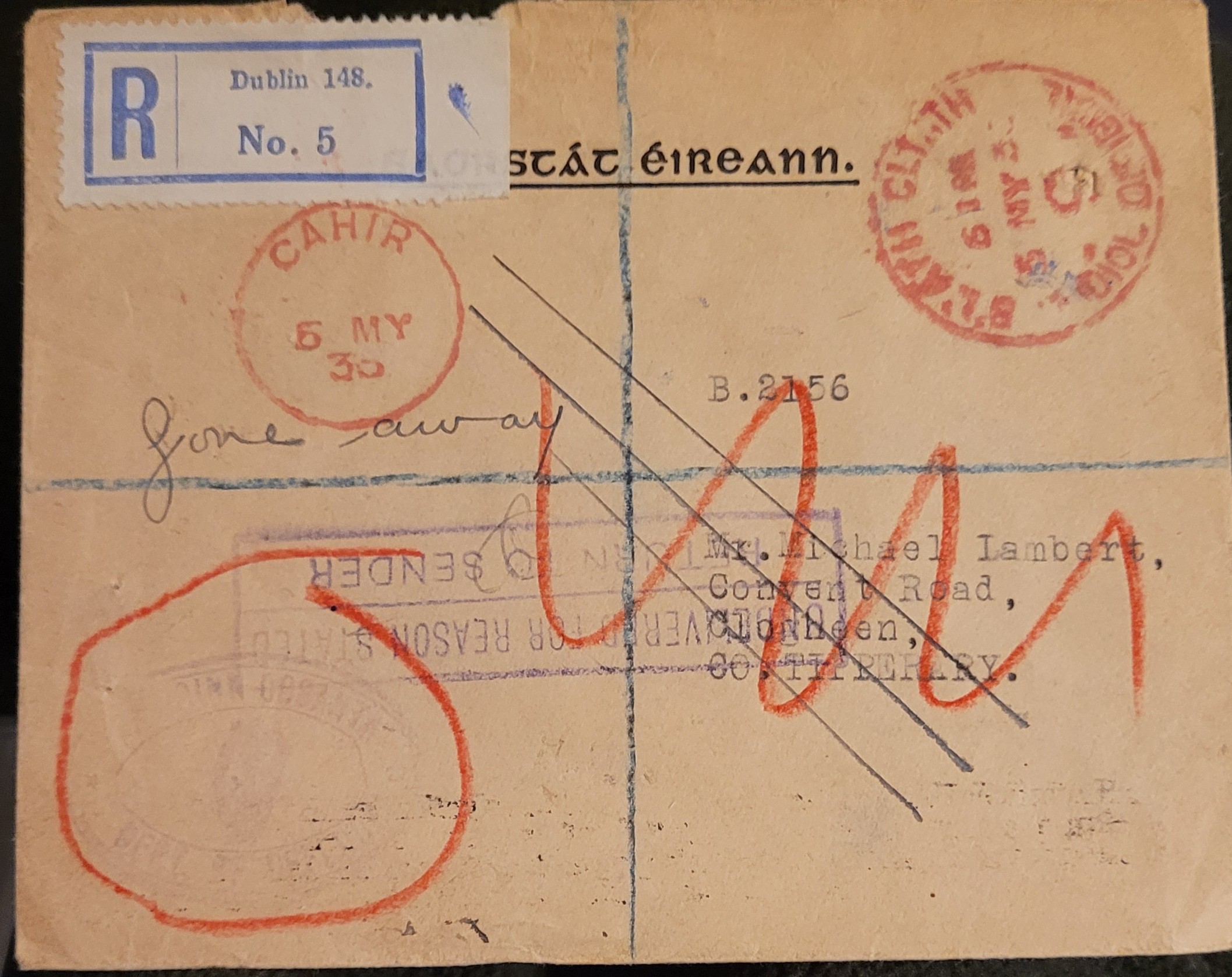
Like many young men, escaping Ireland was Michael’s goal and one of the most common routes of escape for young men was to sign up with the British Army and he actually tried to enlist with the British Army, aged just 12, in 1930 and the envelope below was returned to the family home on rejecting his application to sign up. But he wasn’t one for giving up and eventually made his way to Paddington in London.
There was an extremely large Irish community in London at the time and Michael settled in the Paddington area which had a large established Irish community. It was here that Michael met and married his sweetheart Joanna Driscoll, (known as Anne) in 1940. The young couple had just one son, Michael Lambert junior who was born in Paddington in 1940.
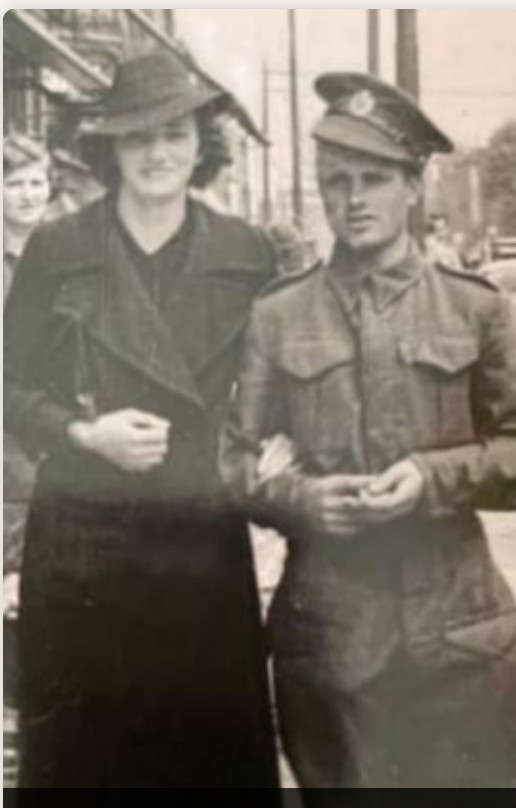
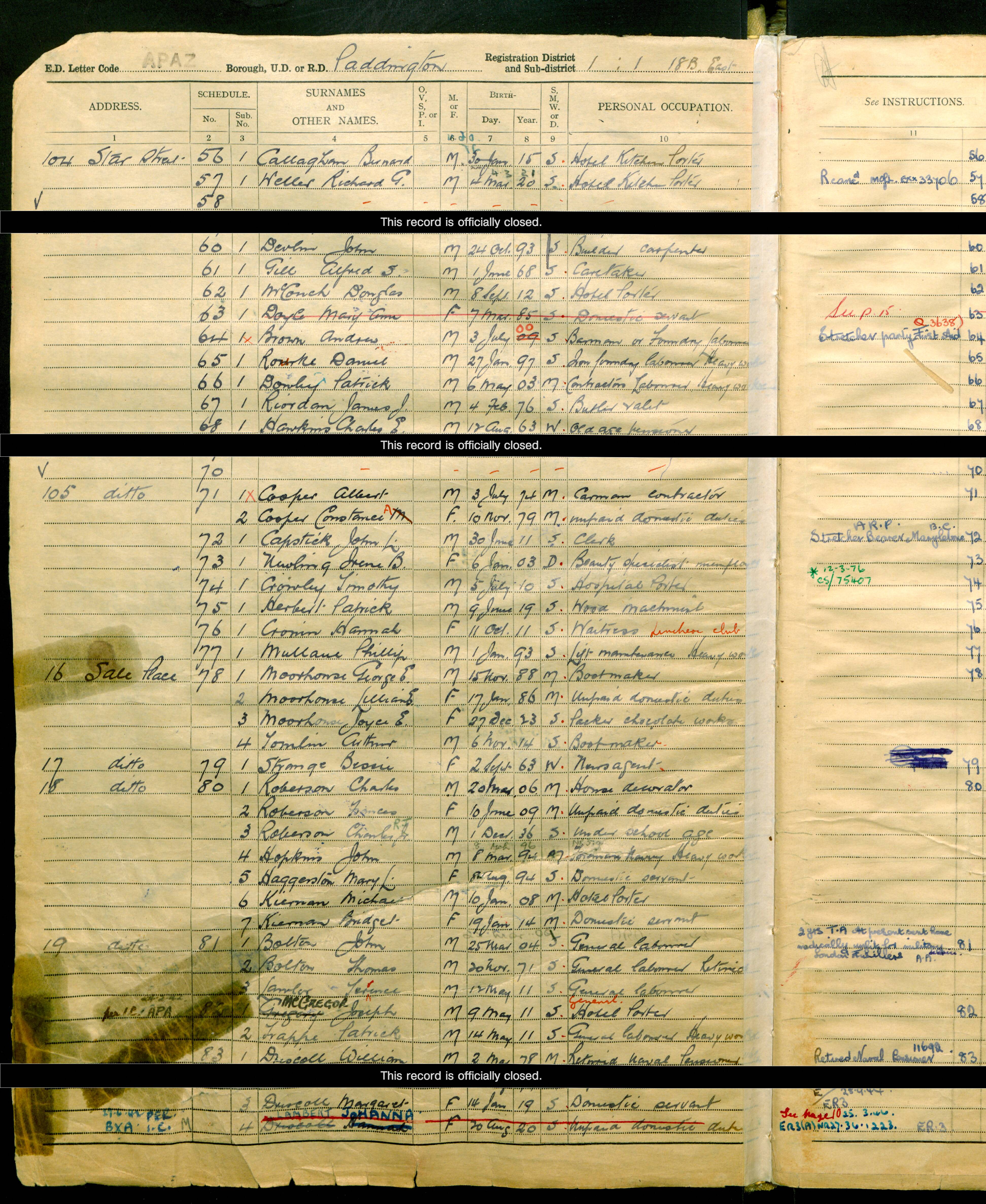
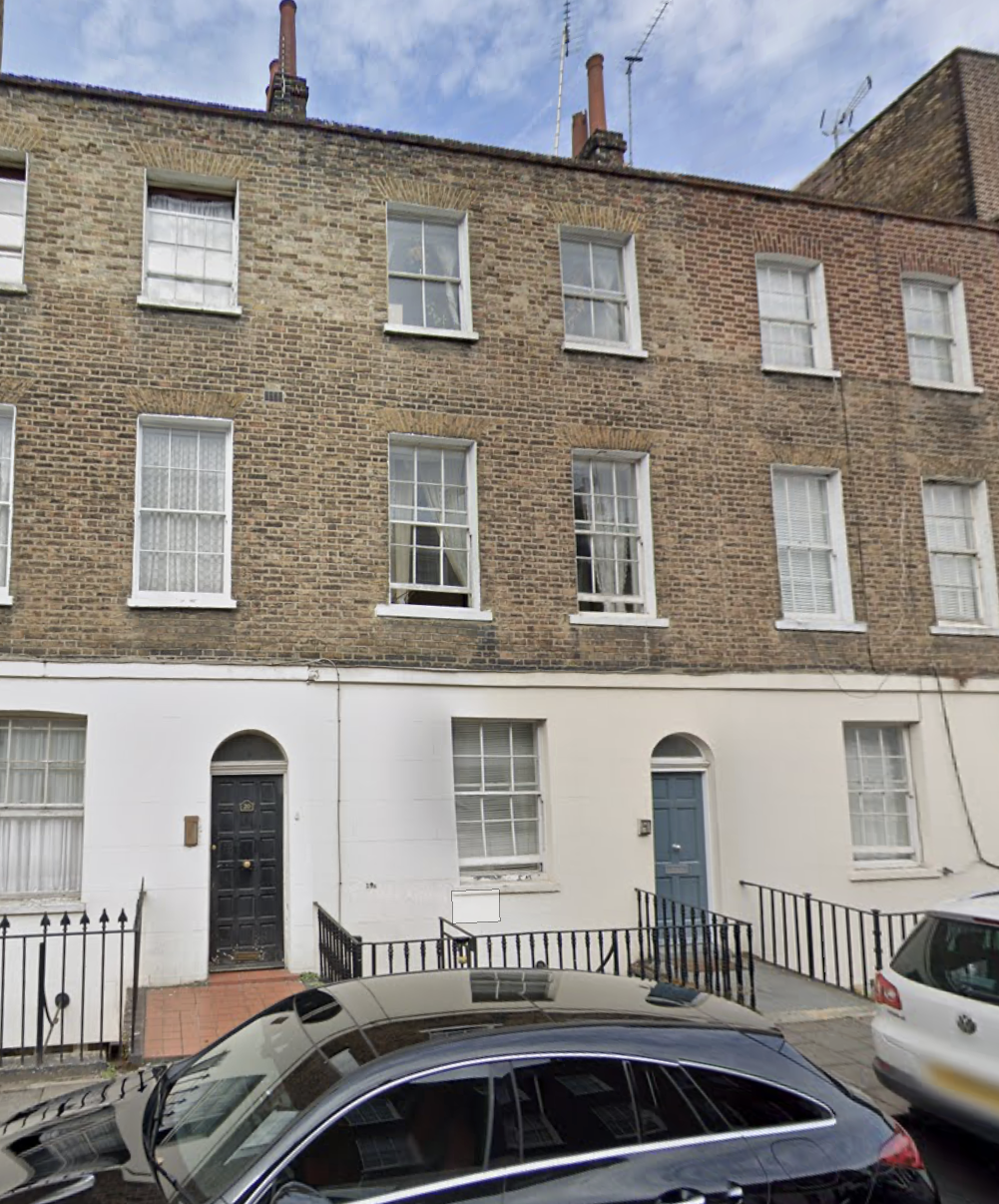
The 1939 Register shows no record for Michael Lambert, this was because he enlisted with the Army just the month before the 1939 Register was taken and the Register itself shows no record for serving Army soldiers, but we can find a record for Joanna who was living with her father William Driscoll and her sister Margaret Driscoll at 19, Star Street in Paddington.
19, Star Street in Paddington can be seen with the grey door in the picture below.
The Country was about to enter its second World War and just prior to the outbreak, Michael Lambert enlisted with the Army on 25 August 1939, just a week before Germany invaded Poland. Michael enlisted with the Royal Engineers and served with 563 Field Company, 501 Field Company and 220 Field Company, before being attached to 10th Battalion The Kings Regiment (Liverpool) Bomb Disposal Unit.
The casualty list and casualty card for Michael Lambert is shown below:
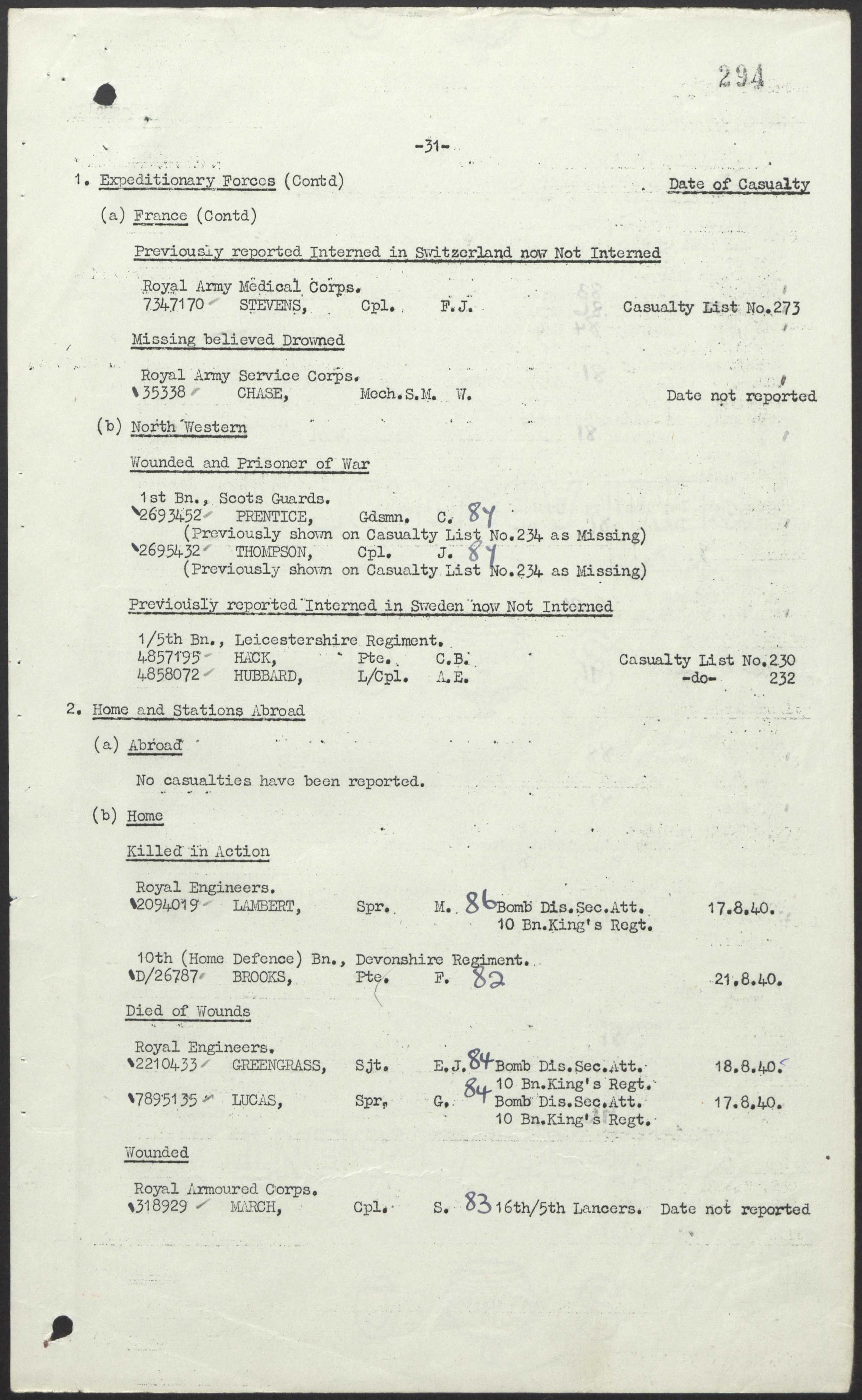
(UK, World War II Army Casualty Lists, 19939-1945)
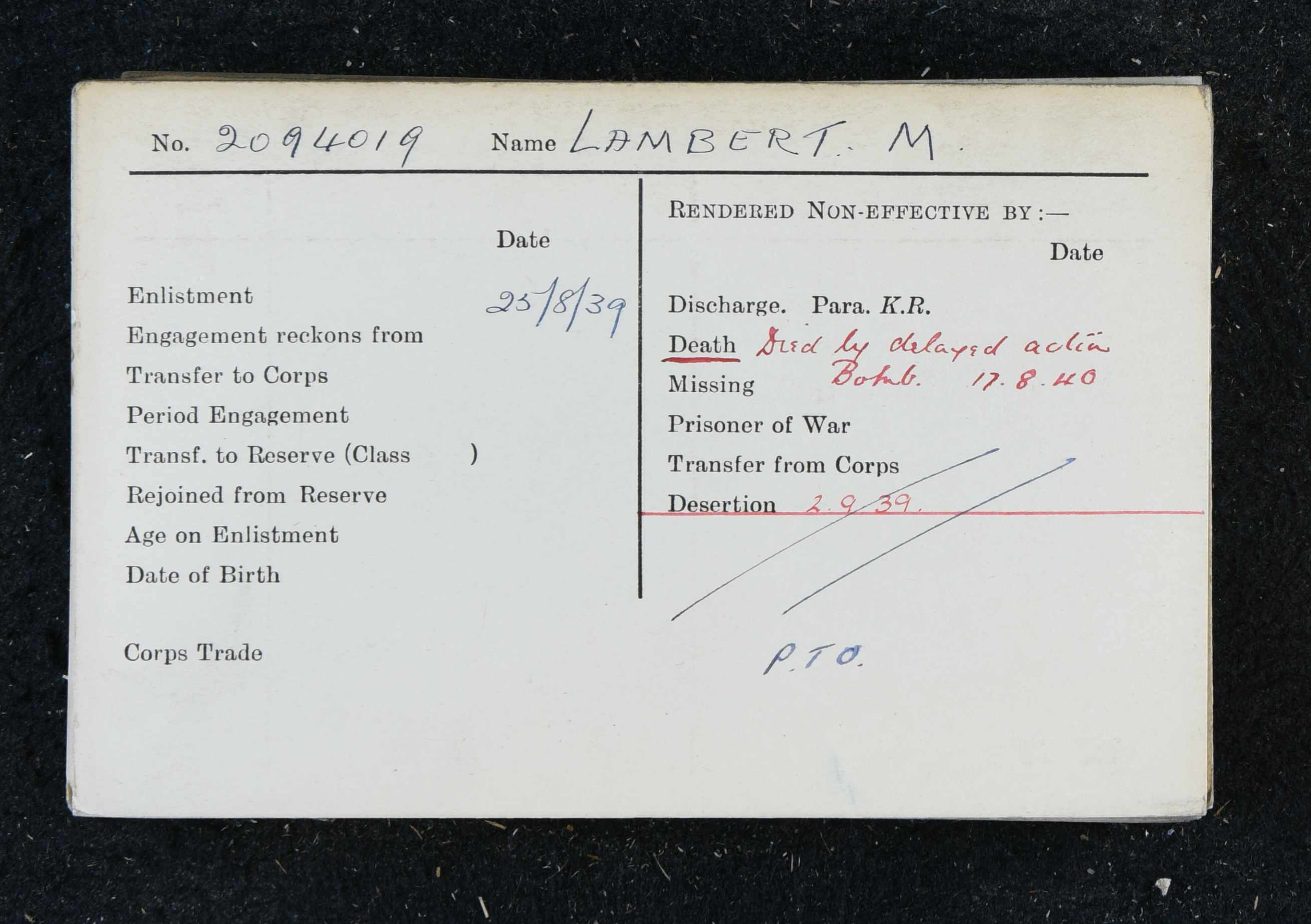
(Casualty Card for Michael Lambert)
As we already know, Michael was part of a team of men despatched to Nantwich in August 1940 to defuse a series of German bombs that were dropped in and around the Town of Nantwich and was tragically killed, alongside five of his colleagues on 17 August 1940 at Brook Farm in Nantwich. You can read the full story of how they died here:
The Story of the Six Brave Royal Engineers Who Died at Nantwich
He is buried at Kensal Green (St Mary’s) Roman Catholic Cemetery, Section. R.S. Grave 395.
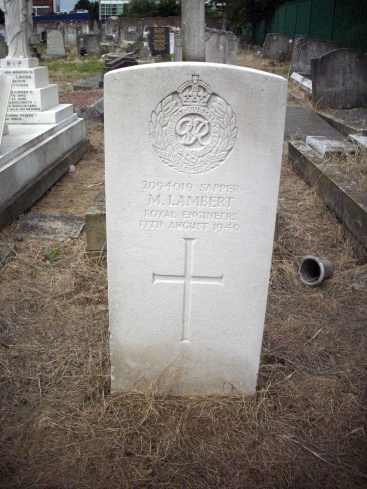
(Michael Lambert’s Headstone at Kensal Green Cemetery)
Michael’s story is doubly tragic because it was over almost before it had begun. He volunteered as a keen and enthusiastic young man, excited about the new adventures that lay ahead of him. His life, like those of his 5 colleagues, cut tragically short at the hands of the German Luftwaffe. We hope that his story goes someway to help to keep his memory alive and we can remember his bravery and courage and the ultimate sacrifice he made in defence of his Country, when it was needed most.
Why not visit my new website:
All My Blogs For Family Tree Magazine in one handy place
Copyright © 2024 Paul Chiddicks | All rights reserved

 The Chiddicks Family Tree
Paul, how sad that this young man’s tragic death cut short a life of promise. You are keeping the memory of his bravery alive for future researchers and family members who never knew about his beginnings and his ambitions.
LikeLiked by 1 person
Thank you Marian I agree, it’s so important that their sacrifice and memory is kept alive
LikeLike