

Sometimes, we discover a story, and sometimes, the story discovers us. This is one of the most remarkable examples of serendipity I’ve encountered in over thirty years of family history research. So sit back, relax, and let me tell you a story…..
Being recognised amongst friends and family as the keeper of all things “old,” I’ve amassed quite the collection of documents and artefacts over the years. Referred to as “dust harborers” by my wife, these family heirlooms are priceless to me. Some might say they’re nothing more than old papers, but for me, they represent moments in time—stories waiting to be told.
Recently a good friend of mine sent me a message: “I have something I’m sure you’ll find interesting.” How could I resist? What my friend had discovered was an old solicitor’s ledger—discarded, forgotten, and tossed into a skip. Little did I know, this seemingly insignificant find would send me on several months of research, with totally unexpected connections.
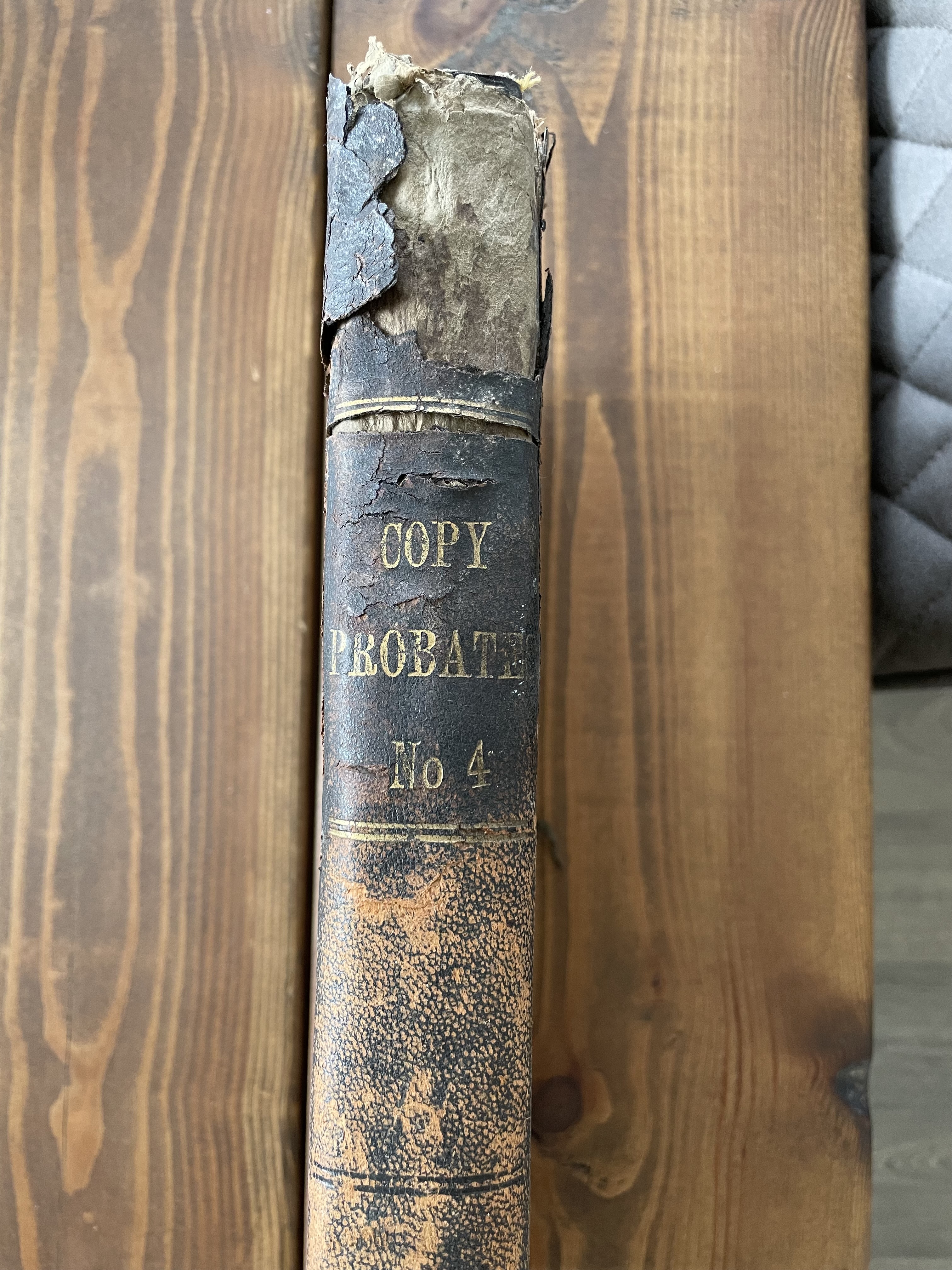
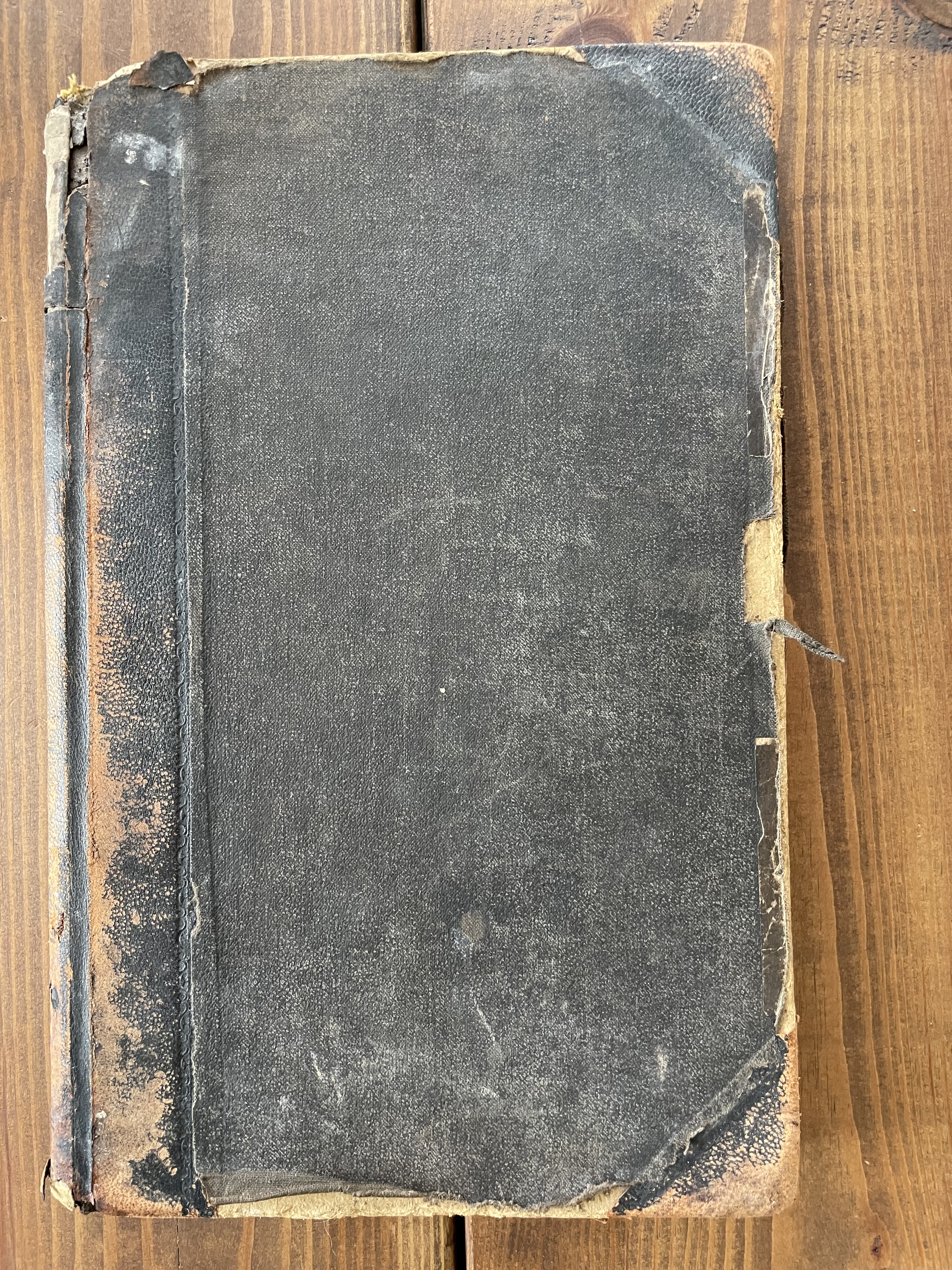
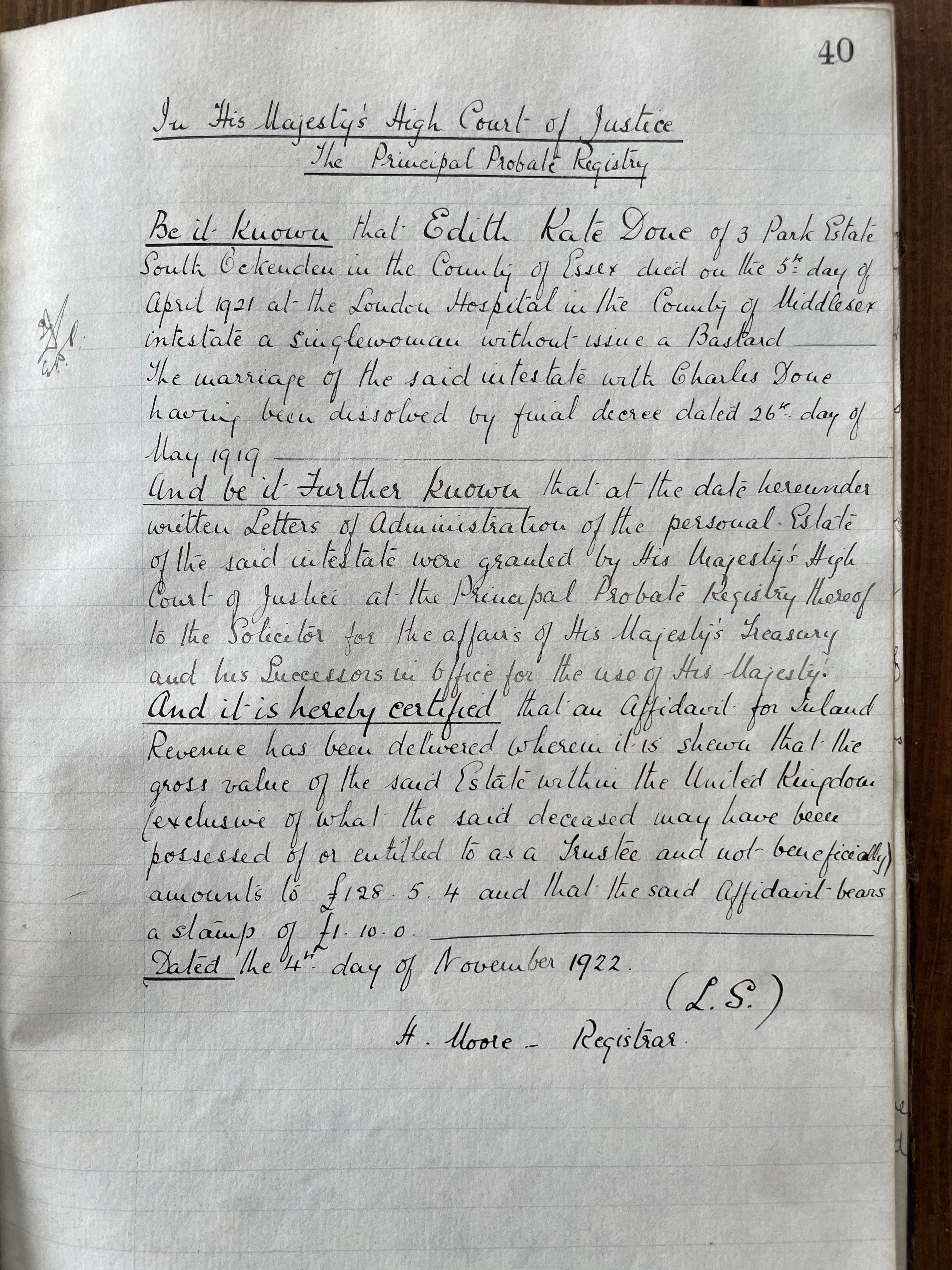
The ledger was well worn, as you would expect, but contained draft copies of hundreds of wills and codicils, all beautifully handwritten. The majority of the entries were from the North West area of England, which is what you would expect, given the fact that the ledger was discovered in Cheshire. Thumbing through the pages, the book opened on a random page that contained an entry for a will, but it wasn’t the details in the will that caught my eye, instead I was immediately drawn to the location of where the deceased lady was living when she died. Edith Kate Done died on 5th April 1921 at The London Hospital, her address at the time was given as 3, Park Estate, South Ockendon in Essex, an address 200 miles away from where the book was found, but why was that address significant to me? Well, South Ockendon is a small village in Essex and incredibly, the very same village where my ‘Chiddicks’ ancestors hailed from! I was astounded and completely blown away at this discovery, why the book opened at this page I will never know. I have since looked through the entire ledger and this is the only entry from Essex and the only entry outside of the North West Region of England, so who couldn’t resist diving head first into this story and what a remarkable story it was!
Edith Kate Done was born Edith Kate Huxley on 15 January 1883 in Bettisfield, Flintshire in Wales. Her birth record records that her mother was Leah Huxley, but there is no father’s name recorded on her birth record. Further documents later revealed that her stepfather was John Hand.

(Birth Record for Edith Kate Huxley)
Leah Huxley and John Hand went on to have seven children of their own, but whether Edith’s father was John Hand remains unknown. Edith’s early years show nothing remarkable in the records, she can be found in the 1891 and 1901 census returns, but it’s after her marriage to Charles Done on 7 November 1904 at the Ellesmere Register office that things take on a more sinister tone.
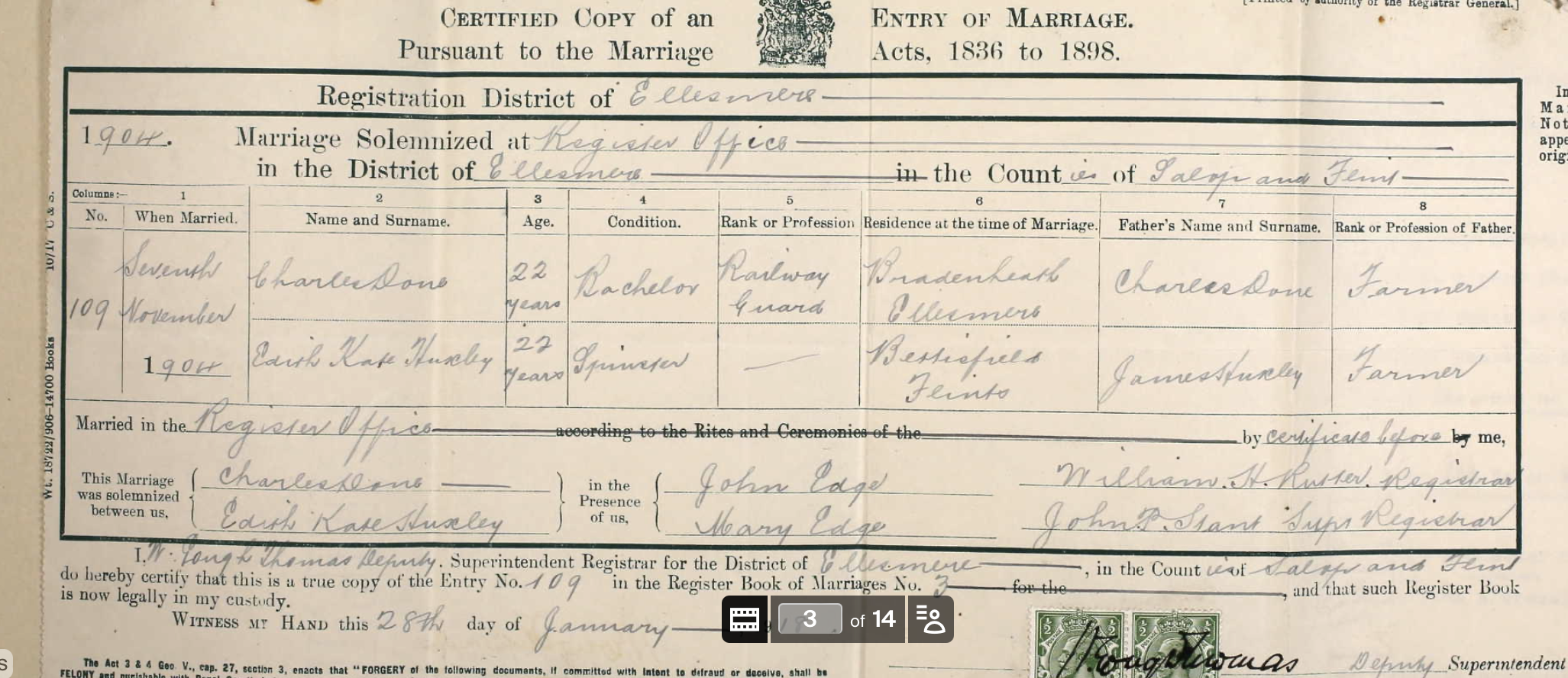
(Marriage Record for Charles Done and Edith Kate Huxley)
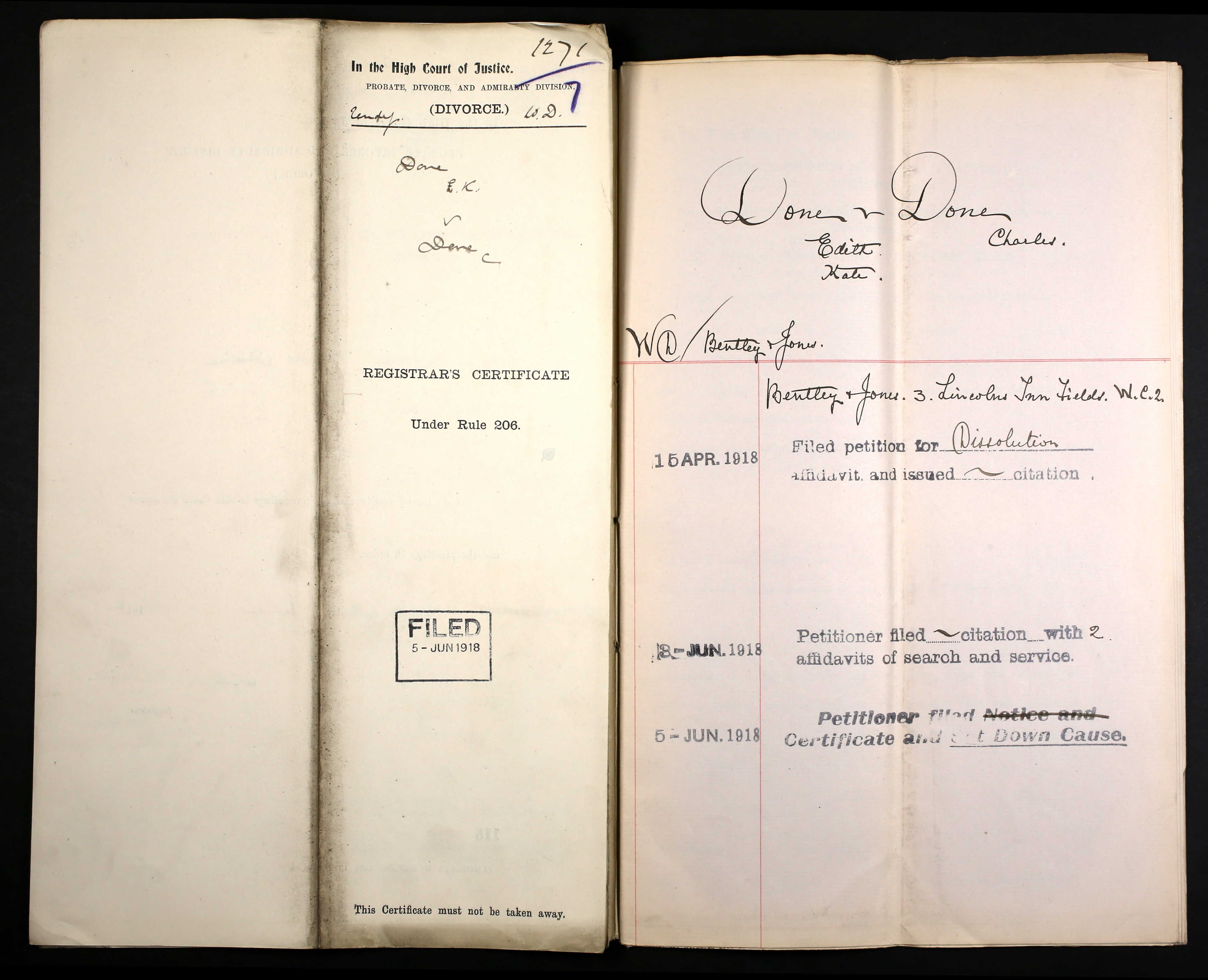
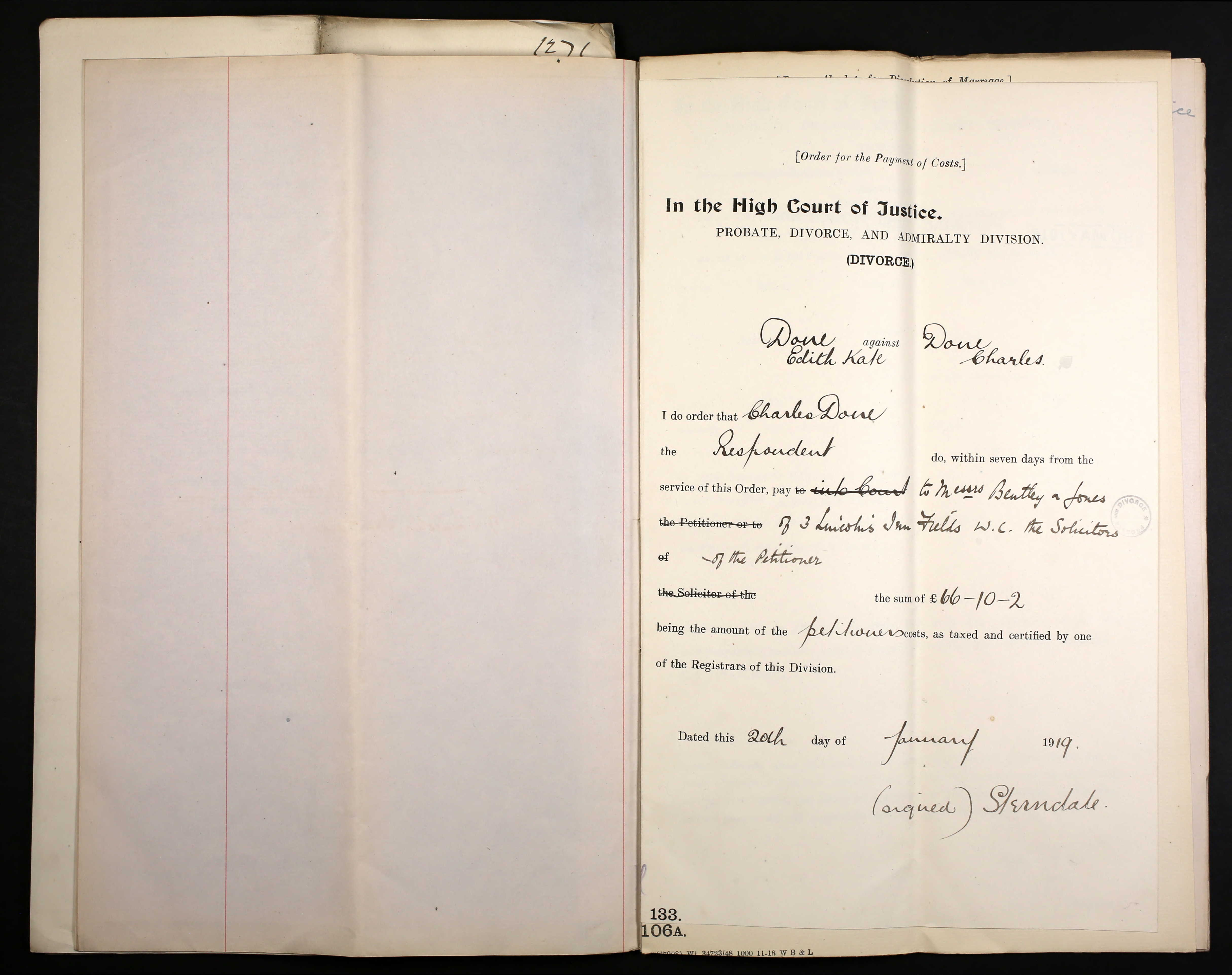
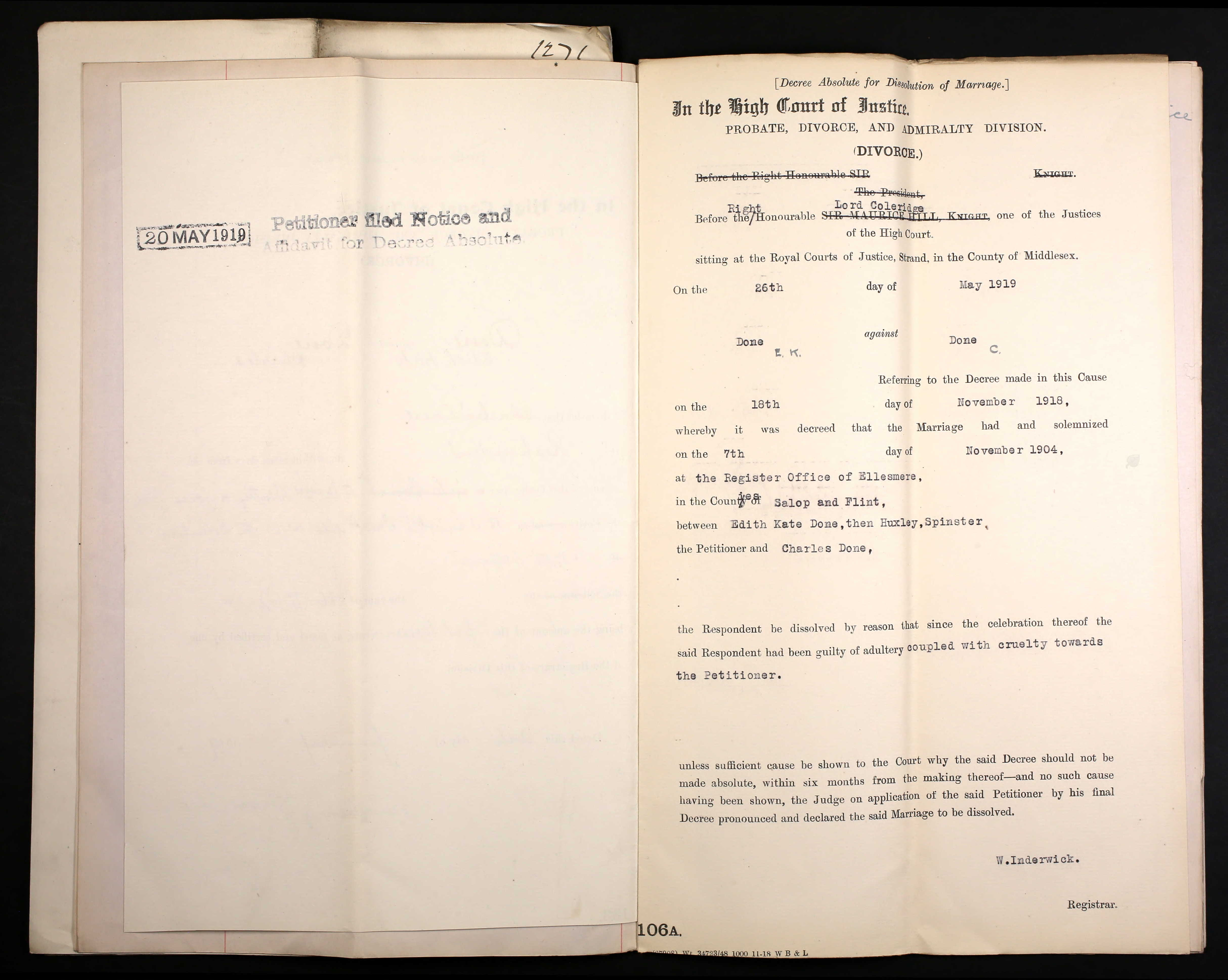
Edith’s husband, Charles Done, a railway worker, subjected Edith to years of cruelty and abuse. Their marriage ended in 1919 after a divorce, which, given the time period, was a significant and costly step for Edith to take. The documents I found revealed a pattern of persistent and shocking violence. The cruelty described in the divorce papers was harrowing: Charles assaulted Edith multiple times, threatening her life with a razor, and committed adultery. The court documents made it clear that Edith had been trapped in an abusive relationship. Yet, somehow, she found the courage to escape.The local press reported on the case, calling attention to Charles’s extraordinary cruelty, but despite the public attention, Edith’s story was far from over. I wouldn’t ordinarily publish online the details of such a case, but felt that as these documents were already in the public domain and available to view online, that it would be acceptable to transcribe the documents that tell this awful story. I felt that it was important that Edith’s voice was heard and that her story was told.
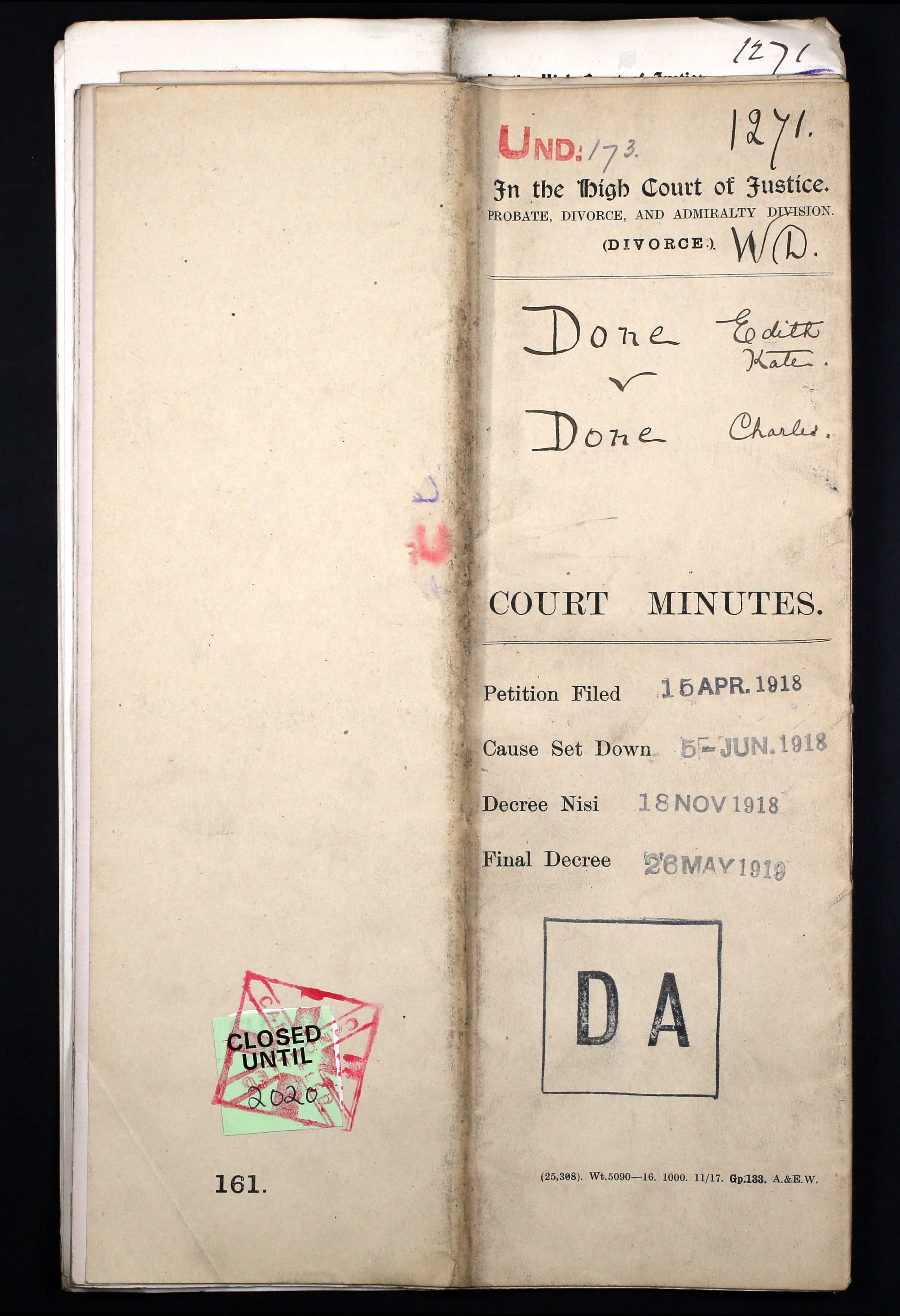
(The National Archives; London, England, UK; Court for Divorce and Matrimonial Causes, later Supreme Court of Judicature: Divorce and Matrimonial Causes Files, J 77; Reference Number: J 77/1348/1271; Series Number: J 77; Piece Number: 1348)
Below is a transcription of the main documents that formed the divorce papers.
“That after her said marriage, that Edith Kate Done, petitioner, and her said husband lived and cohabited at divers places and at No.42, Catherine Street Crewe, No.222 Nantwich Road, Crewe and No.29 Moorfields, Willaston near Nantwich all in the County of Cheshire, and that there has been no issue of the said marriage.“
I will interject at this point with yet another truly remarkable coincidence, Moorfields in Willaston, is actually the road that I currently live on. Add this to the fact that when she sadly passed away, she was living over 200 miles away in a small village that my ancestors lived for over 100 years I still find astonishing. Do you believe in coincidence?
Continuing with extracts from the Divorce papers:
That the Petitioner lives at 153, Welsh Row, Nantwich, in the County of Cheshire. That the said Charles Done is a Checker and lives at 29, Moorfields, Willaston, near Nantwich aforesaid and that he is domiciled in England. That there have been no previous proceedings with reference to the said marriage in the Divorce Division of the High Court of Justice by or on behalf of either of the parties to the same.
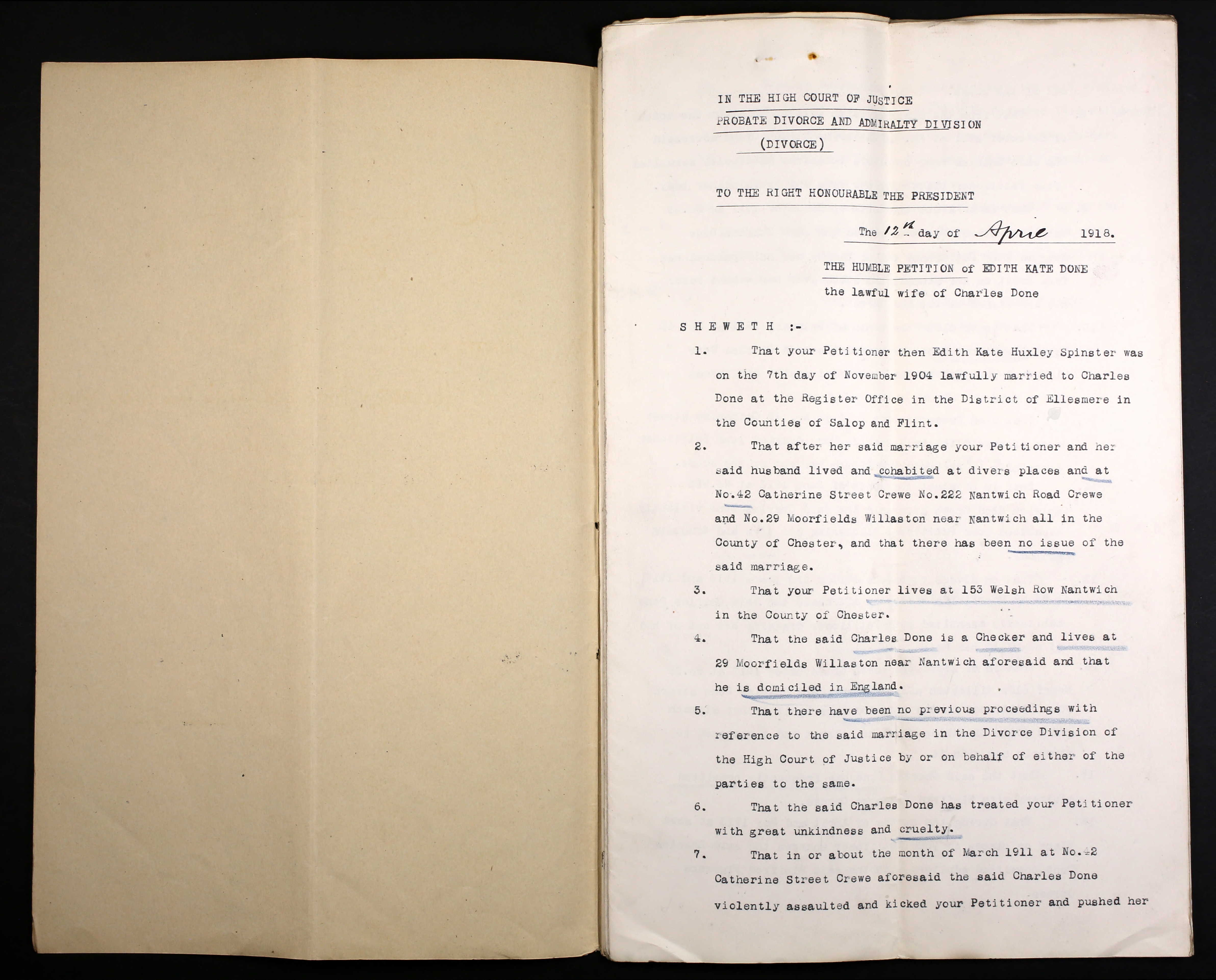
That the said Charles Done has treated the Petitioner (Edith Kate Done) with great unkindness and cruelty. That in or about the month of March 1911, at No.42, Catherine Street, Crewe aforesaid the said Charles Done violently assaulted and kicked the Petitioner and pushed her out of the house: That from about the month of March 1911 up to about the month of December 1911 at No. 42, Catherine Street, Crewe aforesaid the said Charles Done on divers occasions habitually assaulted your Petitioner blackening her eyes and bruising her body. That in or about the month of December 1911 at No.42 Catherine Street, Crewe aforesaid the said Charles Done dragged your Petitioner out of bed by her hair punched her face knelt on her stomach and stood over her with a razor and threatened to cut her throat.
That in or about the month of February 1912, at No. 42, Catherine Street, Crewe, aforesaid, the said Charles Done blackened your Petitioner’s eyes and gashed her throat with a razor. That upon December 25th 1912 at No. 42, Catherine Street, Crewe aforesaid the said Charles Done dragged your Petitioner downstairs by the hair and kicked her out of the house. That in or about the month of June 1913 at No.222, Nantwich Road, Crewe aforesaid the said Charles Done violently assaulted your Petitioner blackening her eyes and bruising her body. That on divers occasions during the years 1916 and 1917 at No.29, Moorfields, Willaston aforesaid the said Charles Done habitually assaulted your Petitioner dragging her out of bed at night by her hair. That in or about the month of December 1917 at No.29, Moorfields, Willaston aforesaid the said Charles Done struck your Petitioner on the arms and legs knelt on her stomach put a piece of string round her throat and threatened to strangle her with it. That the said Charles Done has frequently committed adultery with Winifred Florence Cornes. That during the months of April and May 1913 at some place or places to your Petitioner unknown the said Charles Done committed adultery with the said Winifred Florence Cornes.
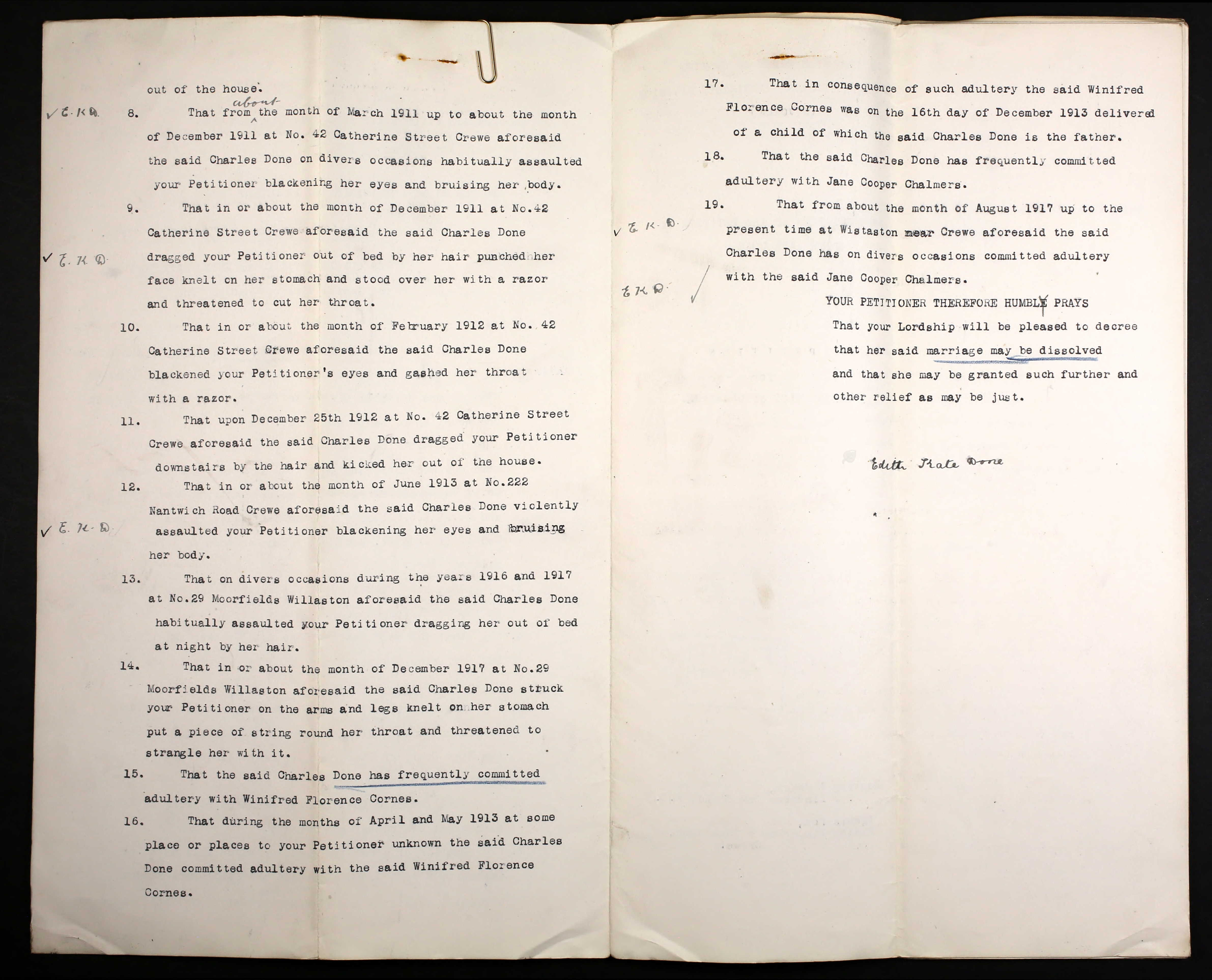
That in consequence of such adultery the said Winifred Florence Cornes was on the 16th day of December 1913 delivered of a child of which the said Charles Done is the father. That the said Charles Done has frequently committed adultery with Jane Cooper Chalmers. That from about the month of August 1917 up to the present time at Wistaston, near Crewe aforesaid the said Charles Done has on divers occasions committed adultery with the said Jane Cooper Chalmers.
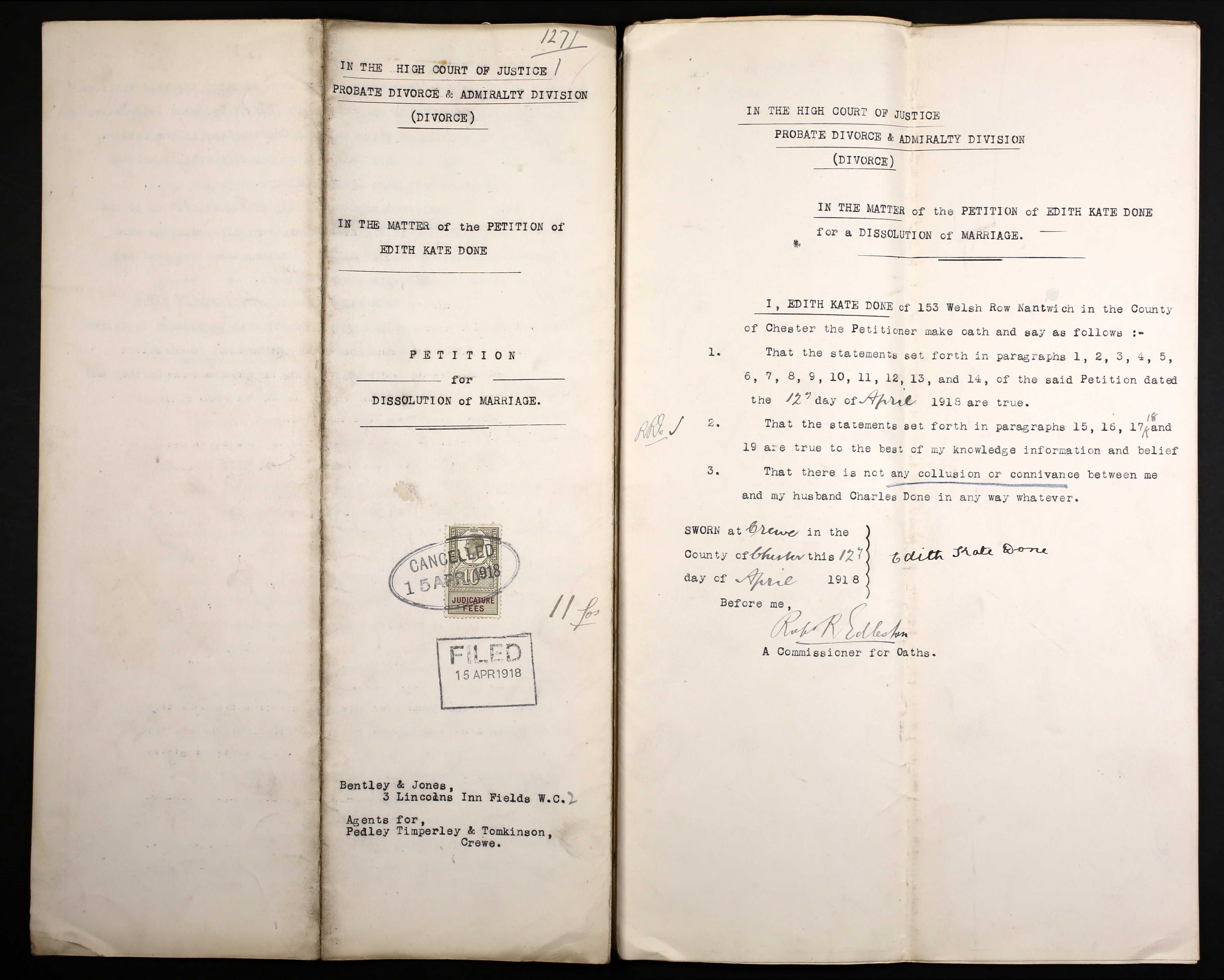
The remainder of the documents contain the legal requirements of the divorce itself and the timeline was as follows:
The petition for divorce was filed on 15 April 1918.
The cause was set down on 5 June 1918.
The decree nisi was declared on 18 November 1918.
Final decree was made on 26 May 1919.
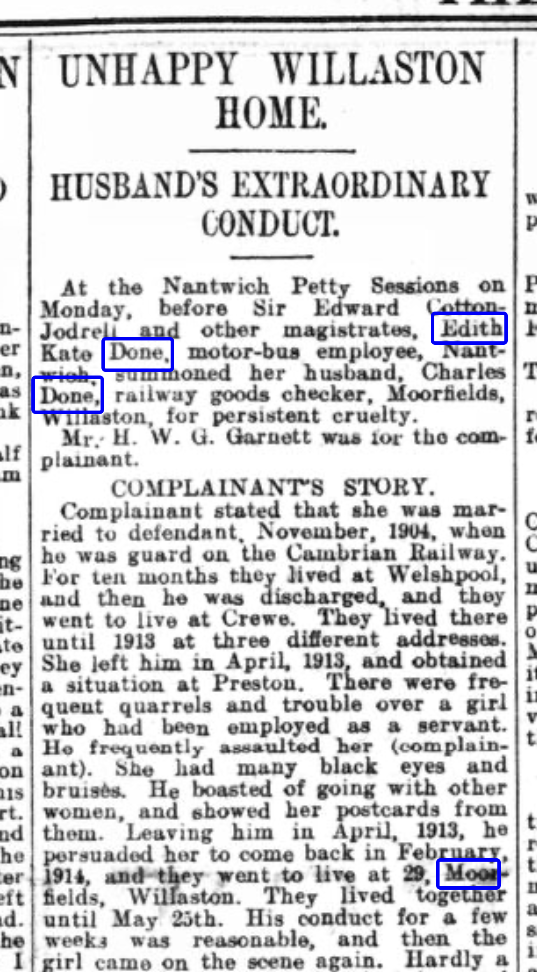
Given the circumstances surrounding the divorce, it inevitably made the newspapers. The following article appeared in The Nantwich Guardian dated 22 June 1917.
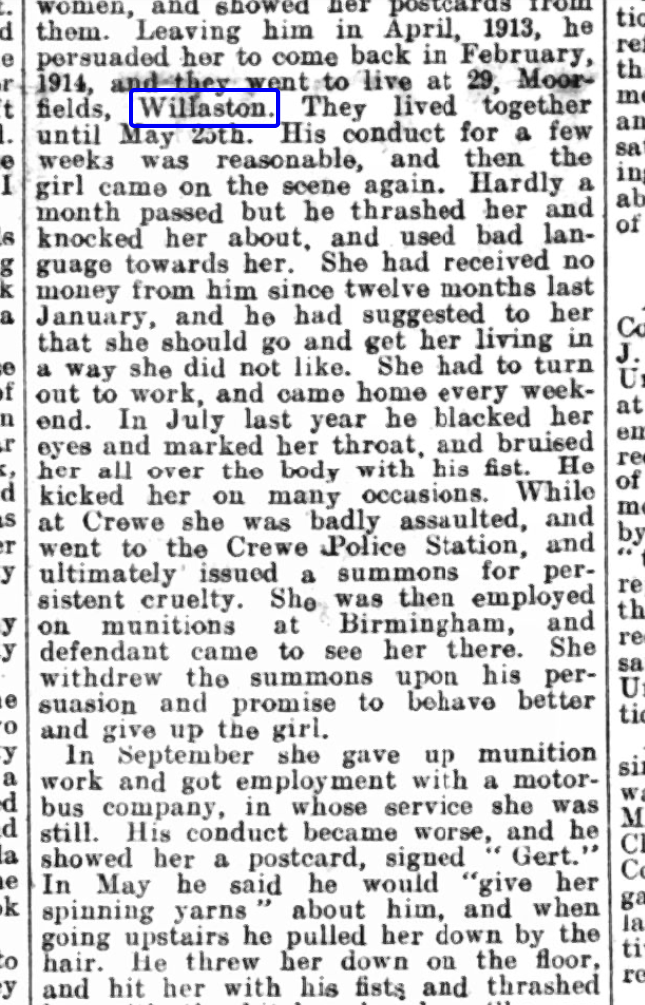
Unhappy Willaston Home
Husband’s Extraordinary Conduct
At the Nantwich Petty Sessions on Monday before Sir Edward Jodrell and other magistrates, Edith Kate Done, motor-bus employee, Nantwich, summoned her husband, Charles Done, railway goods checker, Moorfields, Willaston for persistent cruelty. Complainants Story.
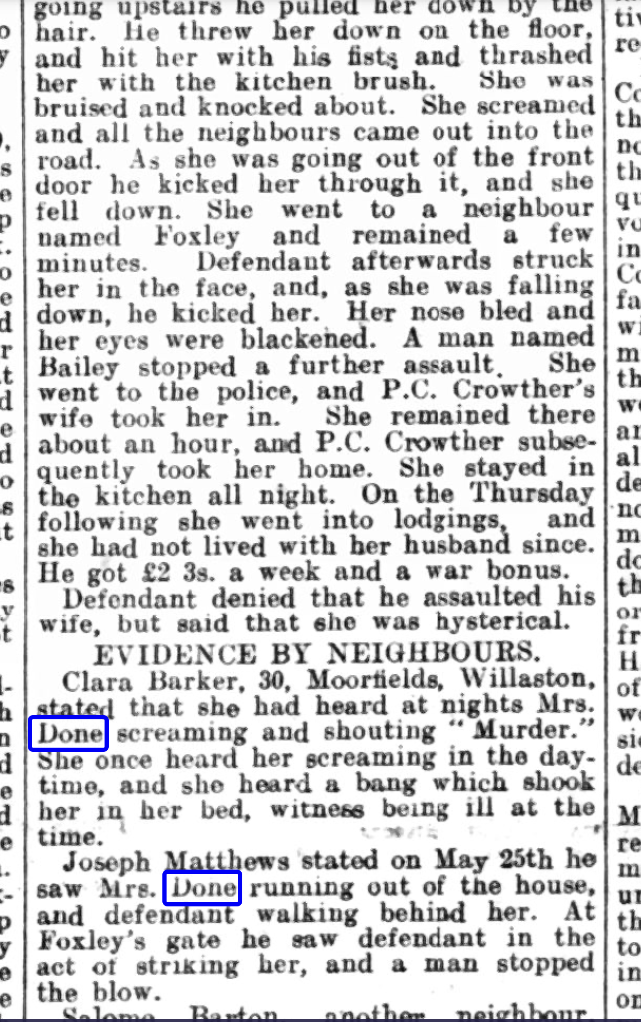
Complainant stated that she was married to defendant, 4 November when he was a guard on the Cambrian Railway. For ten months they lived at Welshpool and then he was discharged and they went to live at Crewe. They lived there until 1913 at three different addresses. She left him in April 1913 and obtained a situation at Preston. There were frequent quarrels and trouble over a girl who had been employed as a servant. He frequently assaulted her (complainant). She had many black eyes and bruises. He boasted of going with other women and showed her postcards from them. Leaving him in April 1913, he persuaded her to come back in February 1914 and they went to live at 29 Moorfields, Willaston. They lived together until 25 May his conduct for a few weeks was reasonable, and then the girl came on the scene again. Hardly a month passed but he thrashed her and knocked to her about and used bad language towards her. She had received no money from him since twelve months last January, and he had suggested to her that she should go and get her living in a way she did not like. She had to turn out to work, and came home every week-end. In July last year he blacked her eyes and marked her throat and bruised her all over the body with his fist. He kicked her on many occasions. While at Crewe she was badly assaulted, and went to the Crewe Police Station, and ultimately’ issued a summons for persistent cruelty. She was then employed on munitions at Birmingham, and defendant came to see her there. She withdrew the summons upon his persuasion and promise to behave better and give up the girl. In September she gave up munition work and got employment with a motor-bus company, in whose service she was still. His conduct became worse and he showed her a postcard signed “Gert”. In May he said he would “give her spinning yarns” about him and when going upstairs he pulled her down by the hair. He threw her down on the floor, and hit her with his fists and thrashed her with the kitchen brush. She was bruised and knocked about. She screamed and all the neighbours came out into the road. As she was going out of the front door he kicked her through it, and she fell down. She went to a neighbour named Foxley and remained a few minutes. Defendant afterwards struck her in the face, as she was falling down, he kicked her. Her nose bled and her eyes were blackened. A man named Bailey stopped a further assault. She went to the police, and P.C. Crowther’s wife took her in. She remained there for about an hour, and P.C. Crowther subsequently took her home. She stayed in the kitchen all night. On the Thursday following she went into lodgings and she had not lived with her husband since. He got £2 3s. a week and a war bonus. Defendant denied that he assaulted his wife, but said that she was hysterical.
EVIDENCE BY NEIGHBOURS.
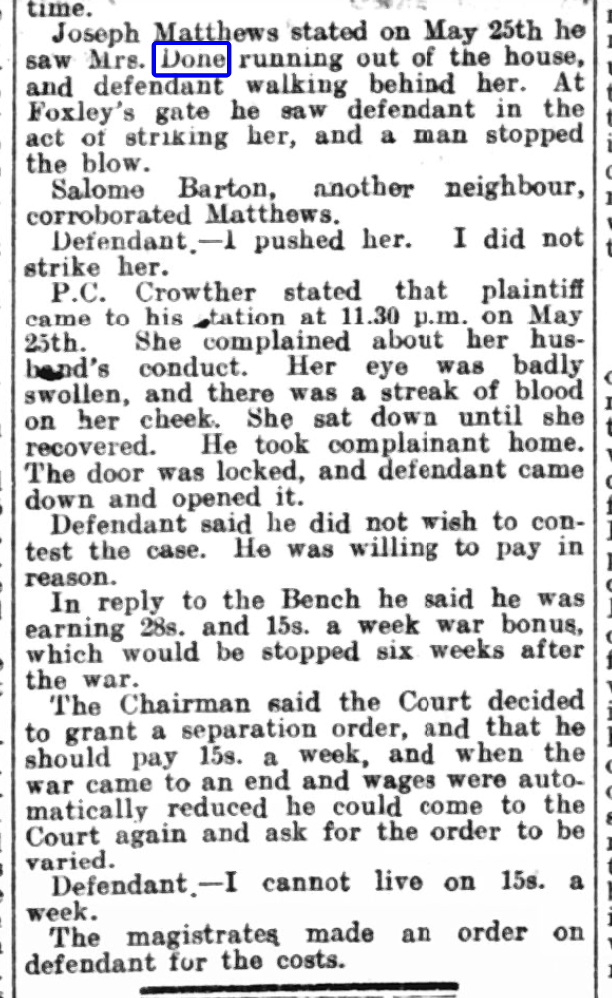
Clara Barker, 30, Moorfields, Willaston, stated that she had heard at nights Mrs Done screaming and shouting “Murder”. She once heard her screaming in the day time, and she heard a bang which shook her in her bed, witness being ill at the time. Joseph Matthews stated on May 25th he saw Mrs Done running out of the house running out of the house and defendant walking behind her. At Foxley’s gate he saw defendant in the act of striking her, and a man stopped the blow. Salome Barton, another neighbour, corroborated Matthews.
Defendant – I pushed her I did not strike her.
P.C. Crowther stated that plaintiff came to the station at 11-30pm on 25th May She complained about her husband’s conduct. Her eye was badly swollen, and there was a streak of blood on her cheek. She sat down until she recovered. He took complainant home. The door was locked, and defendant came down and opened it. Defendant said he did not wish to contest the case. He was willing to pay in reason. In reply to the bench, he said he was earning 28s and 15s a week war bonus which would be stopped six weeks after the war. The Chairman said the Court decided to grant a separation order, and that he should pay 15s. a week, and when the war came to an end and wages were automatically reduced, he could come to the Court again and ask for the order to be varied.
Defendant – I cannot live on 15s. a week. The magistrates made an order on defendant for the costs.
The following article appeared in The People dated 24 November 1918.
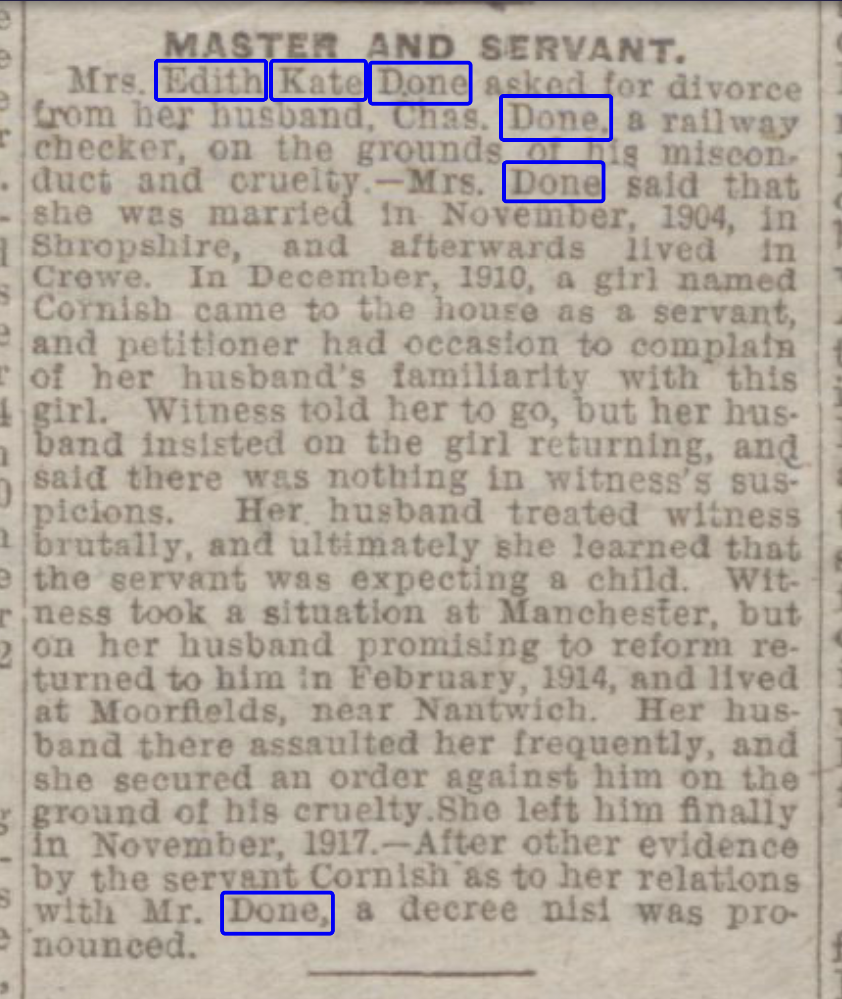
MASTER AND SERVANT.
Mrs Edith Kate Done asked for a divorce from her husband Chas. Done, a railway checker, on the grounds of misconduct and cruelty. Mrs Done said that she was married In November 1904 in Shropshire and afterwards lived in Crewe. In December 1910, a gill named Cornish came to the house as a servant, and petitioner had occasion to complain of her husband’s familiarity with this girl. Witness told her to go, but her husband insisted on the girl returning, and said there was nothing in witness’s suspicions. Her husband treated witness brutally, and ultimately, she learned that the servant was expecting a child. Witness took a situation at Manchester, but on her husband promising to reform returned to him in February 1914, and lived at Moorflelds, near Nantwich. Her husband there assaulted her frequently, and she secured an order against him on the ground of his cruelty. She left him finally In November 1917. After other evidence by the servant Cornish as to her relations with Mr. Done a decree nisi was pronounced
I am sure that you have reached the same conclusions that I have, that Charles was a completely horrible and vile man, that Edith was well rid-of, if truth be known. You are also probably one-step ahead of me and you’re sitting there thinking exactly the same thoughts as me, how does a lady with a modest income afford a divorce in 1919?
The more usual practise, when a marriage irrevocably broke down, was for the couples to simply separate and meet new partners and either live together as an assumed married couple, or actually marry bigamously, but that wasn’t the case here, Edith actually filed and successfully divorced Charles Done. You will often see quoted by many family historians that divorce was simply not affordable to our ancestors back then, but I wanted more than that, I wanted a definite answer to how affordable divorce would have been. Available data online was somewhat limited, so I contacted Marriage Law Expert Dr. Rebecca Probert who kindly put me in touch with the wonderful Dr. Jennifer Aston, an Associate Professor in Law at Northumbria University. Dr. Aston and her team are currently carrying out a study into the costs of divorce so was able to provide me with some detailed specifics.
There is evidence from a pilot study suggests that the relative cost of divorce actually decreased across the 19th and early 20th century as costs seem to have stagnated, but wages tended to increase. In the vast majority of cases, the costs would be borne either by the husband (because if a wife brought a case he would have been deemed the ‘guilty’ party) or by the named co-defendant (i.e. the wife’s adulterous partner), not by the wife. Further information about the cost of divorce can be found in this Journal of Legal History article:
The actual cost in this particular case was £66 10s 2d, which equates to about £3861 today, still a rather significant amount of money, but maybe not so prohibitive as what one might have thought. It’s also worth noting that it was cheaper than it might have been because the case was undefended, otherwise there would have been the defendant’s costs to consider too.
So Edith was finally free from this abhorrent man, but what did she do next?
Firstly, let’s take a step back and take a look at what the divorce papers said about Charles Done’s relationship with Winifred Florence Cornes; That in consequence of such adultery the said Winifred Florence Cornes was on the 16th day of December 1913 delivered of a child of which the said Charles Done is the father.
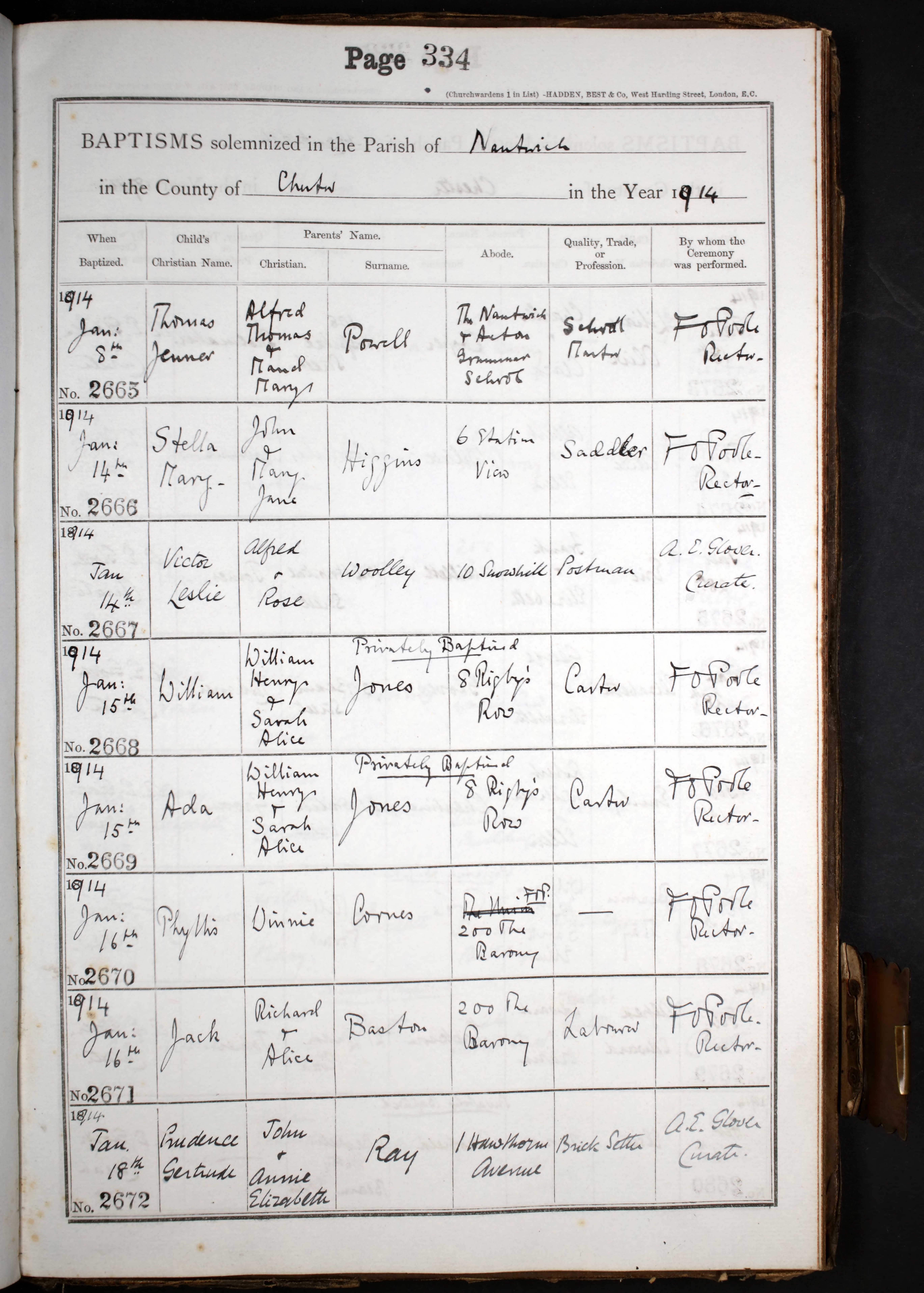
(Baptism Record for Phyllis Cornes – Cheshire West and Chester Council; Cheshire, England; Parish Registers; Reference: P 120/4525/13)
The records show that there was a child born on 16 December 1913, she was named Phyllis Cornes, her birth and baptism records show that there was no father’s name mentioned, just her mother’s name, but we already have the testimony from the divorce proceedings to support the evidence that Charles Done was the father of Phyllis Cornes. If we needed any more corroborating evidence, then this is provided with the 1921 census return. Phyllis Cornes is living with her father Charles Done and the second lady who is mentioned in the divorce proceedings, Jane Cooper Chalmers. By this time Charles Done had actually married Jane Cooper Chalmers, in 1919 and they went onto have four children of their own At the time of the 1921 census the family are living at 29 Moorfields in Willaston Nantwich, yes the same road that I currently live on today and Charles is recorded as a ‘Goods Checker’ with the London and North Western Railway in Gresty Road in Crewe. Also living at the family home was the first of the couples four children together, Charles Done (Jnr). The house in Moorfields, number 29, is a significant property one of the largest detached properties on the road and this again brings into question the financial status of the family.
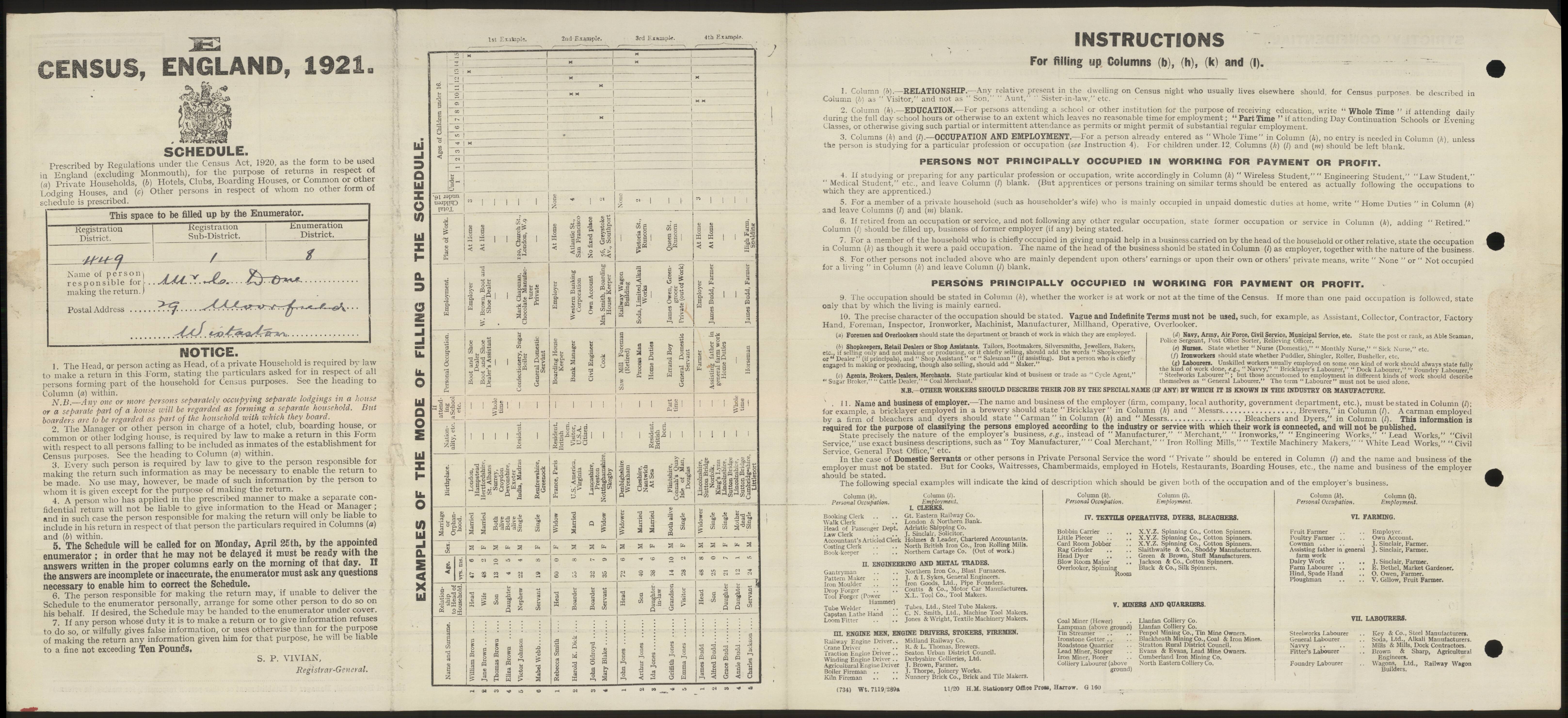
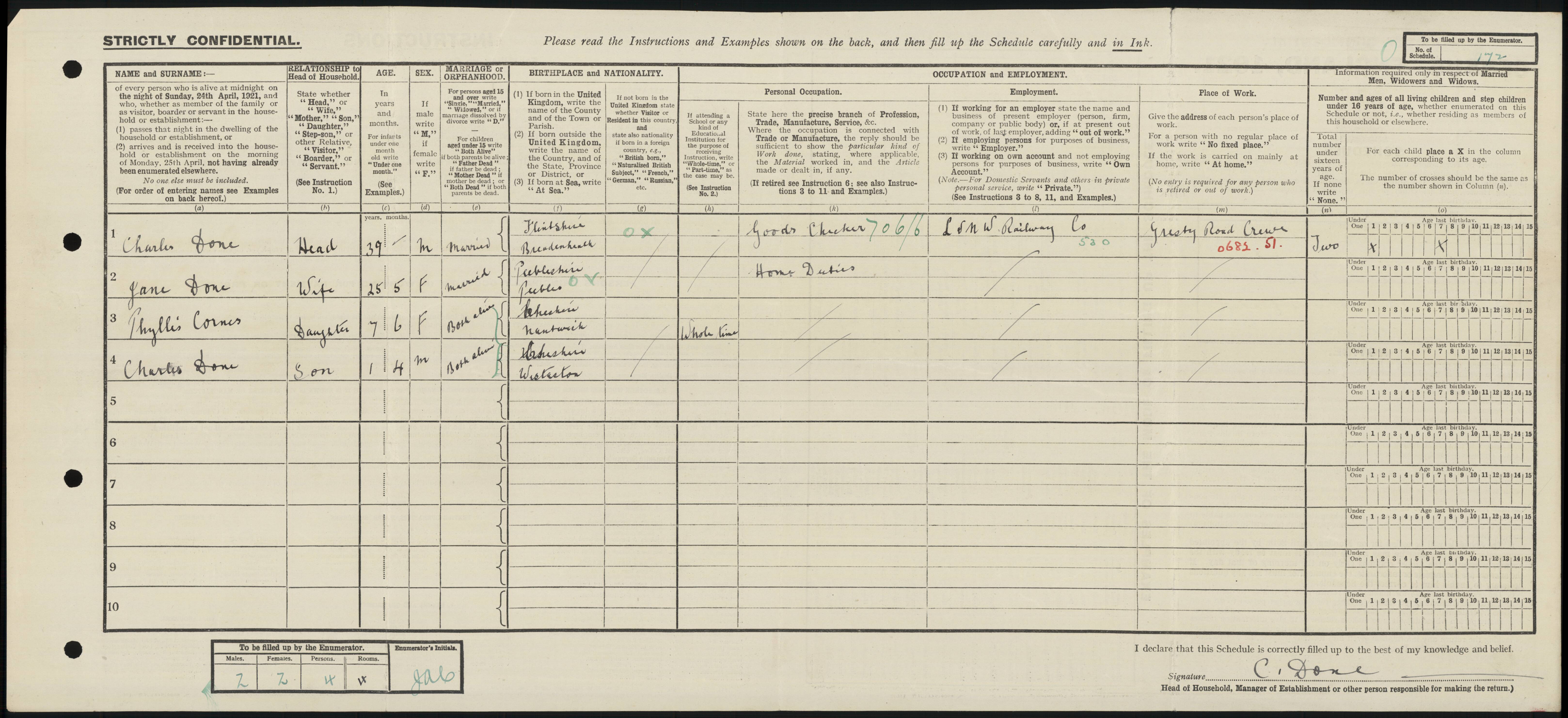
(1921 Census Return – FindMyPast)
After her divorce, Edith made an unexpected decision. She relocated to South Ockendon, far from the familiar places of her past, which as we already know, was the very same village that my Chiddicks family lived. There, she trained as a midwife at the Plaistow Maternity Hospital in London, a new chapter in her life was beginning, for the first time, Edith seemed to be charting her own path—away from the darkness of her marriage and into a life of new possibilities.
Edith trained as a Midwife at the Plaistow Maternity Hospital and thanks to the records held by Barts Health NHS Trust and their extremely helpful Archivist, Kate Jarman I was able to discover the following about her training and time as a Midwife. She initially trained at 17, Howards End which was part of the Hospital, the exact details of the hospital make up can be found here:
There was only one entry for Edith in the training registers that covered the period 1919-1923 (RLHPM/N/2/5).
Edith Kate Done entered for her basic training on 13 March 1919. She failed her CMB (Central Midwives Board) exam on November 1919, but successfully passed her CMB exam on 14 February 1920 gaining the Central Midwives Board certification in Midwifery.
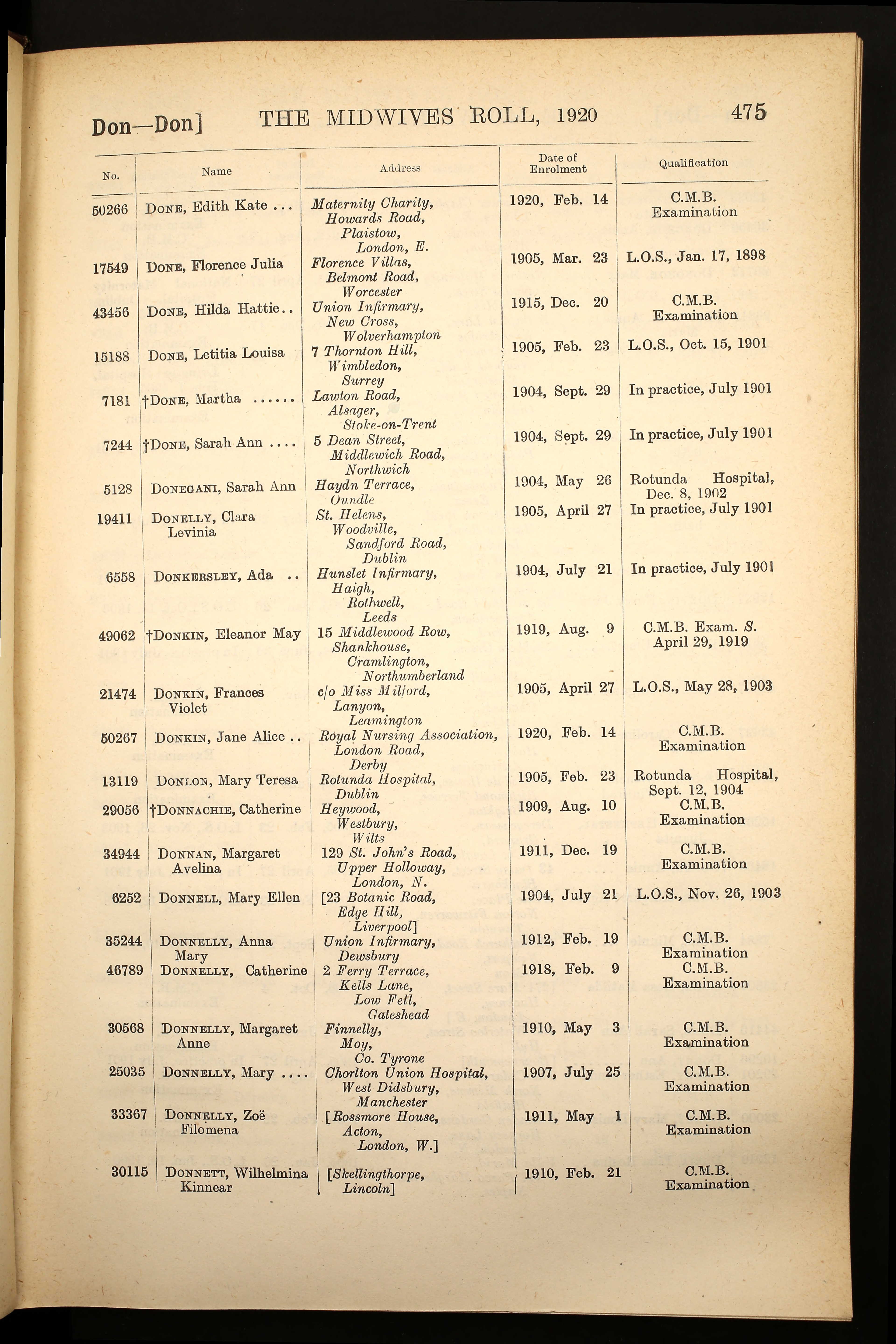
(The Wellcome Trust; London, England; The Midwives Roll; Reference: b24389596_i13779588)
But, tragically, Edith’s new beginning was cut short. She died unexpectedly on 5 April 1921 from diabetes at The London Hospital—a woman of only 35 years. The informant on her death certificate was K. Mansfield who was present at her death and he is recorded as being at Canning Town Police Station. This once again creates more questions than it gives us answers. Did she die alone? Was K. Mansfield an acquaintance, or most likely, just somebody who was there when she died? Was there an incident prior to her dying that caused their paths to cross, something I will never be able to know. At the time of her death her address is recorded as 3, Park Estate, South Ockendon, Essex. Frustratingly for me, the 1921 census was delayed and not taken on the proposed date in April, due to industrial unrest in the Country at the time. The census was delayed until 19 June 1921, so therefore the occupants of 3 Park Estate offer me no further clues.

(Death Record for Edith Kate Done)
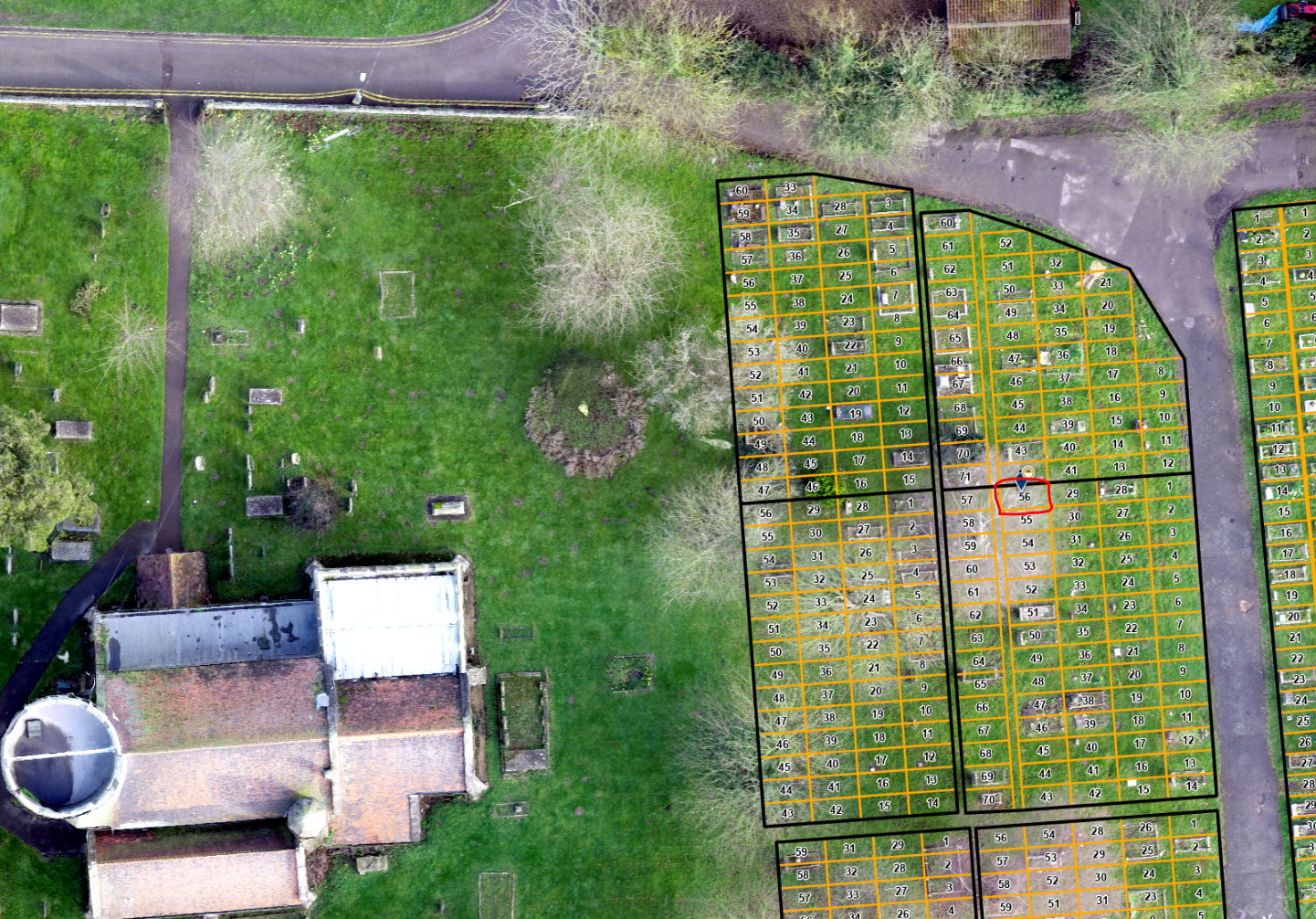
Edith was buried five days later on 10 April 1921 at South Ockendon Cemetery in Section 2, Plot 56. From the overhead photograph kindly provided by Thurrock Council, the plot itself doesn’t appear to have a headstone or any identifying markers.
Edith died intestate (without a will) and without any known blood relatives, so it was the left to The Crown and the Treasury Solicitor to administer her estate. The letters of administration for her affairs that can be found on Ancestry
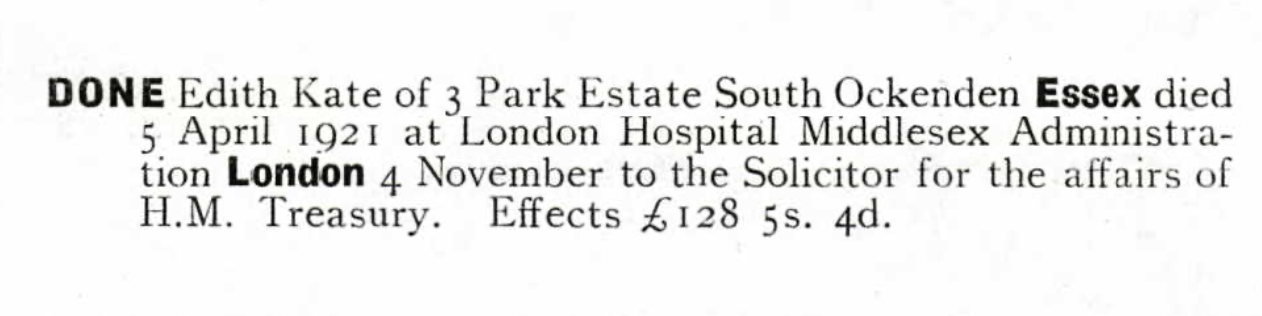
(Principal Probate Registry; London, England; Calendar of the Grants of Probate and Letters of Administration made in the Probate Registries of the High Court of Justice in England)
Sometimes it’s the smallest of Catalyst’s that ignites the researcher within! A chance finding in a discarded book has taken me on a remarkable journey that eventually led to the discovery of a rather harrowing story. I can only hope that before and after her marriage that Edith found some kind of warmth and love in her life. After her divorce from Charles Done it appeared that she was getting her life back and beginning a new chapter only for it all to end almost before it had begun. I feel this story, although complex and, in many ways, well documented, is full of too many questions that I don’t have the answers to. The tragedy in all of this and the most difficult part in Edith’s story is that she most likely died alone, which I find completely heartbreaking. I can only hope that by telling her brief life story, will ensure that she will never be forgotten and that her memory will live on.
Do you believe in coincidence?
Why not visit my new website:
All My Blogs For Family Tree Magazine in one handy place
Copyright © 2024 Paul Chiddicks | All rights reserved

 The Chiddicks Family Tree
Edith was incredibly courageous to seek a divorce and then forge a new path. Sad to see her life cut short. Thanks to your detailed post she will not be forgotten!
LikeLiked by 1 person
Thank you Marian, it’s important that her voice was heard and her sad story told
LikeLike
Remarkable story and I believe in things finding us. Edith deserved better. You brought her story to life. Thank you!
LikeLiked by 1 person
Thanks Kelly it was so important that her voice was heard and that she was remembered
LikeLike
Excellent story of the past and one that needed to be told. Regardless of who you are, your ancestors need to be remembered and honoured. I am sure she must have some living kin who would love to get this well documented tragedy of their family.
Was it coincidence? Maybe! But the book fell into your hands for a reason and you brought your expertise to tell her story.
Thanks for sharing Paul
LikeLiked by 1 person
Thanks Darrell, it was so important for me to tell her story. The story came to me for a reason and I felt compelled to be her voice and ensure that her life was remembered.
LikeLiked by 1 person
Thanks for this interesting and yet sad story. I’ve discovered similar cases of cruelty and divorce from the 1800s and later in my family lines, both along the frontier of the growing United States and in several parts of Germany. A code of silence prevented the truths from coming down to us, as family history was whitewashed, and divorce was said to be a thing that “wasn’t done” in those said to be scrupulously moral days. We must delve deep into these old records to learn the truth I wish they had been honest about.
LikeLiked by 1 person
I wrote about something similar to this recently about how some facts were air brushed out by our ancestors you might find this an interesting read https://chiddicksfamilytree.com/2024/11/29/whose-truth-is-it-anyway/
LikeLike
Thanks
LikeLiked by 1 person
What a story. That poor woman – to go through all that trauma, free herself, begin a new career, and then die without being able to enjoy her new life. At least she had no children by him – I shudder to think of how much worse things would have been for her then.
And yes, I believe in coincidence – I’ve come across many over the course of my research.
LikeLiked by 1 person
At least her story has now been heard Teresa i cling to the hope that she found some comfort in her life after the divorce.
LikeLike