
Killed in the Line of Duty Sergeant Edward Joseph Greengrass Service Number 2210433………..
Edward Joseph Greengrass was born on 15 April 1907 in Great Yarmouth in Norfolk, the eldest of two children born to Edward William Greengrass and Elizabeth Augusta Jones. Edward and Elizabeth also had a daughter, Rose Elizabeth Greengrass who was born on 11 Apr 1909, also in Great Yarmouth. Edward William Greengrass was a Greengrocer by trade and like millions of men across the Country, when their Country needed them, he volunteered to join the Army and fight on the Western Front during WW1. Edward William Greengrass joined his home County Regiment, the Norfolk Regiment and served with the 1st Battalion where he achieved the Rank of Lance Corporal. Sadly, like thousands of his fellow servicemen, Edward did not return from the battlefields and died from wounds on 21 August 1918 in France. He is buried at Foncquevillers Cemetery in France. The Pension Card for Edward William Greengrass can be seen below.

(Western Front Association; London, England; WWI Pension Record Cards and Ledgers; Reference: 084/0383/Gre-Gre)
There are two school records for young Edward Joseph Greengrass which have survived. The first record is dated 16 April 1912 and shows Edward’s attendance at Northgate Infants School and also records the details of his father, Edward Greengrass. The family home is listed as 46, Arundel Road, Great Yarmouth and shows his transfer to the upper school at Northgate on 1 September 1914.

(Northgate Infants School taken from the National School Admission Registers & Log Books 1870-1914)
The second record is dated 1 September 1914 and shows his attendance at the Northgate Boys School. His father is recorded as Edward Greengrass and the family home is listed as 47, Arundel Road, Great Yarmouth. He left school on 23 December 1915 and was transferred to London.

(Northgate Boys School taken from the National School Admission Registers & Log Books 1870-1914)
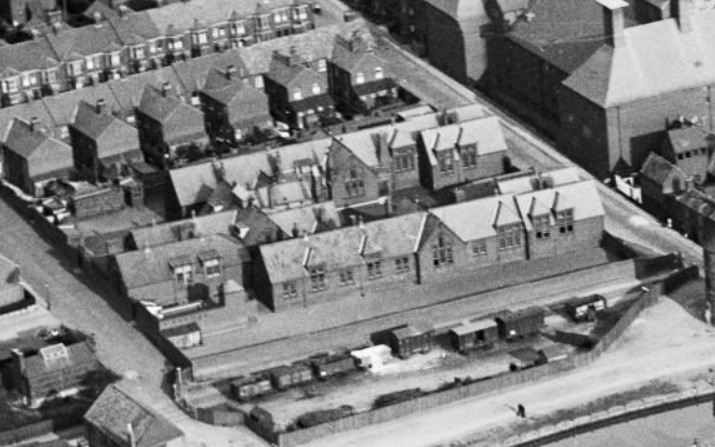
(Northgate School Circa 1900)
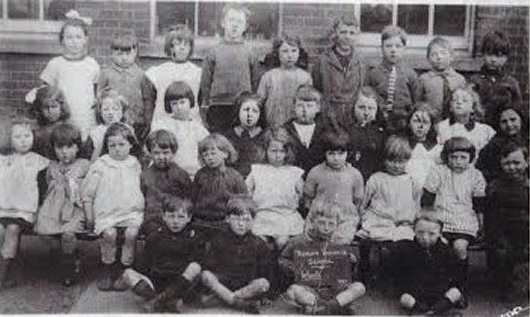
(Northgate School Circa 1920
Whilst at school, unbeknown to him at the time, young Edward Greengrass was to witness his own unique piece of history. During WW1, Great Yarmouth in Norfolk, was the first British town to experience the horror of civilian fatalities due to an aerial bombardment from two German Zeppelins, King’s Lynn was soon to follow. On the morning of 19 January 1915, two German Zeppelin airships, the L3 and L4, took off from Fuhlsbüttel in Hamburg, heading for the Humber, but bad weather led them to reroute and discharge their bombs over the two coastal towns of Norfolk, with devastating effect.
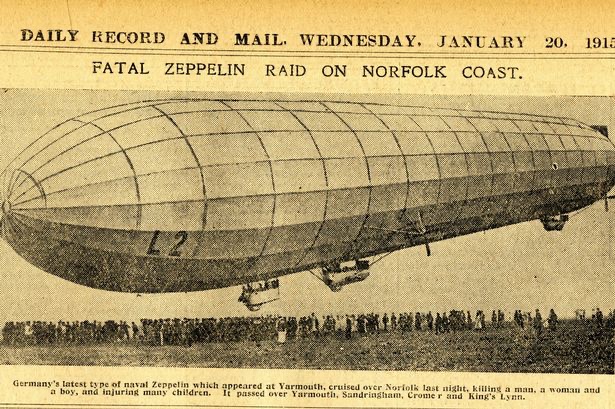
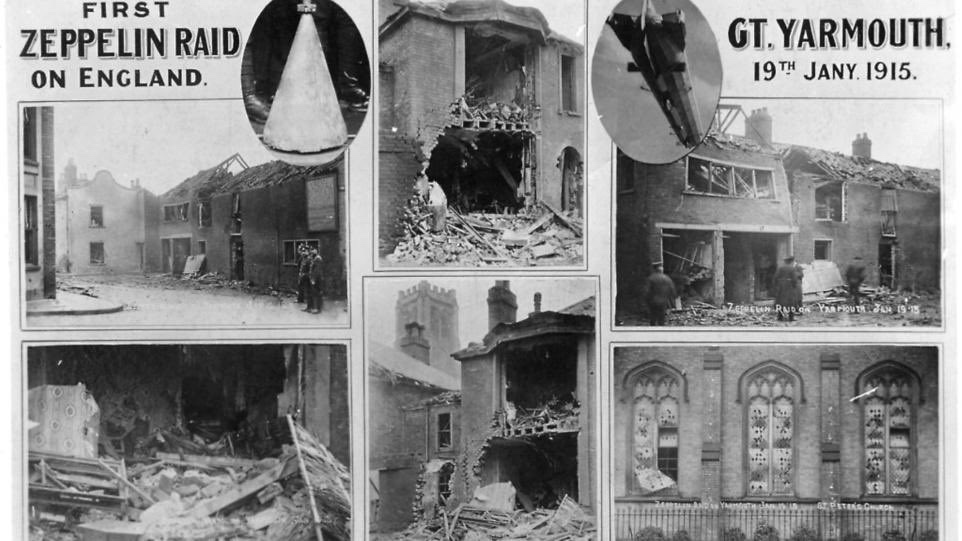
The Zeppelin was a motor-driven rigid airship, developed by German inventor Ferdinand Graf von Zeppelin in 1900 and at the time this was by far the largest airship ever constructed. This would have been a terrifying sight to a young 8-year-old Edward at the time. What must he have thought looking up at the sky watching these absolutely colossus airships as they passed over his home town? Was he terrified, did he fear for his own life and the lives of his family? Did he run and hide to scared to witness what was to follow?

Of course we will never know what Edward thought at the time, but there are some eye-witness stories from some Great Yarmouth residents at the time. William Gedge was a 15-year-old boy who lived in Great Yarmouth at the time, he recalls;
I remember Yarmouth being bombed by Zeppelins – we were the first town in England to be bombed by Zeppelins. And I can remember being in the bar with my father and the whole place shook and he says, ‘Open the door boy, there’s somebody trying to get into the bar.’ And I went to the door and I didn’t see… if there was a flash I couldn’t see them, the bombs, but I could hear half a dozen bombs falling in a straight line down Southgates Road which is near the fish wharf right in the other end of the town.

George White, a soldier in the London Yeomanry, who was stationed at Norfolk recalls;
Well all I had to do was if I heard the Zeps coming over, which they never seemed to come, until this special night. I was in the signallers’ office, he said, ‘If you hear the Zeps come over, phone the Post Office – no, the Post Office will tell you to take action.’ So I thought, ‘Alright, it won’t happen.’ But it did! Well Post Office rang up and said, ‘Take action: Zeps approaching.’ I thought, ‘What the devil shall I do?’ I thought to myself, ‘I won’t say nothing!’ Well I saw the Zeppelin come over all lit up it was. Well they bombed Yarmouth but they didn’t get to London, they turned back I suppose and that was that.
The Greengrass family were to survive the Zeppelin raid, but of course we know that the family, like almost every family in Britain during the War, paid the ultimate sacrifice with the loss of Edward’s father, in France in 1918.
The image below shows the Greengrass family home during WW1, 47, Arundel Road in Great Yarmouth, as it looks today.

The 1921 Census shows Edward Joseph Greengrass living at 34, Elspeth Road, Lavender Hill, Battersea in South London. Edward is recorded as the step-son to the head of the household, William Henry Waters. Edwards father, Edward William Greengrass, we know had sadly died on 21 August 1918 serving on the Western Front and Edward’s mother, Elizabeth Augusta Greengrass (nee Jones) remarried William Henry Waters in 1920. Also living at home was Edward’s younger sister Rose Elizabeth Greengrass.


(1921 Census FindMyPast)
We can see from the image below that 34, Elspeth Road, Lavender Hill, Battersea in South London was a rather impressive looking property.

Initially I thought that Edward had signed up for the Army after leaving school and going to London, but the records show that Edward actually enlisted with the Army on 19th February 1924. I wonder what was his inspiration to join the Army? His own father’s enlistment, or the loss of his father during WW1 possibly? Whatever the reason, after he enlisted, he excelled in the Army and was promoted to the rank of Sergeant on 1 July 1939.
The inter-war years saw a large expansion in the population of London, by 1927 the population had reached 7.8 million, which was an increase of around 20% in just 25 years. As the City grew suburbs to the South of the river were swallowed up during this rapid rise and expansion, including, Clapham, Rotherhithe, Camberwell and Battersea where the Greengrass family lived. As the population grew so did the demand for housing and public transport to connect these ever increasing areas. We have to remember that London’s population at the time was far greater than New York and as well as being the largest city in the world it was also home to the largest port in the world. It was of course the home of the government, the monarchy and the judiciary as well as being the heart of the British Empire. During his time there Edward would have witnessed all of this rapid expansion, including the building of the now iconic Battersea Power Station. The demand for electricity was rising and The London Power Company (LPC) proposed Battersea as London’s answer to the energy demand, it was forecast to generate more power than all nine of their other power stations combined. As industry grew during this period the Industries South of the River were able to find their own niche in the market and the leather industry, in particular, leather tanning, were able to thrive. Although I have been unable to locate a record to confirm it, I believe that when Edward moved to London, he served an apprenticeship as a leather worker at some time between 1915 and 1924. At some point in the early 1920’s Edward was to meet and marry his sweetheart, Dora Glanville. The young couple were married on 6 April 1929 at Saint Mary the Virgin Church in Wandsworth London, Edward was aged 21 and Dora 19 at the time. Edward is recorded as a Leather Manufacturer, which ties in with oral testimony from the family that he was a purse maker. His father is recorded as Edward William Greengrass, Greengrocer, deceased. The couple are both living at 130, Allfarthing Lane in Wandsworth on the marriage entry.

Below we can see 130, Allfarthing Lane in Wandsworth as it looks today.
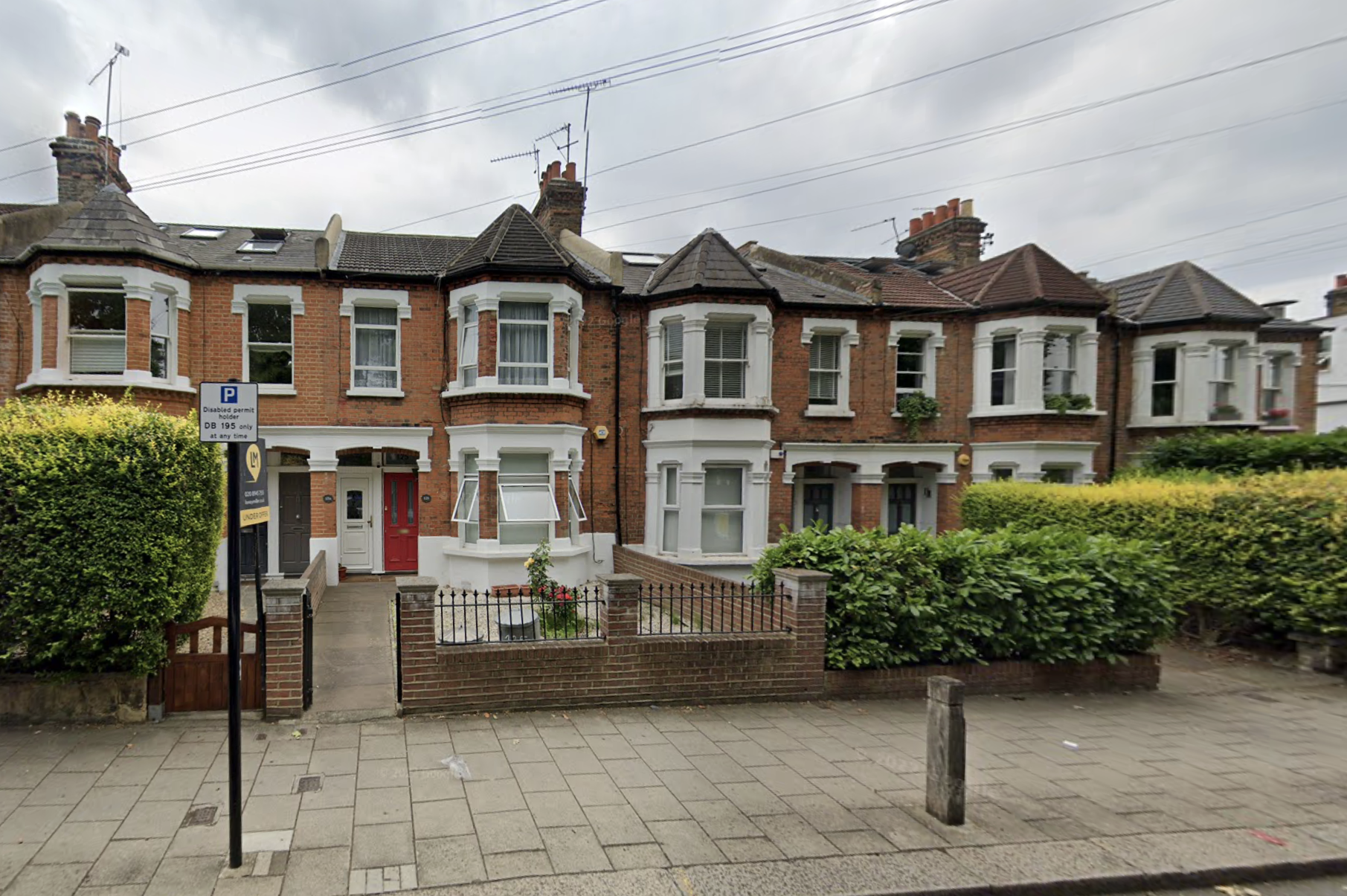
Edward and Dora had four children, but sadly three of the four were to die at an extremely young age. Barbara Greengrass who was born in 1929 in Lambeth and she tragically died when she was just 18, from cancer of the spine. Doreen Edna Greengrass who was born in 1933, in Hanover Square in London. Edward Greengrass who was born and died in infancy, in Battersea 1935 and Kathleen Greengrass who also sadly died in infancy, in 1937 in Chelsea.
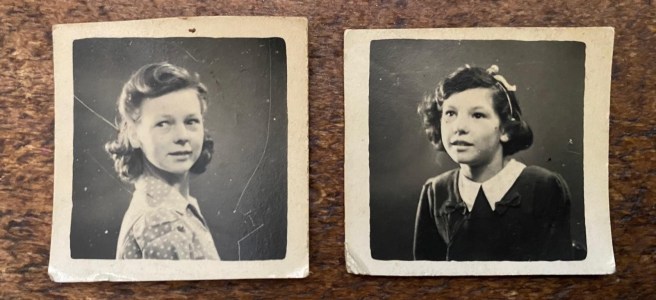
The beautiful picture below shows Doreen Greengrass on the right and Barbara Greengrass on the left as we look.

Before the outbreak of the Second World War, Edward Greengrass had his own shop in the Battersea and Wandsworth area which caused family uproar at the time when he shortened the family surname to Edward Green.
The 1939 Register below shows Dora Greengrass living at 16, Candahar Road in Battersea with her brother Sidney and his wife Ada. Her husband Edward Joseph Greengrass is not recorded because serving military personnel are not recorded in the 1939 Register.

(The National Archives; Kew, London, England; 1939 Register)
The picture below shows 16, Candahar Road, Battersea as it looks today.

At the outbreak of WW2, like his colleagues he was assigned to the 86 Bomb Disposal Section and attached to the 10th Battalion The Kings Regiment (Liverpool) and assigned the service number 2210433. The following military records were found for Edward Joseph Greengrass.
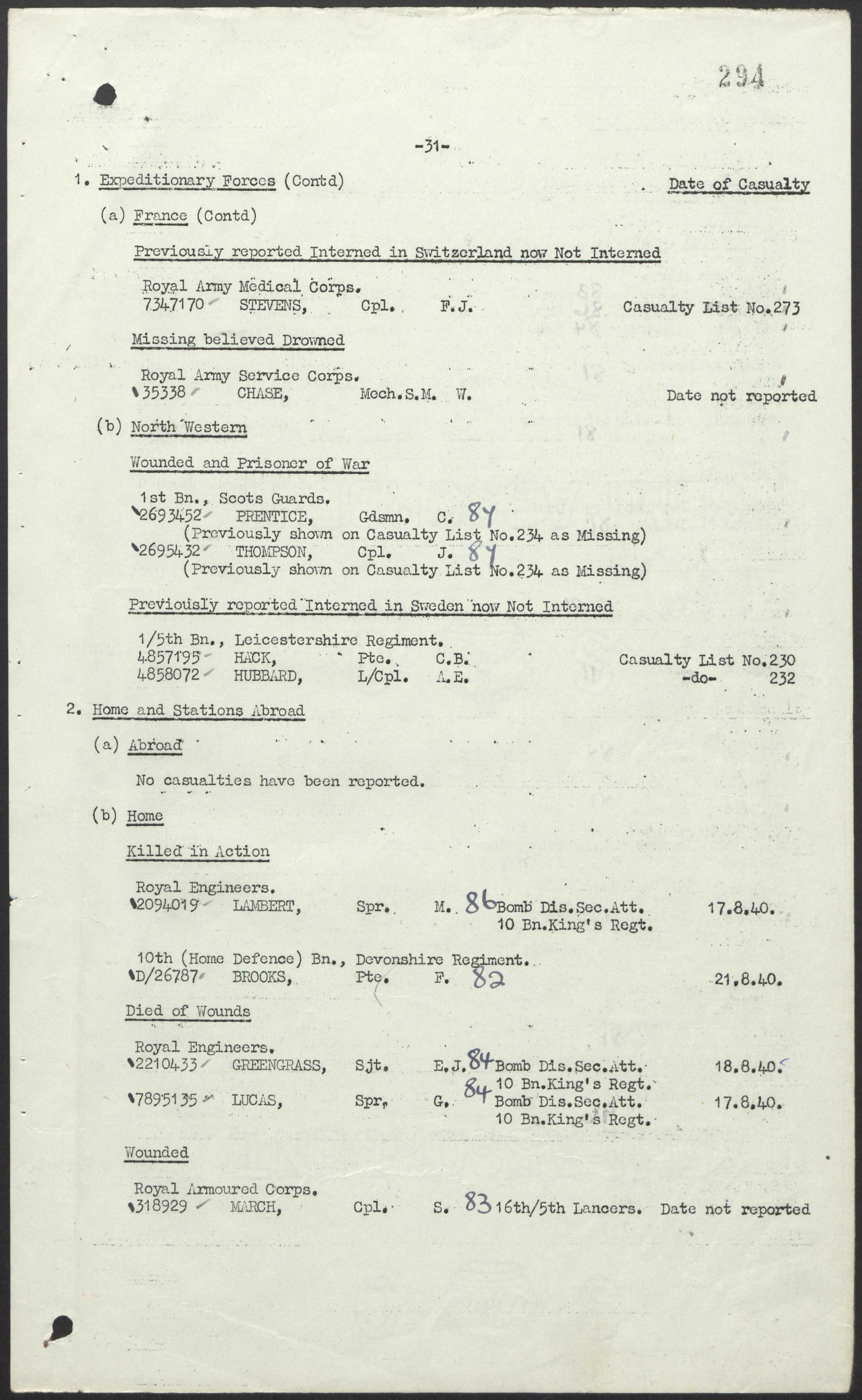
(The National Archives in London, England, UK; WO 417: Army Casualty Lists, 1939-45 War; Reference: WO 417/17)
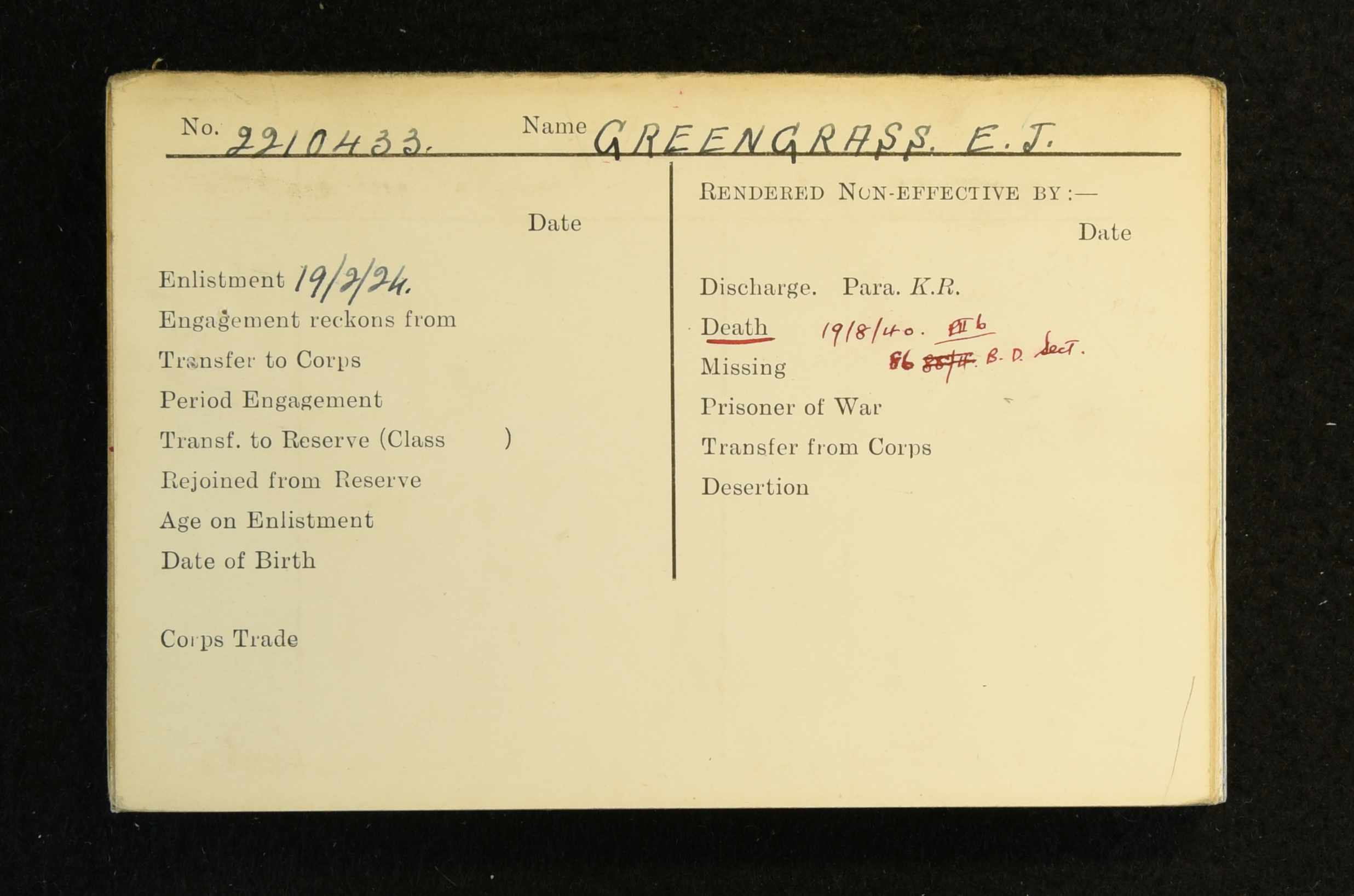
(Edward Joseph Greengrass Casualty Card)
Of the six men that sadly died attempting to defuse the bomb found at Nantwich, Edward and Sapper John Perrins were both to survive the initial blast and were taken to the Cottage Hospital in Nantwich. Sadly, Edward died two days later on 19th August 1940. You can read the full story of how they died here:
The Story of the Six Brave Royal Engineers Who Died at Nantwich
Edward was buried at Wandsworth (Earlsfield) Cemetery and is commemorated on the wall in the cemetery alongside all the men and women who died serving their Country. Edward’s name appears on Screen Wall, block 30 and he is buried in grave 439.


(Wandsworth (Earlsfield) Cemetery)
During my research I was able to trace the living descendants of Edward Joseph Greengrass and they were unaware of the memorial dedicated to the men that died, which is situated at Alvaston Hall in Nantwich in Cheshire, so I was really pleased to be able let them know about the memorial and the family recently paid their respects to Edward and his colleagues by leaving flowers at the memorial. A fitting mark of respect for the men that gave the ultimate sacrifice in the name of serving their country.


A man struck down in the prime of his life. It’s so important that we keep their memories alive and the next generation remembers the sacrifice that their family member gave, in order that we all enjoy our freedom today. Without those willing volunteers putting themselves on the line, day and night, Britain would have fallen under the continual bombardment from the Luftwaffe. We can all be thankful to Edward Greengrass and the Bomb Disposal men and women who defended the “Home Front’.
Why not visit my new website:
All My Blogs For Family Tree Magazine in one handy place
Copyright © 2024 Paul Chiddicks | All rights reserved

 The Chiddicks Family Tree
A heart-breaking story. Poor Dora – losing her husband and son to war service, and three of her four grand-children.
LikeLiked by 1 person
Some people and families seem to suffer so much loss in their lives
LikeLiked by 1 person
Your detailed blog post is yet another fine memorial to the life of this man and his dedication to country. Thank you for sharing the photos and documents that tell his story.
LikeLiked by 1 person
Thanks so much Marian his memory will be forever in our hearts and we are thankful to him and his colleagues for all that they gave
LikeLike
A moving piece of history. Those zeppelins really must have been terrifying to behold!
LikeLiked by 2 people
Indeed especially you a young 8-year-old boy!
LikeLiked by 1 person