
Family history research is often a journey of twists, turns, and unexpected breakthroughs. But when you’re dealing with a family member who was adopted and separated from the family at a young age, the search can feel even more daunting. In this post, I’ll share with you the unique circumstances that led my friend Rob, to trace his mum’s adopted sister Maureen, through a death certificate and the 1939 Register – a discovery that should have been impossible but, through sheer persistence, became a reality.
The Family History Backstory
To understand the complexity of tracing Maureen, it helps to know a little bit about Rob’s family. Rob’s mum Kay, was the youngest of four siblings, born to parents who never married. Towards the end of the Second World War, when this relationship broke down and the parents separated, all four children were put up for adoption. Eventually, the children were sent their separate ways, each child adopted by a different family in the Staffordshire area.
The family were originally from London, but the children were evacuated to Sussex sometime just before the 1939 Register was taken, which is a key part of the story, as we will discover later. The family eventually moved to North Staffordshire during WWII, because Rob’s grandfather had secured work at the local munitions factory. The four children were Maureen, Peter, Daphne and Kay and Rob’s mum had no contact with her siblings after the adoption.
Of the four children that were adopted, Peter Collinson was the only boy, but he never forgot his sisters and he always dreamt of one day being reunited with them. Peter and Rob’s mum Kay were finally reunited with each other again, after a gap of over 40 years, in the late 1980s, through a small ad placed in a local newspaper by Peter’s family, which, as you can imagine was an emotional and joyous reunion. After the reunion, Kay said:
“It was so special to meet Peter. All I knew was that I had an older brother and I so wanted to meet him. I was so happy when I finally met Peter, there was a connection straight away. We were so alike, in our mannerisms and our interests. We became very close.”
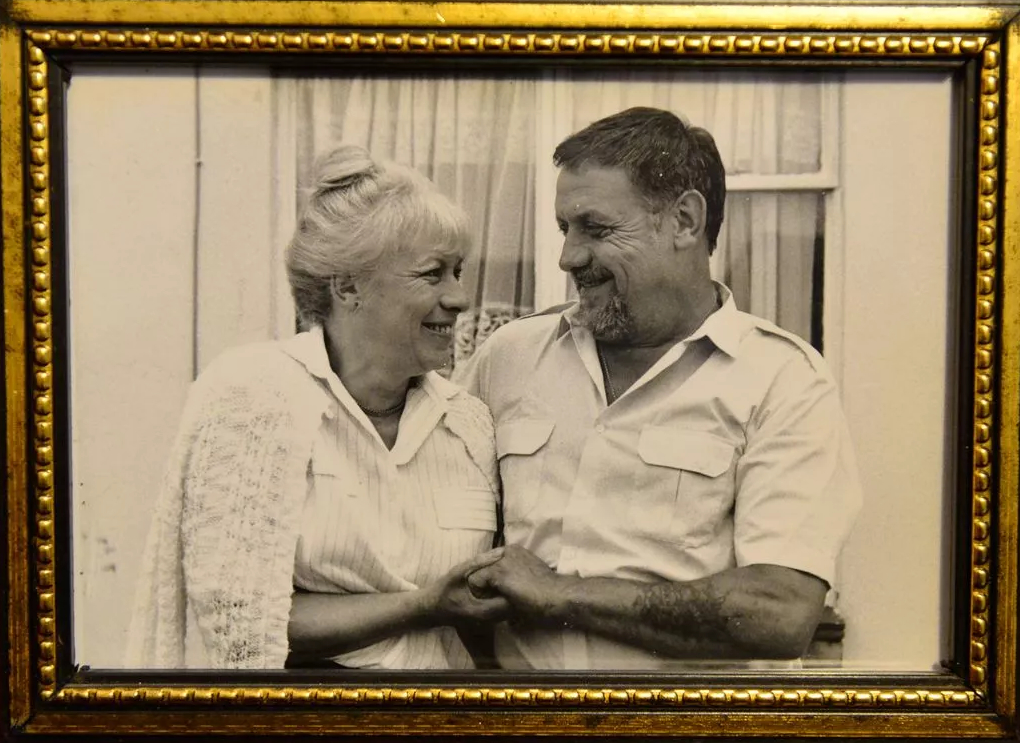
(Kay and Peter Reunited after a lifetime apart)
Sadly Peter and Kay’s time together was short-lived as Peter tragically died in the late 1990s which understandably devastated Rob’s mum. Peter’s widow said: “Peter was heartbroken when he was separated from his sisters. His (adoptive) mother said he cried for three days. He was always trying to trace his sisters. When he met Kay he was over the moon, they were so close.”
But crucially Peter’s passing also meant that his entry on the 1939 Register was unredacted. While Kay and Peter never managed to trace Maureen or Daphne, this is the story of how Rob traced and discovered what happened to Maureen and Daphne, even though it seemed an impossible task.
The 1939 Register
When Rob began his family history research, he didn’t know much about the 1939 Register, but what he learnt along the way, however, turned out to be crucial to his later discoveries. As most of you will already know, the 1939 Register was used initially, before the outbreak of WW2, as a means of identifying the numbers of men available for active service with the Armed forces. It would also later go on to serve a number of other useful purposes including being used for the issue of ration books – which is possibly why some people managed to be recorded more than once – and later it would be used to create the original NHS Register, after it was founded in 1948. Another key part in this story was the fact that the Register was continuously updated. Which meant any changes to surnames, due to marriages or adoption, were added to the original document. This continued until the NHS went over to a computerised system in the early 1990s. There is an excellent detailed explanation of the 1939 Register and how it was taken and recorded in the recent Lost Cousins Newsletter and I have attached the link here:
It was back in 2015 that Rob decided to undertake the mammoth task of tracing his mum’s lost siblings. Rob started by searching for Peter in the 1939 register and after some initial frustrations, he eventually found him under his adopted name, in Sussex, where of course we know the children were evacuated to at the start of the War. Also included on the entry were a number of other redacted names and Rob had a hunch that Maureen must be one of them.
The Breakthrough: Tracking Maureen Through a Death Certificate:
After a conversation with members of Peter Collinson’s family, who had been researching his siblings in the late 1970s, Rob learnt that they had found a death record for someone named “Maureen” in the 1990s. So he began searching for that same record in the indexes, but finding the entry in the indexes was only one part of the puzzle, he still had to confirm whether it was the right person. The only way to know for sure would be to order the death certificate. We should note that the birth certificate Rob already had and this death certificate, alone, would not prove that he had the right person, but it would certainly add to the evidence.
Rob ordered the death certificate, and when it arrived, it contained details that seemed to match Maureen—but, crucially, it also listed her maiden name and married surname. He used her maiden name to search for her birth record but found no match under that name. This wasn’t surprising—since, as an adopted child, it was likely that Maureen’s birth name had been changed. That’s when he realised that he could now potentially unlock a closed 1939 Register record by submitting the address where Maureen had been living at the time and providing a death certificate. This was the chance to confirm whether he had found Maureen, and against all odds, the record was unlocked. The person that Rob had found was indeed his mum’s eldest sister, Maureen.
Emotions and Discoveries:
The discovery of Maureen was bittersweet. The 1939 Register confirmed Maureen’s birth name, her adoptive surname, and the surnames she had taken through two marriages. The fact that he had found her after all these years filled him with a strange mixture of elation and sadness. Elation, because he had traced her—finally—after decades of separation, and sadness because Maureen had sadly passed away over 20 years ago.
While this discovery was significant, there was more work to be done. He still had to respect the privacy of Maureen’s family, but he also felt compelled to reach out and make contact with them. Through his growing research skills, Rob found Maureen’s second husband and their grown-up children on Facebook. Fortunately, much to his relief, they responded positively, and after a few meetings, Maureen’s second husband kindly gave Rob’s mum some cherished photos of her sister Maureen.

The Larger Picture: Family, Lost Connections, and Reflection:
There was also one last piece of the puzzle for Rob to solve and that was what happened to his mum’s last missing sister Daphne. Rob discovered that Daphne had changed her name to Doreen, but it was a bittersweet moment as Rob sadly found out that Daphne had also died. However finding out what had happened to Daphne led Rob to also trace her daughter and the discovery of a new “cousin”, who had no idea of the missing links in her own family.
Tracing Maureen was part of a larger journey of reconnecting with lost family members. Rob also managed to trace two of Maureen’s maternal aunts, who had also been separated from the family after the war. When he took his mum to meet them, as you can imagine, it was a very emotional moment. They were also able to share with Rob and his mum the location of the grave of Violet Lily Reed (Kay’s mother), who had tragically passed away at the age of 29 in 1946 and was buried with her own mother Lily Agnes Reed who died in 1953.
While Rob’s research into Maureen’s life led him to trace her family and connect with long-lost relatives, it also brought him face-to-face with the complexities of family dynamics. He discovered that his mum’s father had gone on to have multiple families, and it’s hard to ignore the strange irony of visiting his grave, which stood very near to the grave of his mum’s adoptive parents. These discoveries were emotional and complicated, but they also confirmed how through the closeness of family history, people are connected, yet separated by time, circumstance, and choices.
Tracing Maureen was an emotional rollercoaster, full of surprises, frustrations, and eventual joy. Through a combination of genealogy research, death certificates, and hard work, Rob was able to piece together a missing part of his family’s story and reunite four corners of the same family after a 75-year gap. While the process was at times painful, the connections that he discovered — both through documents and real-life encounters—reminded him of the importance of family.
If you’ve ever wondered about your own family’s past, I encourage you to dive in, even when the journey seems impossible. You might uncover pieces of your story that change the way you see your family and yourself. Genealogy is not just about finding names and dates—it’s about discovering the stories behind them. For me, Rob’s journey of tracing Maureen was a journey not only through records and certificates, but through emotions, family bonds, and the complicated, beautiful tapestry that makes up our own unique family history.
Why not visit my new website:
All My Blogs For Family Tree Magazine in one handy place
Copyright © 2025 Paul Chiddicks | All rights reserved

 The Chiddicks Family Tree
Fascinating story
LikeLiked by 1 person
Thanks Sheree
LikeLiked by 1 person
My mum’s family was split up when her mother died in 1937. Her father, a merchant seaman, couldn’t cope with four children. The eldest boy was about to enter the Navy as a boy rating so spent the intervening time with a still-unidentified Auntie Lou ( we have an idea about her), the two middle children went to the Seamen’s Orphanage in Liverpool – hundreds of miles away from their home – and the youngest (only 2 years old) was handed over to Barnardos. Although the three older children managed to keep in touch and reunited later on, the youngest was lost to the family for over 60 years. Barbarossa didn’t seem to know what had happened to him and thought he may have emigrated or died. This was all before the days of the internet and easy access to public records.Then a cousin (running a school fete) casually asked someone on the Barnardos stall how they might trace him. The volunteer took the details, warning that it might not be good news and my cousin thought no more about it. Some weeks later she received a phone call aabout our missing uncle. And then he made contact with us. He had been adopted from Barnardos and told at one stage that his family had all emigrated to Canada. Despite a difficult start, he had made a good life for himself and created a happy family. The reunion was too late for two of his siblings but he met the rest of us and we had nearly 20 years of connection before he died.
LikeLiked by 1 person
What a beautiful heartwarming story Annie thank you so much for sharing that with me. Those 20 years must have been so precious to you all
LikeLike
Very emotional to see the difficult challenge facing Rob as he traced his family and what he eventually learned.
LikeLiked by 1 person
Thanks Marian the impact on the family was immeasurable
LikeLike
Such an emotional journey with all kinds of discoveries! The journeys we undertake in our genealogy research are remarkable and often heartbreaking. Thank you for sharing Rob’s findings!
LikeLiked by 1 person
Thanks Sue, it was a real roller coaster journey for Rob and his family and one that I enjoyed sharing here with everyone
LikeLiked by 1 person
Thanks for writing this up so beautifully Paul, I and my family really appreciate it. I’m not sure I’ve ever explained it quite so painstakingly as I explained it to you. It goes without saying that I could not have written it up so well. I do have more stories, Mum’s Dad had 3 families in total and the eldest child he had, Terry, stayed with him across all 3 families and he essentially had 3 Mums before he turned 10. I found Terry’s full sibling, Janet, a few years ago and I reunited them. Terry’s first (ex) wife also took their son Nigel to Australia in 1970, when he was 10. I traced Nigel a few years ago and Terry and Nigel had a phone call ritual once a week for a number of years.
LikeLike
It was my pleasure to be able to do this for you Rib. It’s always a very humbling experience being entrusted to tell another families story. It sounds like you have enough material there for me to write a book!
LikeLike
How very sad to have split the siblings like that. Moving story.
LikeLiked by 2 people
Sadly this happened far too often Eilene
LikeLiked by 1 person
What a shame that these four siblings were split up as children. It’s very sad that two of them passed away before they could be reconnected, but it’s lovely that the families have helped to fill in the gaps.
LikeLike
I know so awful, but also sadly not untypical of the time, but like you say, it’s lovely that some of the siblings were eventually reunited.
LikeLike