
About Forgotten Ancestors – Every family tree holds stories lost to time, distant relatives whose lives passed quietly, leaving barely a mark, but whose experiences shaped the generations that followed. In this series, I explore the lives of those forgotten ancestors, bringing their names, stories, and voices back into the light.
“History remembers only the celebrated, genealogy remembers them all.” ~ Laurence Overmire
We all have those ancestors that sit on the outlying branches of our tree, call them ‘forgotten ancestors’, for want of a better description. But in all honesty, it’s going to take something a little bit special to make you sit up and notice your 2nd Cousin 2 x removed. So when I found out that my 2nd Cousin 2 x removed had the wonderful name of ‘Horatio Nelson Hallsey’, who wouldn’t blame me for sitting up and paying attention. However, this story is a rather sad and harrowing tale.
At first glance, a connection to Admiral Nelson would seem a logical ‘fit’, especially given the Hallsey family’s deep roots along the River Thames. For over 150 years, more than twenty members of the Hallsey family worked as Watermen and Lightermen in Gravesend, ferrying people and cargo up and down the river. It all lines up nicely…….until it doesn’t. Horatio’s father, Thomas Hallsey, wasn’t a Waterman at all; he was a carpenter.
The Hallsey family’s roots were in Gravesend, stretching back to my 4x great-grandfather Daniel Hallsey, who was born in Gravesend circa 1760. Now, Daniel was definitely a Waterman. Horatio’s parents were Thomas Hallsey and Eliza Crane, who married on 3 November 1873 at the Milton Parish Church in Gravesend in Kent. Like many families at the time, the Hallseys had a large family, and Horatio was born on 4 April 1878 and baptised on 21 April 1878 at the Christ Church in Milton, Gravesend. Thomas is recorded as a carpenter, and the family home address is 38 Peacock Street, Milton, Gravesend, Kent.
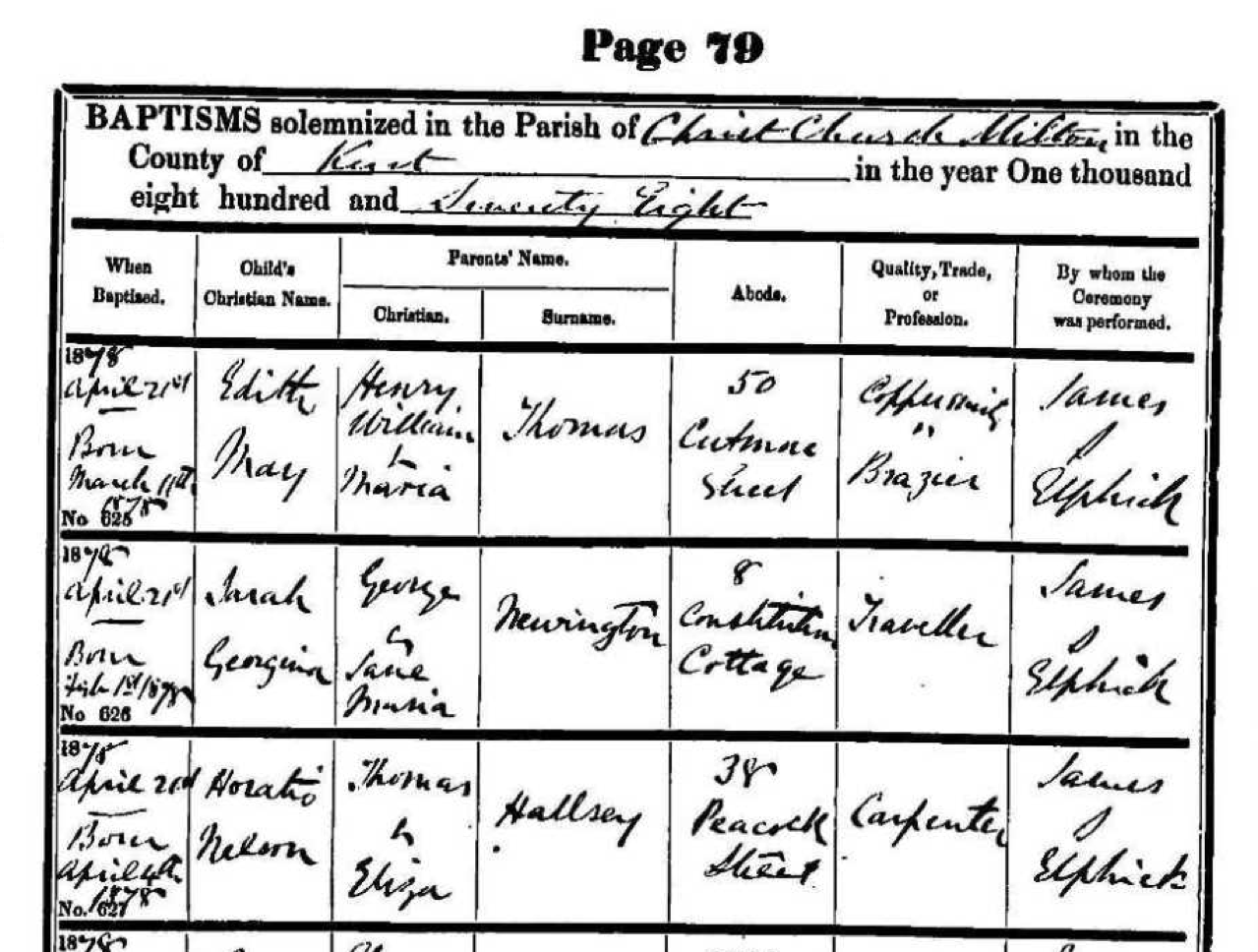
(Baptism record of Horatio Nelson Hallsey, 1878)
But baby Horatio’s life was heartbreakingly brief.
He died at just nine months old in deeply tragic and harrowing circumstances — the kind of story that sticks with you long after you’ve read it. His death was reported in several newspapers at the time, including this chilling account from the Worcester Chronicle, dated February 1st, 1879:
SINGULAR DEATH OF A CHILD.-At Gravesend
On Monday, an inquest was held concerning the death of Horatio Nelson Hallsey aged nine months. The facts of the case are of a peculiar character. The mother of the child, who resides at 38, Peacock Street, retired to rest at twelve o’clock on Saturday night with the child on her arm. She awoke about four hours afterwards and found the child had disappeared. On arousing her husband, they discovered that the infant had fallen between the bed and the wall by the side of the fireplace. There was just sufficient space to allow the body to pass through, but the child’s head rested with its back against the wall, and its chin on the mattress, which was on the bedstead. The child was taken from its peculiar position, and Dr. Pinching was sent for. Immediately on his arrival he examined the child and found it was dead, its death resulting from suffocation. The Jury returned a verdict of “Accidental Death.”
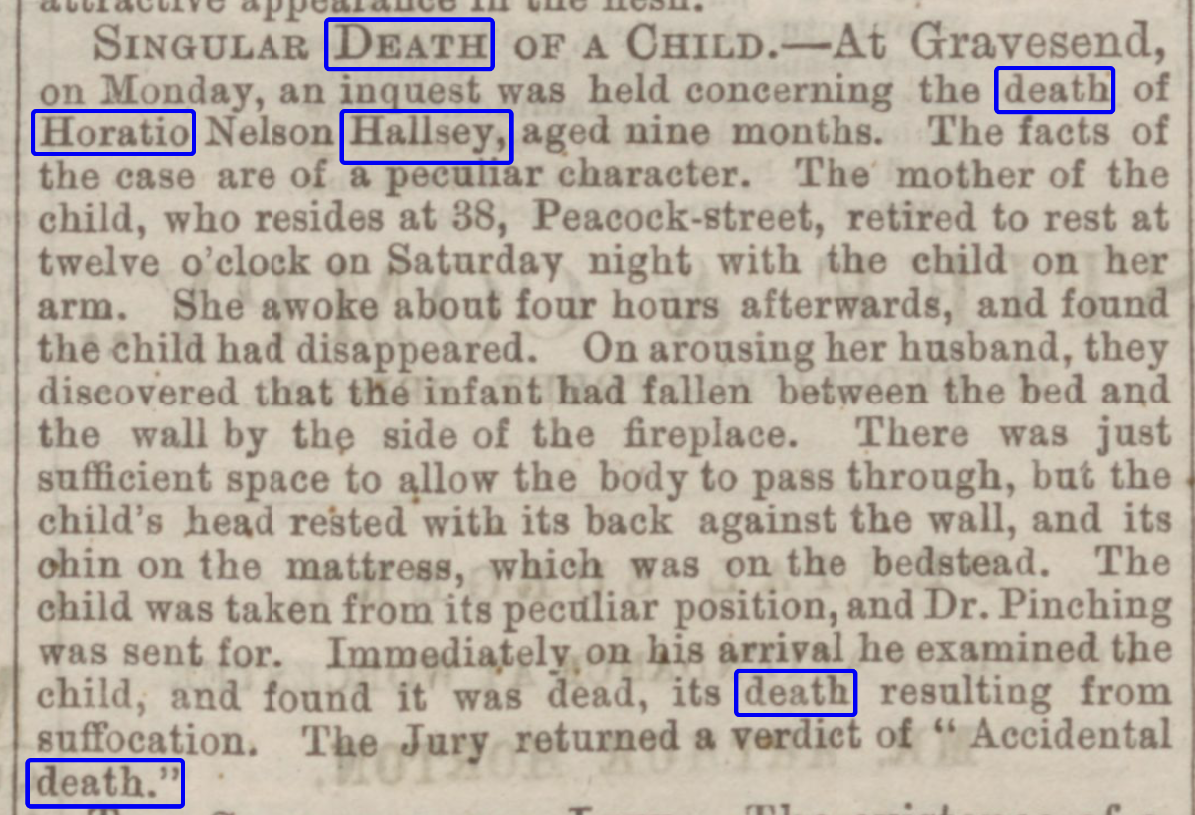
The newspaper account is striking in its cold detachment — a clinical report of something that must have been utterly devastating for the parents. Their baby had died in their own bed while they slept. It’s almost too awful to imagine.
Horatio was buried on January 31st, 1879, in the Municipal Cemetery in Gravesend. A small life, taken before it had truly begun.
There’s a common misconception in genealogy circles — that our Victorian ancestors somehow felt the pain of loss less deeply because death was more frequent. I don’t believe that for a moment. Grief doesn’t dilute with repetition. I have no doubt that each loss, especially the death of a child, would have been deeply and permanently felt.
Horatio may only leave a small footprint in official records, but he was someone’s son, grandson, brother and someone’s heartbreak. He was loved, and now, he is remembered.
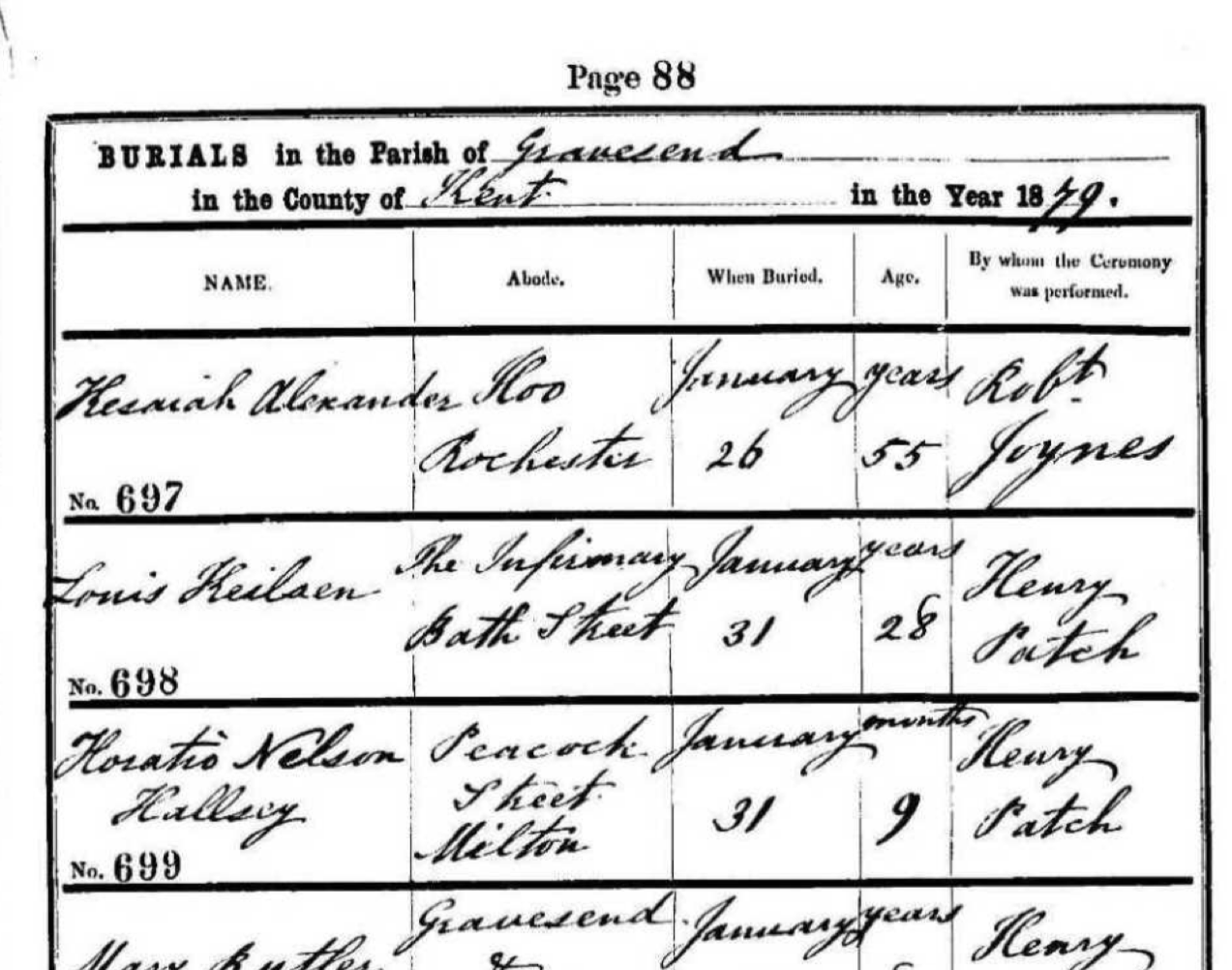
Burial record of Horatio Nelson Hallsey, 1879)
The tragic story of Horatio Nelson Hallsey reminds us that genealogy is not just about dates, names, and places. It’s about people — real people — with lives as rich, complicated, joyful, and painful as our own. Some of their stories were never meant to be headlines. Many were lost in the sands of time. But when we dig deep enough, we can bring them back into the light, if only for a moment.
What strikes me most is how easily Horatio could have remained just another name in the parish register, his short life reduced to a line on a certificate. But he was part of a family. He had parents who loved him. He had siblings, a home, and a name that carried weight and ambition — Horatio Nelson Hallsey. He had a place in the world, however brief.
Uncovering stories like Horatio’s is part of what makes family history so powerful. We give a voice to those who never got to tell their stories.
So the next time you come across a distant cousin, tucked away on a quiet corner of your family tree, don’t skip past. Take a closer look. There might be a Horatio waiting for you, too — a forgotten ancestor with a story worth telling.
In Memory of Horatio Nelson Hallsey (1878–1879)
You were here. You are remembered.
Have you found a ‘forgotten ancestor’ in your own tree? If so I would love to hear their story.
(Header image was created by AI on ChatGPT)
Why not visit my new website:
All My Blogs For Family Tree Magazine in one handy place
Copyright © 2025 Paul Chiddicks | All rights reserved

 The Chiddicks Family Tree
Heartbreaking
LikeLiked by 1 person
its truly awful
LikeLiked by 1 person
We give a voice to those who never got to tell their stories, indeed! I’m remembering the small siblings of my great grandmother (who died when I was a freshman in college): https://joynealkidney.com/2017/03/13/forgotten-stories/
LikeLike
What an incredible story and wonderful piece of research Joy woven together into a sad but poignant story. So many lives taken far too soon
LikeLike
I agree with you that our ancestors felt the pain of a loss of a child just as we would – whether or not it was more common.
LikeLiked by 1 person
another one of those family history myths debunked
LikeLiked by 1 person
The tragic death of Horatio Nelson Hallsey must have been very sad for everyone around him. I can’t even imagine the tears. His name will live on because you told his story and shared it widely.
LikeLiked by 1 person
I want to remember those lost souls on my tree the ones who left little trace they were there
LikeLike
I agree with you that our ancestors felt the loss of these children. Perhaps they were more reserved because they knew other families around them who experienced the same? Maybe lost more children?
I try to fit the little ones in whenever I can. I can only hope their parents “know” that someone thought about their child a century later, and that they weren’t totally lost to history.
LikeLiked by 1 person
Thanks Christine that’s such a beautiful sentiment
LikeLike