
About Forgotten Ancestors – Every family tree holds stories lost to time, distant relatives whose lives passed quietly, leaving barely a mark, but whose experiences shaped the generations that followed. In this series, I explore the lives of those forgotten ancestors, bringing their names, stories, and voices back into the light.
“History remembers only the celebrated, genealogy remembers them all.” ~ Laurence Overmire
Some ancestors only leave a small footprint in the official records, and James Hallsey only left five records for me to find. But one line from a newspaper article captures the heart of his story more than any other:
a fine promising youth, the son of Captain Halsey
Those words stayed with me. A fine, promising youth—so much potential, just at the start of his journey. Would he have followed in his father’s footsteps, perhaps even earned the title of Captain himself? Sadly, we’ll never know.
James Hallsey was my 2x great-grand uncle, one of twelve children born to Daniel and Harriet Hallsey (née Simmons). He was baptised on 12 November 1826 in the parish church at Milton, Gravesend, Kent. Like many Hallseys before and after him, James was part of a long tradition of Watermen and Lightermen—men who made their living on the River Thames.

The 1841 census is the only census that James appears in, and he is recorded living with his parents, older sister Sophia, and younger siblings Eleanor, William, and Edmund. The record is sparse, as most 1841 entries are, offering only the barest glimpse into their lives. But one detail stands out—his father Daniel’s occupation: Waterman.

The role of a Waterman on the Thames was as a skilled and professional boatman who ferried people across and along the River Thames, particularly before the advent of more modern transportation. The role of a Lighterman was very similar, but instead of people, the Lighterman transported goods and cargo on the river. Watermen were especially prominent from the 16th to 19th centuries, though the trade dates back earlier. The profession was formally regulated by the Company of Watermen and Lightermen, established in 1555 to control fares, ensure safety, and train apprentices. Both James and his father, Daniel, were registered with the Company of Watermen and Lightermen. It was through this institution that James began his own path; he was officially apprenticed to his father on 11 March 1841.
This record can be found on FindMyPast in the record set Thames Watermen & Lightermen 1688-2010 under Source Binding Records 1692-1949. Like all apprenticeships, they would have been set for a set duration, and the records would normally show a ‘bound date’, when the apprenticeship started, and a ‘date free’, when the apprenticeship ended. In this instance, under ‘date free’, it states DEAD, one of the harshest words to read on your ancestors’ records and documents.
Sadly, just three years after starting his apprenticeship, James’ life was to suddenly end whilst working on the River Thames. The details of the accident were reported in the Kentish Mercury dated 11 May 1844:
Gravesend
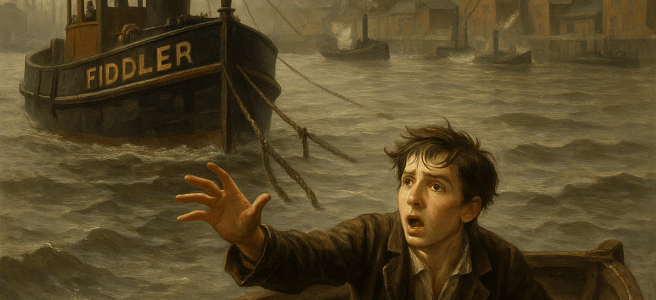
INQUEST – An inquest was held on Saturday at the Town-hall, before C. J. Carttar, Esq., coroner, on the body of James Halsey, a fine promising youth, the son of Captain Halsey of the Diamond Steam Packet Company, who was lately drowned in Long Reach. It appears that the deceased was in a boat towed by the Fiddler steam-tug, two ropes being used for the purpose, which were made fast to each quarter of the steamer – one of those ropes broke, and the boat sheering off filled with water; the other rope not having sufficient strength to hold the great weight then upon it broke also, and the boat was then adrift in a sinking state, with the unfortunate deceased on board. The jury returned a verdict of ‘Accidental Death’


(Image created by AI via ChatGPT)
James Hallsey, of Queen Street, Milton, Gravesend, was laid to rest on 27 April 1844 at Gravesend Municipal Cemetery. Though his life was brief and his legacy nearly lost, James’s story has now been told. He lives on in our family memory and now, in these words.

Researching James’s life left a deeper impression on me than I expected. At first, he was simply a name on a census—just one of twelve children in a busy Victorian household. But with each record I uncovered, his story began to take shape, and I felt a growing connection to this young man whose life ended far too soon. Seeing the word “DEAD” on his apprenticeship record was jarring, so final. A heartbreaking ending to a life that had only just begun. I kept thinking about how proud he might have felt following in his father’s footsteps, and how quickly that future was taken away. It reminded me that behind every name is a life once lived. Telling James’s story feels like a small way to honour that life. Though history forgot him, we don’t have to. Through these stories, we can bring our ancestors back to life and make sure that their voices are heard and ensure that they will be forever remembered and never forgotten.
In Memory of James Hallsey (1826–1844)
You were here. You are remembered.

Have you found a ‘forgotten ancestor’ in your own tree? If so I would love to hear their story.
Why not visit my new website:
All My Blogs For Family Tree Magazine in one handy place
Copyright © 2025 Paul Chiddicks | All rights reserved

 The Chiddicks Family Tree
It’s wonderful that you’ve unearthed so much about your ancestors
LikeLiked by 1 person
Thank you so much Sheree
LikeLiked by 1 person
Sad about poor James.
LikeLiked by 1 person
Thank you
LikeLiked by 1 person
He began with such a promising future. Your sensitive retelling of his story keeps his memory alive for the future.
LikeLiked by 1 person
Thank you Marian, he will be forever remembered now
LikeLike
This is a lovely tribute to an ancestor – thank you for sharing his story! Lynne
LikeLiked by 1 person
Thanks so much Lynne 😊
LikeLike
Thank you for everything you do in out community, Paul.
And thanks for another inspiring post.
In researching my upcoming book ‘…Yet’: A Story of Triumph Over Childhood Separation, Trauma, and Disability, I discovered thousands of forgotten children disabled by bovine TB from drinking unpasteurised milk.
The diagnosis was stigmatised and the treatment took months and years away from the children’s home and community. Everyone knew of someone affected, but it wasn’t talked about.
I’m tring to raise awareness about these forgotten ancestors. Did you have anyone affected in your family, Paul?
Warm wishes,
Helen Parker-Drabble
LikeLike
Thank you for everything you do in out community, Paul.
And thanks for another inspiring post.
In researching my upcoming book ‘…Yet’: A Story of Triumph Over Childhood Separation, Trauma, and Disability, I discovered thousands of forgotten children disabled by bovine TB from drinking unpasteurised milk.
The diagnosis was stigmatised and the treatment took months and years away from the children’s home and community. Everyone knew of someone affected, but it wasn’t talked about.
I’m tring to raise awareness about these forgotten ancestors. Did you have anyone affected in your family, Paul?
Warm wishes,
Helen Parker-Drabble
LikeLiked by 1 person
Hi Helen many thanks for yuor kind words I really do appreciate it. My great-uncle died from TB aged just 23 in 1923. I have visited his grave a number of times,e extremely sad.
LikeLike