
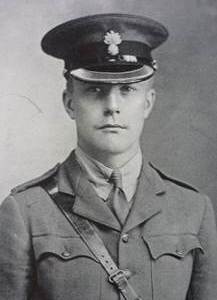
One of the unknown soldiers I promised to honour…….
During the summer of 2025, I had the privilege of visiting the battlefields of the Western Front to honour and remember three members of my wider family who gave the ultimate sacrifice during the First World War. It was an emotional and humbling journey, walking among the rows of white headstones, each representing a life cut short and a family forever changed.
As I moved from cemetery to cemetery, I made a promise to myself. At every place of rest I visited, I would choose one individual, not known to me, not connected to my family, and I would research and tell their story. This is the first of those stories. It is my small way of ensuring that their names live on.
Today, I honour and remember Second Lieutenant Clement John Byron, of the Honourable Artillery Company, who lies buried in Beaumont-Hamel British Cemetery.
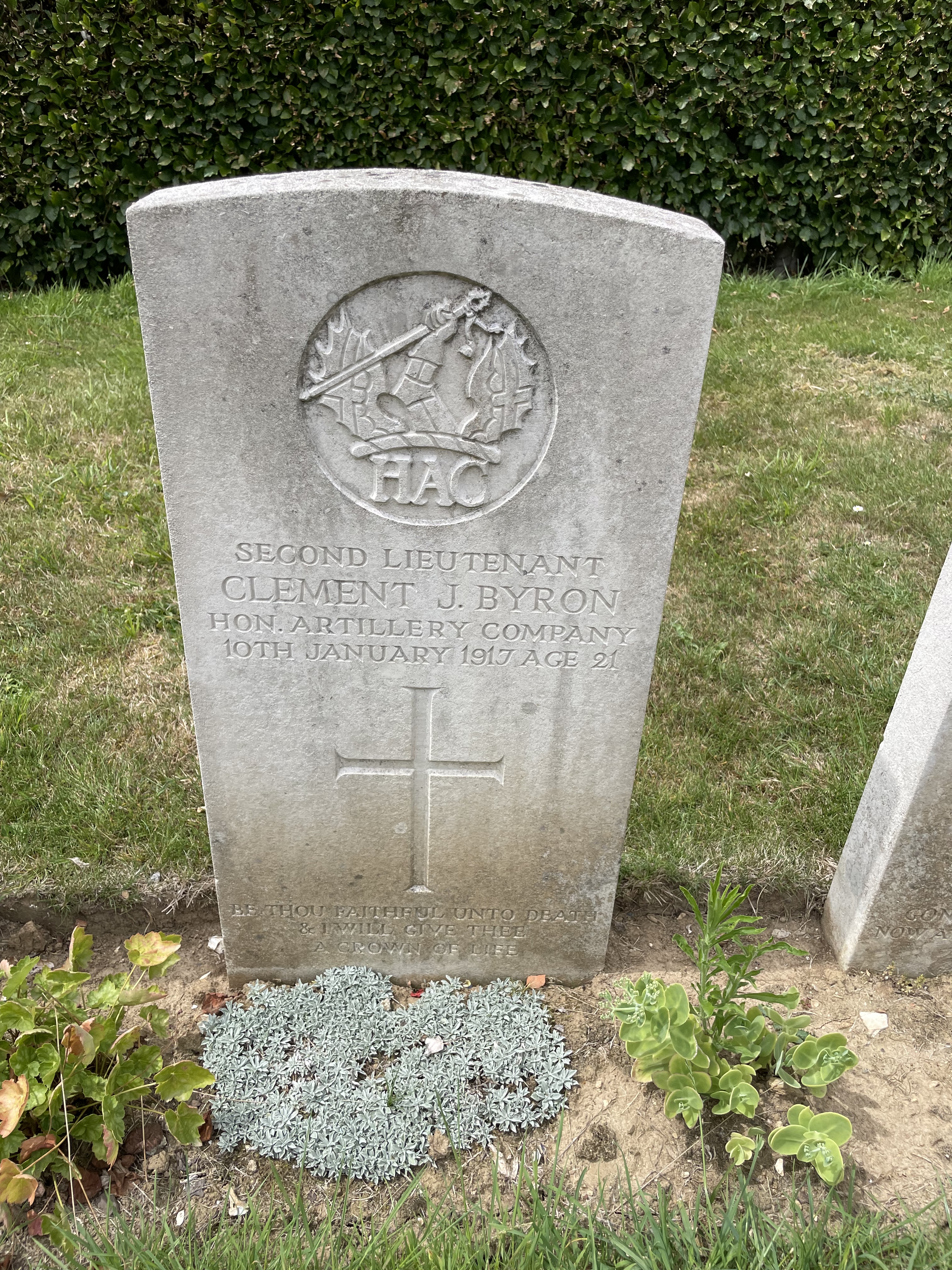
(Image taken at Beaumont-Hamel Cemetery, France, from my own collection)
A Privileged Childhood
Clement John Byron was born on 23 November 1895, the youngest of five children, at 18 Warren Road, Upper Clapton, London. His arrival came thirteen years after his next-oldest sibling. Clement was a late addition to the well-to-do Byron family.
His father, John Byron (1846–1936), was a successful shipowner and partner in the firm John T. Rennie, Son & Co., trading with South Africa. His mother, Clara Byron (née Kibbler) (1851–1932), was the daughter of a distinguished army surgeon
The family’s life was one of comfort and privilege. Their home in Beckenham, “Wyefield”, had servants, tennis lawns, and even a Sunbeam motor car, a rare luxury at the time.
He was educated at Clare House Preparatory School and Orley Farm, Harrow, before earning a scholarship to Harrow School in 1909. There, he thrived and earned himself a place at Magdalen College, Oxford. His housemaster described him as “of good ability, diligent and very attractive, good at music and games” and Magdalen’s President later wrote that he “could hardly have failed to do well at Oxford.”
But the world had other plans.
A Family of Service
Clement came from a family proud of its service and adventure. His grandfather, Captain John Byron, had commanded emigrant ships from Britain to Australia during the 1850s. His father continued the maritime legacy, and both of Clement’s elder brothers would also serve.
Sidney Byron joined the Honourable Artillery Company in 1896 and rose to the rank of Captain, while Lewis Ambrose Byron emigrated to South Africa, serving with the Natal Mounted Rifles, later attaining the rank of Major.
Service to country, it seemed, ran in the blood.
Answering the Call
When war broke out in August 1914, Clement was 18 years old and preparing for Oxford. He had already served four years in the Harrow Officers’ Training Corps, reaching the rank of Sergeant and gaining Certificate A.
Eager to serve, he enlisted in the Honourable Artillery Company on 8 September 1914, just six days after the Battalion had formed. His brother Sidney used his influence to help him join.
He quickly rose through the ranks, from Private to Sergeant, before accepting a commission as Second Lieutenant on 2 October 1915. He specialised in grenade bombing and machine gunnery, becoming an instructor in the newly developed Lewis Gun.

(2nd Battalion of the Honourable Artillery Company at the Tower of London, c.1915 (© HAC Archives)
His letters home from this time reveal his humour and optimism, the kind of quiet confidence that only youth can bring.
To the Western Front
In October 1916, after two years of training in England, Byron’s Battalion finally crossed the Channel to France. His letters tell of the excitement and discomfort of trench life, the cold, the noise, the mud.
By November, they were sent south to the Somme, to the devastated village of Beaumont-Hamel, captured only days earlier. The task of consolidating and holding the position fell to the Honourable Artillery Company.
The conditions were atrocious. The trenches were deep with mud and water, and the men often used the bodies of the fallen as stepping stones. Yet Byron’s letters remained light-hearted. He reassured his family that “things were not as awful as the newspapers suggested” and joked about his walking stick “Fido,” who was “longing to hit a Hun over the head.”
Endurance and Leadership
Throughout the winter of 1916–17, Clement led by example. Frequently in command of ‘C’ Company, he moved tirelessly between the men, ensuring rations arrived and morale was maintained.
He wrote:
“Cold, mud, water, shells, bullets… but I am fit and well.”
Even amid hardship, his humour shone through. He wrote of being “plastered from head to foot in yellow mud” and of a mouth “like a bird cage” after too much army rum.
By Christmas 1916, Clement was the sole surviving officer from his Company who had left London just months earlier. His resilience and courage were evident to all who served with him.
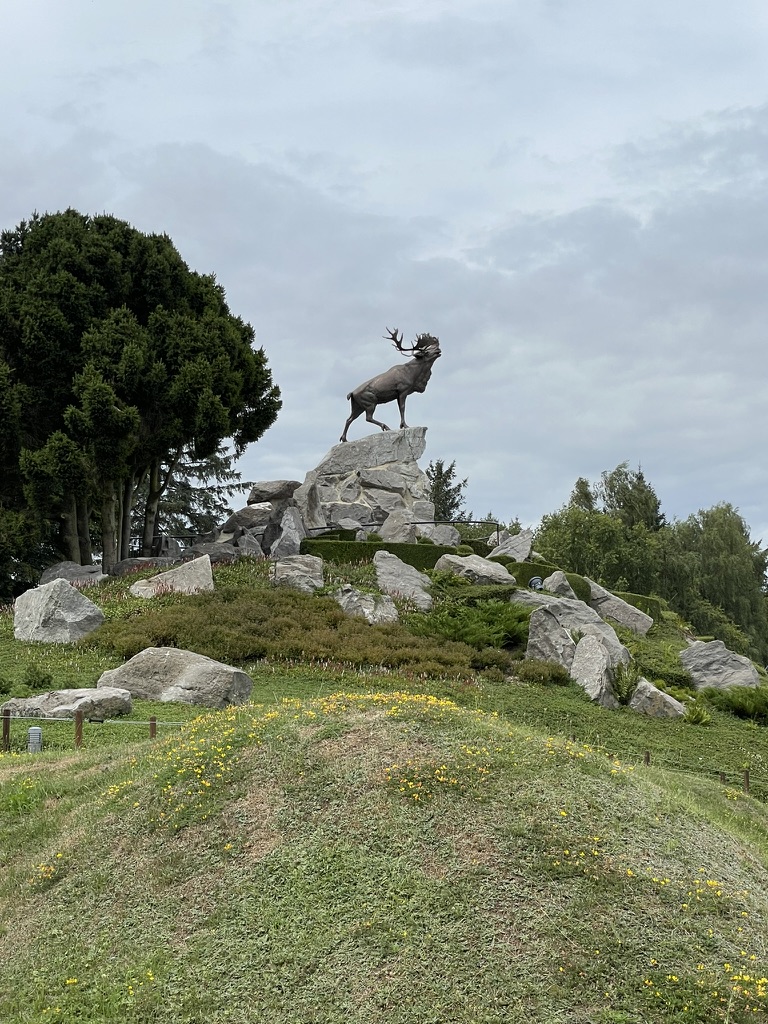
(Image of the Newfoundland Memorial Park from my own collection.)
Faithful Unto Death
On 10 January 1917, Clement was emerging from his dugout in a fortified sunken lane near Beaumont-Hamel when a German shell made a direct hit. He was killed instantly, along with Private Frederick Arthur Scott, aged 24, from Walthamstow.
Clement was just 21 years old.
His commanding officer later wrote:
“It was an awful blow to all of us, for he was such a fine soldier, fearless and splendid – there was no better officer in the Battalion and I loved the boy, he was so calm, thorough, and reliable. I would not leave until I had got the dear boy away and buried in a cemetery close by. Bowes (a pioneer) and two men dug his grave under heavy fire and completed it after having to leave off three times for the bombardment. […] I have arranged for a Padre to read the service over him to-morrow, and his resting-place has a cross, but only a rough one. I will have a better one made and erected in a day or so. I loved the boy, he was so calm and thorough and reliable.“
Clement was buried in Beaumont-Hamel British Cemetery, Grave B.34, beside Private Scott. His headstone bears the inscription:
“Thou faithful unto death, I will give thee the crown of life.” — Revelation 2:10
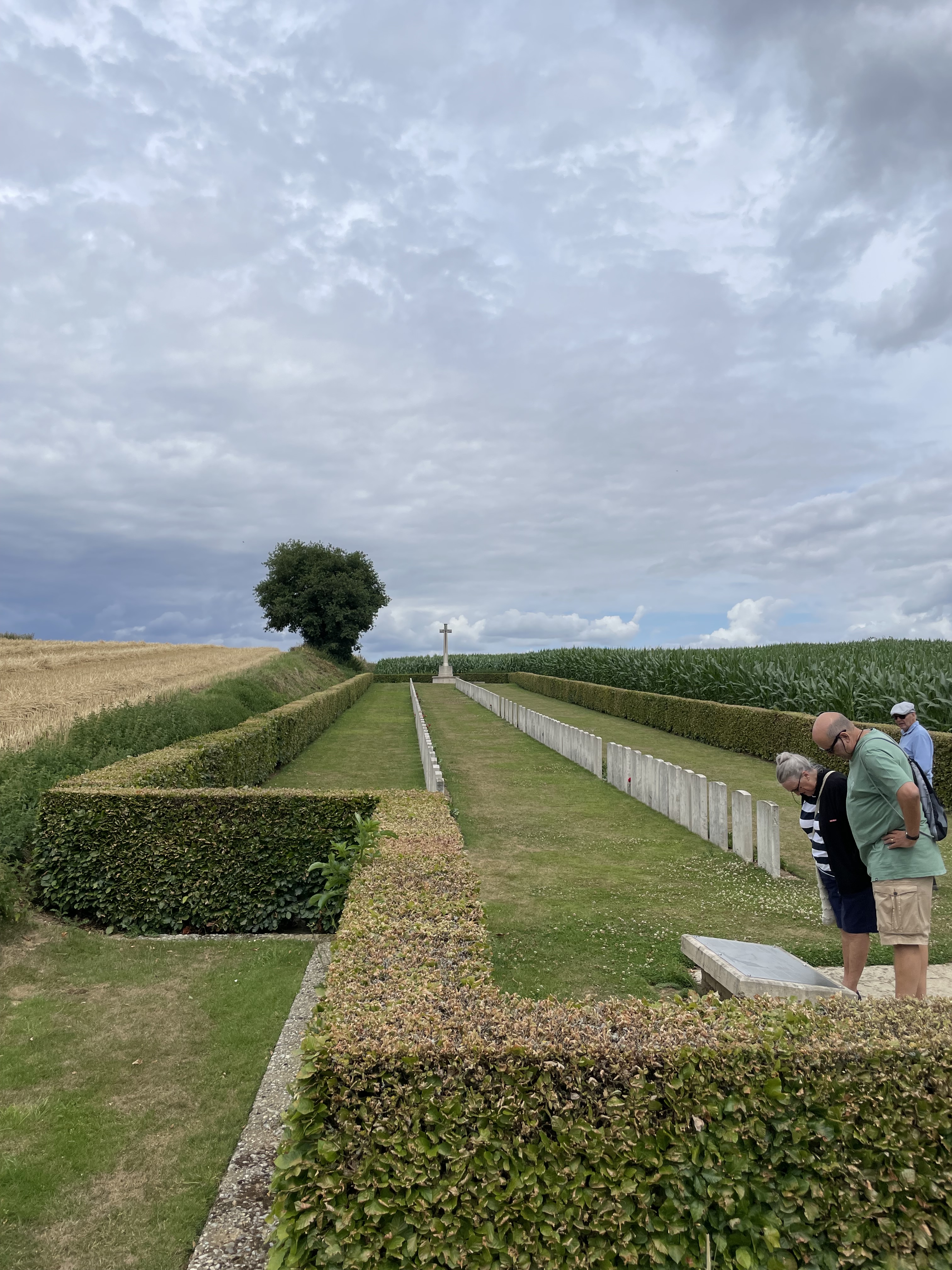
(Image taken at Beaumont-Hamel Cemetery, France from my own collection)
Remembered Still
Clement John Byron never made it to Oxford, never fulfilled the promise that so many saw in him. Yet his letters and writings, later collected by his mother in a small memorial book, reveal a young man of intelligence, humour, and heart.
Standing by his grave at Beaumont-Hamel, I felt the weight of the promise I made to tell their stories, to make sure they are not forgotten.
Today, 108 years after his death, Second Lieutenant Clement John Byron is remembered not just as a name on a headstone, but as a son, a brother, a friend, and a young man who gave everything in the service of others.
Lest we forget: In memory of Second Lieutenant Clement John Byron of Honourable Artillery Company.
I spend a lot of time researching and sharing these family connections, so if this post helped you uncover part of your family story, you can support my ongoing research here:


(Image reproduced by permission of the President and Fellows of Magdalen College, Oxford.)
Why not visit my new website:
All My Blogs For Family Tree Magazine in one handy place
Copyright © 2025 Paul Chiddicks | All rights reserved

 The Chiddicks Family Tree
Lovely homage
LikeLiked by 1 person
Thanks Sheree
LikeLiked by 1 person
Pleasure! You put so much work into your research.
LikeLiked by 1 person
Thank you for sharing what you’ve learned about Clement’s life and his death. A sad loss for the country, for his family, and for his future. Not forgotten!
LikeLiked by 1 person
Thank you Marian his story and sacrifice will forever be remembered now
LikeLike
A solemn and moving story of the life of one man and your daring rescue of his breif life. Honored.
LikeLiked by 1 person
Thanks Kelly
LikeLiked by 1 person
I finished a trilogy today by Lars Mytting a Norwegian novelist. This quote seemed to coincide with your resurrection. “The Promise. They are patient, the dead. There is a hush there, among the gravestones, but never silence. The dead are the best of listeners, and it is possible to imagine that they are happy whenever some-body comes, and that, through the consecrated ground, they notice the footsteps from the world of light above. On the whole they must know that these footsteps will fade into the distance. A cemetery is so big, most visitors will head for another grave, and those who visit the dead die too, so that fewer and fewer stop to say a few words.” You, Paul remembered. It matters.
LikeLike
Thank you so much for sending that Kelly it’s very poignant for this post
LikeLike
Well done. I enjoyed this very much.
LikeLiked by 1 person
Many thanks I’m glad you enjoyed it 😊
LikeLike
A wonderful tribute…and proof yet again that all the wealth and privilege in the world doesn’t matter in the face of war, at least for those not sitting behind a desk and directing from afar. Clement’s service is a testament to his character – thank you for bringing his story to our attention.
LikeLiked by 1 person
Thank you for reading his story Teresa it’s by sharing and remembering their stories that keeps their memories alive.
LikeLike