

In the summer of 2025, I travelled to the battlefields of the Western Front to pay tribute to three members of my extended family who gave their lives in the First World War. The experience was both moving and deeply humbling, walking among the countless white headstones, each one marking a life ended too soon and a loved one left behind.
As I made my way from one cemetery to the next, I set myself a quiet pledge. At every place of rest, I would choose one soldier, someone unknown to me, unconnected to my family, and I would research and share their story. This story is the second fulfilment of that promise, my small effort to help keep their memory alive.

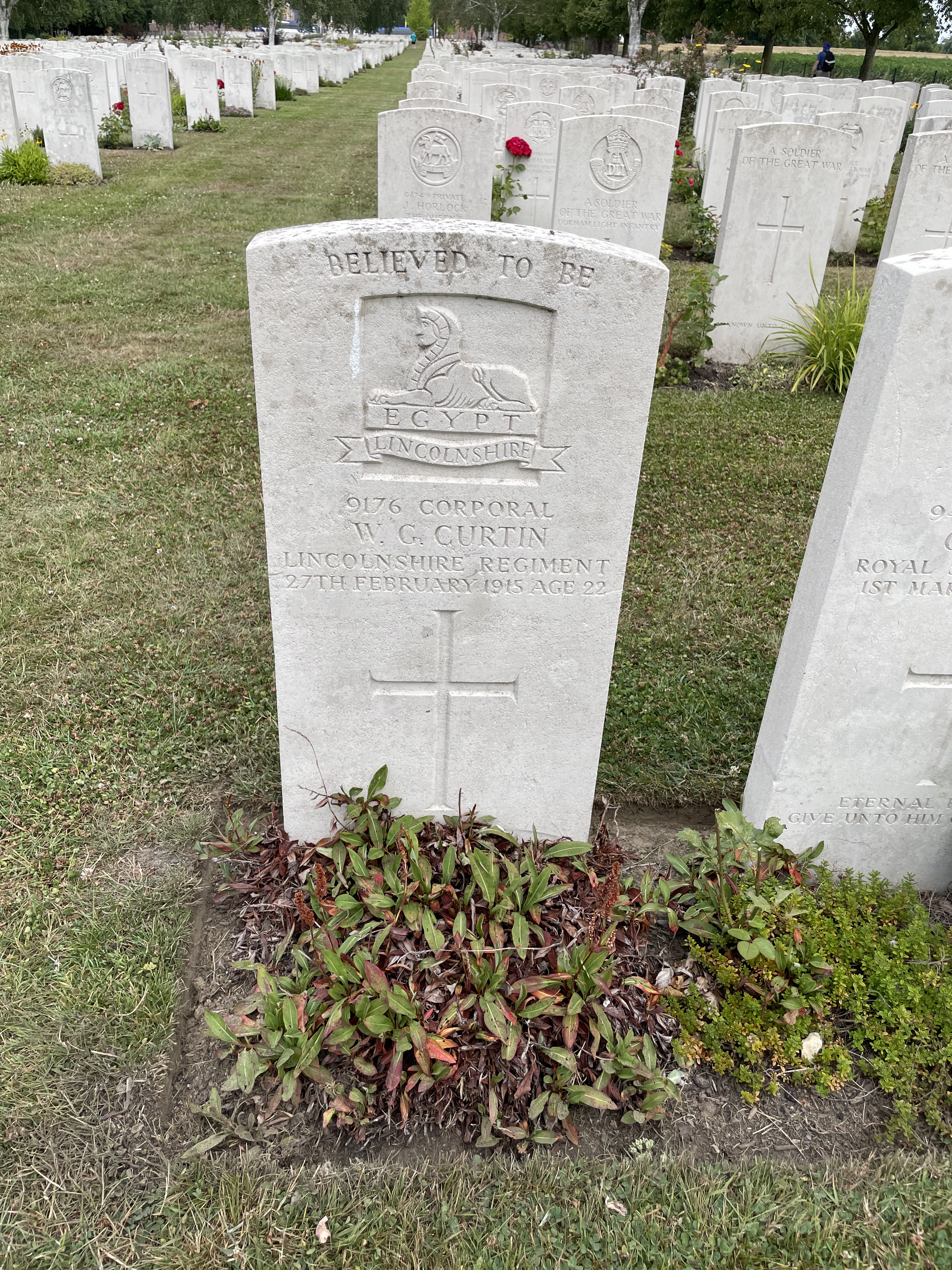
(Image from my collection, taken during my WW1 battlefield visit in July 2025)
William George Curtin was born in 1891 in Lambeth in Surrey, to parents John Joseph Curtin and Hannah Elizabeth Curtin, nee Dennis. William was the fourth eldest of six children. Two of his brothers were also to serve during the Great War; older brother Thomas Edward Curtin served with the Leicestershire Regiment, and younger brother Charles Martin Curtin served with the Royal Engineers. Like thousands of families up and down the Country, the Curtin family answered their country’s call to arms when it was needed most.
Fortunately, William’s service papers survived the Luftwaffe bombing raids of the Second World War, and they now provide us with a valuable insight into the course of his military career. These records allow us to trace the key stages of his army service and provide a valuable insight into William’s journey on the Western Front.
William George Curtin, aged 19 years 8 months, a Footman, attested in London on 26th June 1911. At the time, the family home was 4, Cumberland St., Pimlico, London. He was allocated the Service number 9176 and he enlisted in the 2nd Battalion, Lincolnshire Regiment. The 2nd Battalion was a regular battalion part of the pre-war standing army, and like many regular battalions, it was mobilised in August 1914 and sent to France with the British Expeditionary Force. For the men of the 2nd Lincolnshires, the first months of the war were a mixture of rapid manoeuvre, stabilising a front, and the slow, deadly business of digging in. By the winter and early spring of 1915, the battalion was in the Ypres Salient, the Flemish town that would, for the next four years, be one of the most dangerous areas of the Western Front. Before the outbreak of the War, William’s service papers mention his service in Bermuda as well as a stay in a military hospital in Gibraltar from 28.2.13 to 3.3.13 due to colic from poor diet, a brief glimpse into what was to come for William and thousands of other soldiers on the Western Front.
During the fighting around Ypres in early 1915, men rotated through front-line posts, carried rations, repaired parapets, listened for the tell-tale crack of snipers, and moved in and out of their positions under the thin covering smoke of the artillery. Patrols probed the enemy lines at night; small raids were mounted to get prisoners or to destroy wiring and observation posts. Artillery bombardment was constant and unpredictable: Sometimes a short, sharp concentration of fire; at other times, it would be hour after hour, a relentless barrage.

(Image reprooduced from the Imperial War Museum Collection Source / Licensing: IWM (Q 5100)
It is within this unforgiving context that William’s final days must be understood. Official records give his date of death as 27 February 1915. He now lies at Hooge Crater Cemetery, though he was originally buried at La Chapelle Cemetery in Zillebeke and re-interred after the war when many smaller cemeteries were ‘concentrated’ into much larger cemeteries. Hooge, on the eastern edge of the Ypres Salient, had already become notorious by 1915 for its churned, cratered landscape and the relentless seesaw of trench warfare fought across it.
The winter of 1915 was a time of sustained trench warfare. From the battalion’s perspective, the 2nd Lincolnshires were routinely holding, relieving, and being relieved in the forward trenches East of Ypres; casualties were common and came from snipers, trench-mortar and shell fragments, and the occasional raid or counter-attack. When records say a soldier “died of wounds”, that often reflects a soldier who was wounded in the line, perhaps by shrapnel, a bullet, or a blast, who was treated first by a Regimental Aid Post or Field Ambulance, and then either succumbed before evacuation or died in a nearby casualty clearing station. Ironically, just before William was tragically killed, he was appointed an ‘acting corporal’ on 4 February 1915, and just twenty-three days later, he died from his wounds.

(The National Archives; London, England, UK; War Office: Soldiers’ Documents, First World War WO363)
I have summarised the War Diaries of the 2nd Battalion Lincolnshire Regiment for February 1915 to provide a clearer understanding of William George Curtin’s movements leading up to his death.
This summary outlines the Battalion’s activities and movements during February 1915, based on the war diary entry WO 95/1730/1. Private William George Curtin (9176) died on 27 February 1915 while the Battalion was holding the forward trenches at Rue Tilleloy, during a period of increased enemy activity.
Key Diary Transcription (1–28 February 1915)
• 1 Feb – 6 p.m., Tilleloy: Relieved 1st R.I.R. in trenches.
• 9 & 20 Feb – In trenches.
• 21 Feb – 6 p.m., F. D’Esquin: Relieved by 8th R.I.R. and went into billets. B & D Coys at HQ; A Coy at Picantin; C Coy at Rue du Bois. (3 killed, 3 wounded – faint notation)
• 22–23 Feb – In billets.
• 24 Feb – 6 p.m., Tilleloy: Relieved 1st R.I.R. in trenches.
• 25–26 Feb – In trenches. Germans shelled the line with increased activity.
• 27 Feb – In trenches; later relieved by 1st R.I.R. (notation suggests 1 killed). Pte. Curtin died this day.
• 28 Feb – In billets (Divisional Reserve at Laventie).
My conclusion is that, in what would have been William’s final moments on 25 and 26 February, the entire Division was conducting offensive operations, with the Lincolns occupying the front-line position in their sector. The battalion remained continuously exposed in the trenches during and after this attack. Private William George Curtin (9176) died on 27 February 1915, a day when the battalion was still entrenched under the same operational strain. There is no mention of a specific assault that day, so it is most consistent with a death caused by the constant low-level dangers of trench warfare, likely shellfire or sniper activity. The battalion was finally relieved the following evening, 28 February, retiring to billets in Laventie.
The geography of Hooge explains why so many wounded eventually finished in that cemetery. Hooge was on a spit of higher ground and was heavily contested because it formed a salient and a natural observation point over the surrounding fields. In July 1915, the area would become the site of an enormous mine explosion laid by the British, but already in February, the ground around Hooge was routinely shelled and the trenches there were under frequent bombardment from rifle and machine-gun fire.

(The Infamous Hooge Crater – Image from my collection, taken during my WW1 battlefield visit in July 2025)
The effect of those small, repeated incidents, the sniper’s bullet, the mortar that takes a small group, the wire-clearing patrol that meets a machine gun, is easy to lose when we look only for named battles. Yet for men like William, the danger was always immediate. A soldier could be at the front for days and weeks of routine and then be hit by a single, unlucky explosion. His service number, battalion and cemetery location place his last service in the Ypres sector, and the date places him in a period of attritional fighting rather than in a single headline battle. That is a sober but powerful fact: many thousands of soldiers’ lives were lost in this way, not in the big charges across open ground, but in the constant, grinding attrition of the trenches.
William’s family at home in Lambeth would have been notified by letter and, soon after, by the local newspapers and the official rolls. For families, the distance between the front and home was partly measured in paperwork: the casualty forms that reached the War Office, the notifications of death and the eventual arrival of his medals or a former comrade’s account, if one existed.

(Morning Post dated 22 March 1915 Courtesy of FMP)
The presence of two other Curtin brothers in uniform, Thomas Edward with the Leicestershire Regiment and Charles Martin with the Royal Engineers, would have amplified both pride and dread in the Curtin household. Like many families with multiple sons at the front, they would have watched each posting and waited for every letter with bated breath.
Among William’s service papers is a carefully itemised list of the personal effects that were sent home to his grieving family: one watch, a purse, two pocket books, a shoulder badge, a single letter, a cigarette case, a tobacco pouch, two knives, and two pipes, both of them broken. It’s a small and rather humble collection, hardly enough to represent the fullness of a soldier’s life or the person he once was.
Tucked alongside these records is a particularly poignant letter from William’s mother, A. Curtin, gently enquiring about a missing chain she believed should have been among his belongings. Her words carry the weight of a mother’s hope and sorrow, clinging to the possibility of recovering one last tangible connection to her son. I find myself wondering whether that chain was ever found, and whether it made its way back to her hands, offering even a moment’s comfort in the midst of her loss.

(The National Archives; London, England, UK; War Office: Soldiers’ Documents, First World War WO363)
In remembering William, we are also acknowledging a common truth of the early war months: before the big offensives that later absorb our attention, there was a long period in which men endured cold, mud, and constant risk. The thousands of small tragedies each young life curtailed add up to the great national story we remember today. William George Curtin was just twenty when he died; he had been born into a working-class London family, shared childhood and adolescence with five siblings, and, like so many of his generation, found himself in a foreign field fighting for his country.
If you take one thing away from reading his story, it is this: the war was not only the big offensives or the famous names; it was also the many small moments of bravery and endurance, the quietness of men kept awake through the nights by shells, and the too common letter home that began a family’s long grief. The Curtins’ sacrifice and the loss of William stand as an everyday monument to that reality.
(Image from my collection, taken during my WW1 battlefield visit in July 2025)
A soldier dies twice: once in battle, and once when he is forgotten.
Why not visit my new website:
All My Blogs For Family Tree Magazine in one handy place
Copyright © 2025 Paul Chiddicks | All rights reserved

 The Chiddicks Family Tree
Absorbing and informative read which must have taken hours of research.
LikeLiked by 1 person
Thanks Sheree 😊
LikeLiked by 1 person
Knowing that William was the oldest son, I imagine the loss to his family would have been especially devastating. Such a touching story with a sad ending.
LikeLiked by 1 person
Thank you Marian but a sad story that was reflected across thousands of households throughout the country
LikeLike
Paul, this is such a generous gesture. We give thanks to their sacrifice each day we treasure and protect freedom. Thank you.
LikeLiked by 1 person
Thank you Barbara it’s the sharing and telling of their stories that helps to keep their memories alive
LikeLiked by 1 person
Your research in telling this story is excellent. But even better than your research is the telling of this soldier’s story. You did William Curtin proud. The only trouble is that we have way too many William Curtins.
LikeLiked by 1 person
Thank you so much for taking the time to read his story and comment. It’s the telling of the stories that helps to keep their memories alive
LikeLike
This is an excellent idea for a series. Thanks for putting it all together for William Curtin
LikeLiked by 1 person
Thanks for reading his story Eilene 😊
LikeLiked by 1 person