
Family history often begins with names and dates, but it rarely ends there. In this post, we explore what genealogy can teach us about the space between those dates, inspired by the poem “The Dash.”
When we explore family history, whether walking through a graveyard, browsing parish registers, or scrolling through old records, we see the same pattern repeated again and again:
Name: Year of birth – Year of death
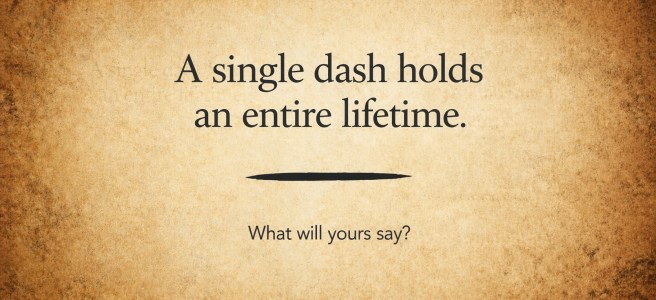
And in between those two dates? A simple dash. That tiny mark, so small it almost disappears, represents a person’s entire lifetime. As a family historian, I’ve come to realise that this is where the real story lives.
The poem “The Dash” by Linda Ellis captures this beautifully. It reminds us that what truly matters is not the year someone was born or the year they died, but how they lived in the space between. In many ways, genealogy isn’t just about building a family tree or going back as far as possible, it’s about uncovering the stories and discovering what lies within the dash.
More Than Names and Dates
Like many people researching their family tree, I began with the basics: names, dates, and records. Birth certificates, marriage records, census returns and burial entries. These form the foundation of family history research and the building blocks of any family tree. But before long, I realised something important: a family tree filled only with names and dates feels incomplete. It tells us when someone lived… but not how.
What was their everyday life really like?
What mattered most to them?
What hardships shaped them?
Who did they love and who loved them?
These are the questions that bring a family tree to life. Because the truth is, everything that matters exists within that small dash.
Looking Beyond the Records
When researching our ancestors, it’s easy to focus only on what’s written down. But behind every record is a real life.
The labourer working long hours in the fields.
The family living through war or economic hardship.
The ancestor who left everything behind to start again in a new country.
The mother holding a household together.
The father carrying responsibility without recognition.
A record might show 1823–1891. But between those dates were thousands of days filled with decisions, relationships, struggles, and small moments that mattered. That single dash holds a lifetime of courage, resilience, love, humour, and hope.
A Shift in Perspective
Reading “The Dash” changes how we think about family history.
Instead of simply asking:
When were they born?
Where were they buried?
We begin asking:
What shaped their life?
What kind of person were they?
What did they leave behind, beyond records?
This is where family history becomes something deeper. It stops being just about building a tree and becomes about understanding the people who shaped us.
The Inheritance You Can’t See
Not everything we inherit is documented. Family history isn’t only about surnames and bloodlines, it’s also about what’s quietly passed down through generations.
A sense of humour.
Resilience in difficult times.
A strong work ethic.
A love of storytelling.
Traditions, habits, and ways of seeing the world.
These things don’t appear in parish records or census returns. But they live on in us. When we research our family tree, we’re not just tracing lineage. We’re uncovering patterns of character, choices, and values that still echo today.
Living Our Own Dash
This is where family history becomes personal. Our ancestors had their dash. We are living ours. And one day, someone may look us up in a record, see two dates, and wonder who we were. What will our dash say about us?
Family history often gives us a sense of connection and gratitude, but it also carries a quiet responsibility. We are now part of that story. The poem reminds us that the dash is not measured in wealth or status, but in how we lived, how we treated others, and what we stood for.
Preserving Stories for the Future
One of the most meaningful things we can do as family historians is to go beyond the records.
To write things down.
To record memories.
To share stories.
To preserve photographs and voices.
Because when we do that, we give depth to the dash. We ensure that future generations won’t just see names and dates, they’ll understand the lives behind them. And in doing so, we’re not only preserving the past, we’re shaping how our own stories will be remembered.
Final Thoughts
The dash may be small, but it carries the full weight of a life. As we continue researching our family history, it’s worth remembering that the real story isn’t found in dates, alone, but in the lives lived between them. And as we live our own years, we might ask ourselves:
What story will my dash tell?
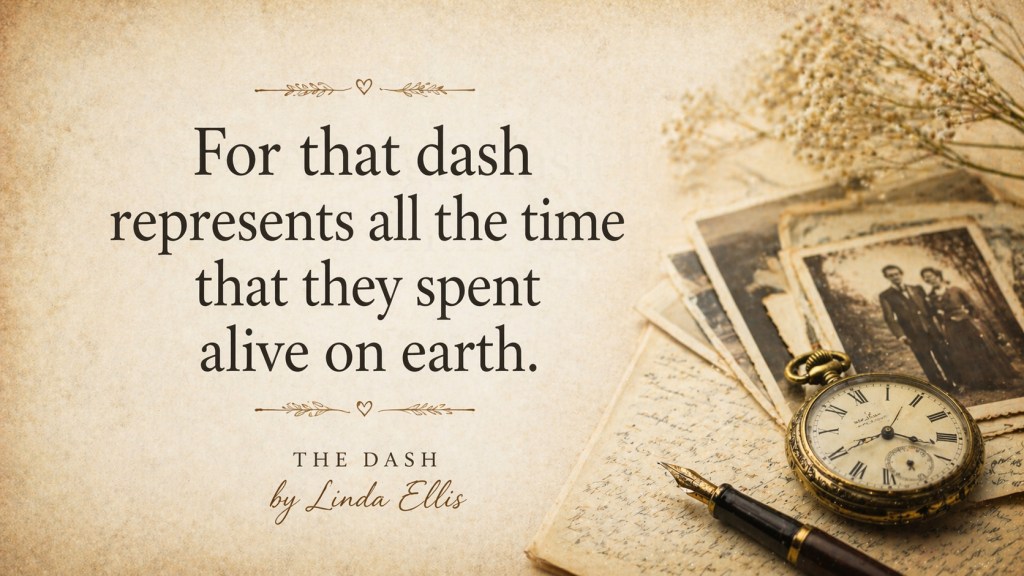
“For that dash represents all the time
that they spent alive on earth.”
This simple idea sits at the heart of “The Dash” by Linda Ellis, which beautifully captures the meaning of the life lived between two dates.
The Dash By Linda Ellis
I read of a man who stood to speak
at the funeral of a friend.
He referred to the dates on the tombstone
from the beginning to the end.
He noted first came the date of the birth
and spoke the following date with tears.
But he said what mattered most of all
was the dash between the years.
For that dash represents all the time
that they spent life on Earth.
And now only those who loved them
know what that little line is worth.
For it matters not how much we own,
the cars, the house, the cash.
What matters is how we live and love,
and how we spend our dash.
So, think about this long and hard.
Are there things you’d like to change?
For you never know how much time is left
that can still be rearranged.
If we could just slow down enough
to consider what’s true and real,
and always try to understand
the way other people feel.
And be less quick to anger,
and show appreciation more,
and love the people in our lives
like we’ve never loved before.
If we treat each other with respect
and more often wear a smile,
remembering that this special dash
might only last a little while.
So, when your eulogy is being read
with your life’s actions to rehash,
would you be proud of the things they say
about how you spent your dash?
If you’re researching your own family tree, take a moment to look beyond the dates. What stories can you uncover about the dash?
“The Dash Poem by Linda Ellis, © Southwestern Family of Companies, Used by Permission.”
Feel free to share your thoughts or discoveries. I’d love to hear about your journey……..
This piece was also shared on my Substack https://chiddickstree.substack.com where I write about family history and genealogy.
I spend a lot of time researching and sharing these family connections, so if this post helped you uncover part of your family story, you can support my ongoing research here:
Why not visit my new website:
All My Blogs For Family Tree Magazine in one handy place
Copyright © 2026 Paul Chiddicks | All rights reserved

 The Chiddicks Family Tree
Most interesting
LikeLiked by 1 person
Eloquently said, Paul.
LikeLiked by 1 person
Thank you Eilene
LikeLiked by 1 person
Finding more than just the dates has been my focus for a while now…great reminder to pass record my own memories etc as well!
LikeLiked by 1 person
Thanks Teresa I’m glad you found it useful
LikeLike
You are so right. The “dash” hides so many stories of lives lived while the world seemed to be falling apart. It’s the dash that keeps me interested in genealogy and the dash that gives me hope that we can get through the current turmoil (especially here in the US).
As a result, I often find myself down rabbit holes researching relatives that aren’t necessarily my direct ancestors.
There was a spinster who was a teacher at a college in the 1800s, who was never graced with the title of professor, almost certainly because of her gender.
Then there was my several times great aunt Sarah Jane, from my grandmother’s family who married my several times great uncle Cornelius, from my grandfather’s family. Cornelius was killed in a Civil War battle shortly before or after the birth of the couple’s first child. Sarah Jane’s three brothers also fought in that war, two for the Union and one for the Confederacy. Though all three returned safely, one died of an accidental gunshot to the head before he reached the age of 21. About eight years later, Sarah Jane remarried. She and her second husband had seven children. In the census a held a year before her death Sarah is noted as having had a total of eight children, four of whom were still alive. graveyard records show three of the children died before their second birthdays. Sarah died at just 59 having survived more tragedy than one person should have to bear.
I also explored “women’s work” after noticing two distant female relatives who were listed as “without occupation” on the 1880 census. They lived in a farm in West Virginia, for heaven’s sake; they were hardly sitting on the couch eating bon bons! I was lucky to find an article detailing the lives of women in the state at that time, and it turns out (surprise, surprise) the work their work was as difficult and plentiful as that of the men. But only the men and the boys were considered to have an occupation as far as the census was concerned.
Sometimes it seems harder to focus more close to home, but I did eventually piece together a little of my father’s history when I finally sat down and went through his WWII military papers. My stepsister gave me the documents when her mother went into a nursing home, and from them and other online sources I was able to sew together a little of Dad’s experiences as a young man. He joined the navy at 17 to avoid being drafted into the army when he turned 18, and though he was fortunate to not have participated in any battles (as far as I could tell), he was present for at least one major historic event – Japan’s official surrender in Tokyo harbor. He never spoke about his service, but I know he had some experiences that must have been quite a shock for a boy from the hollers of West Virginia.
When I discover stories like these hidden beneath that dash, I become more grateful for my own life, which will prove much less interesting if some future genealogist researches me. After all, that old expression “May you live in interesting times” is said to be a curse, rather than a blessing, and I quite agree!
LikeLiked by 1 person
What a powerful reflection on exactly the kind of “hidden life” the dash so often contains.
You’ve highlighted something that comes up again and again in family history research: once we start looking closely, the neat lines of “birth–death” quickly dissolve into something far more complex, and often far more human. The stories you’ve uncovered, loss, resilience, overlooked work, and quiet endurance are exactly the kind of narratives that never make it into the brief records, but absolutely define a life.
Your example of women recorded as having “no occupation” is a perfect reminder of how limited our sources can be. The record is often not a reflection of reality, but of what the recorder thought was worth noting. In rural and industrial communities alike, women’s labour was frequently essential but invisible in official documentation. What looks like absence in the archive is often anything but in real life.
The same is true of your ancestor Sarah Jane’s story. It’s sobering to read, but it also shows why genealogy can feel so emotionally layered. We’re not just tracing lineage, we’re encountering the uneven weight of what previous generations carried, often with very little support or recognition. It does change how we think about our own place in that continuum.
I also think your point about branching into “collateral” relatives is important. Those side branches often end up carrying some of the richest context for understanding a family’s lived experience. They show us patterns, shared circumstances, and the wider social world our direct ancestors moved through. In many ways, they are part of the same dash, just viewed from a wider angle.
And your father’s story adds another layer again: how even relatively “quiet” military service can still sit inside major historical moments, shaping someone in ways they rarely articulate.
That, to me, is the enduring tension of genealogy: every dash feels complete once we’ve pieced together enough fragments, but it also reminds us how much of any life—past or present—remains just out of reach.
LikeLike
I think we have very similar viewpoints on genealogy. It’s the history of ordinary people, so often forgotten, that reach out to me. And I find it surprising how much we can piece together just from official records if we only stop to consider what they signify. Thank you for your kind and considered reply to my comment.
LikeLiked by 1 person