
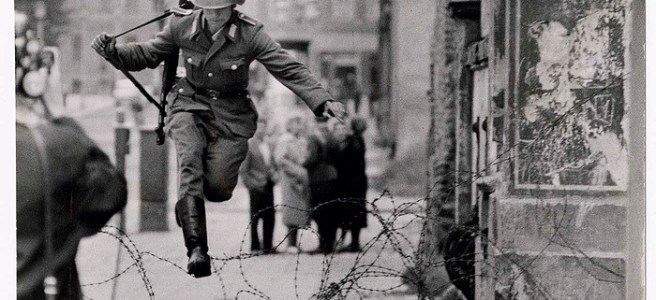
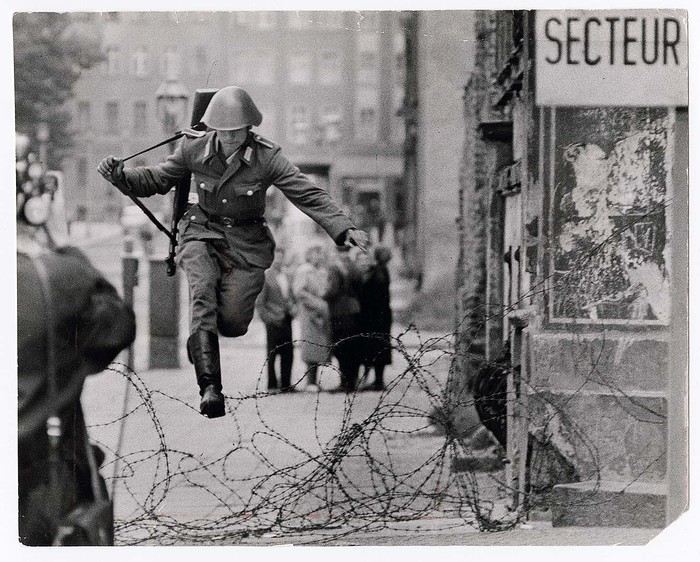
(Photo: Peter Leibing / Library of Congress / International Center of Photography.)
Some photographs capture a moment in time. Others become part of history itself.
On 15 August 1961, a 19-year-old East German police officer made a split-second decision that would change the course of his life. As the Berlin Wall was beginning to take shape, Konrad Schumann leapt over a coil of barbed wire into West Berlin. A young photographer, Peter Leibing, captured the moment, and the resulting image would travel around the world.
It became one of the defining photographs of the Cold War. But behind that remarkable image was a young man who had left everything he knew behind, and whose life would never quite be the same again.
This is the story of Konrad Schumann, the circumstances surrounding his escape, and what happened to him after that famous leap.
A Divided City, A Divided World
To understand Schumann’s escape, we need to go back a little.
Following the end of the Second World War in 1945, Germany was divided into four occupation zones, controlled by the United States, Britain, France and the Soviet Union. Berlin, although situated deep within the Soviet-controlled zone, was also divided between the four victorious powers.
As the years passed, the political differences between the Soviet-controlled East and the democratic West became increasingly difficult to ignore. In 1949, two separate German states were established: the Federal Republic of Germany in the West and the German Democratic Republic in the East.
For many people living in East Germany, life under the communist regime offered little freedom or opportunity. Thousands left for the West, and Berlin became the most accessible route. By 1961, the steady flow of people leaving East Germany had become a serious problem for its government.
The response came in the early hours of 13 August 1961. Barriers began appearing across Berlin, streets were blocked, transport links were disrupted and barbed wire was laid along the border. What began as a hastily constructed barrier would eventually become the Berlin Wall.
For the people of Berlin, the consequences were immediate. Families and friends found themselves separated, sometimes with little or no warning. A city that had been divided politically was now being physically cut in two.
A Young Guard on the Front Line
Konrad Schumann was born on 28 March 1942 in Zschochau, Saxony. He had trained as a shepherd before being called up to serve with the East German Bereitschaftspolizei, a paramilitary police force.
In August 1961, he was sent to Berlin as part of the forces deployed to secure the newly closed border. His posting brought him to the junction of Bernauer Straße and Ruppiner Straße, where he was stationed alongside the growing barrier of barbed wire.
He was just 19 years old.
It is easy to look at the famous photograph today and see only the dramatic moment of his escape. But Schumann had been standing on that border for several days, watching events unfold at close quarters. He was also listening to the people on the West Berlin side, some of whom were shouting encouragement to the young guards.
In an account given to the West Berlin police on the day after his escape, Schumann explained that his doubts had begun while he was on duty. He had been told one thing about the people in the West, but what he was witnessing for himself did not match those stories.
He described being impressed by the calls for freedom coming from the other side. He had also noticed that the West Berlin police were trying to prevent confrontations rather than provoke them.
His decision to escape was not something he had planned for months. According to his own account, the thought first came to him while he was standing at the border. As the hours passed, the idea became stronger.
The Leap That Changed History
On the afternoon of 15 August 1961, Schumann saw his opportunity.
There were photographers and reporters on the West Berlin side who had been watching the young guards. Some had even asked him whether he intended to come across. Schumann indicated that he might make his escape later, but events took a different turn.
The photographers began directing their attention towards other guards, encouraging them to look away from Schumann. This gave him the space he needed.
At approximately 3.40 pm, he made his move.
He dropped his MP 41 submachine gun, ran towards the barbed wire and leapt over it into West Berlin. A police vehicle was waiting nearby, its rear door open. Schumann ran towards it and climbed inside, escaping before the East German guards could react.
Photographer Peter Leibing was in position to capture the moment. His photograph shows Schumann suspended in mid-air, his body stretched over the barbed wire, with his weapon falling away beneath him.
It is an extraordinary image. There is no elaborate backdrop, no carefully arranged scene and no opportunity for a second attempt. Just one young man, a barrier and a decision that could not be undone.
The photograph, widely known as Leap into Freedom, was published around the world. It quickly became one of the most recognisable images of the Cold War, representing the desire for freedom among people living in East Germany.
But while the photograph captured the moment perfectly, it could never tell the whole story.
Life After the Wall
Schumann’s escape did not mean that life suddenly became straightforward.
He initially spent time at the Marienfelde emergency reception centre in West Berlin before being transferred to West Germany later that year. He eventually settled in Bavaria, where he began building a new life.
He married in 1962 and had a son. His working life took him through several jobs, including employment in a winery before he later joined the Audi factory in Ingolstadt.
The photograph had made him famous, but Schumann himself was not particularly comfortable with the attention. He had become a symbol of freedom, recognised by people who knew very little about the man behind the image.
There was also the question of what he had left behind. His family, his home and the life he had known were all in East Germany. His escape had given him a new beginning, but it had also brought a separation that could never easily be put right.
The Berlin Wall itself continued to grow into a formidable barrier. The original coils of barbed wire were replaced by concrete sections, watchtowers, patrol roads and heavily guarded border installations. Escape became increasingly difficult and dangerous.
Over the 28 years that followed, many people risked their lives trying to cross into the West. Some succeeded through tunnels, concealed vehicles and ingenious escape plans. Others were caught, and many lost their lives. The Berlin Wall Foundation records at least 140 deaths connected with the Wall.
Schumann’s leap had been made possible by the briefest of opportunities. For those who came afterwards, the chances of making a similar escape were very different.
The Legacy of a Famous Photograph
The Berlin Wall finally fell on 9 November 1989, bringing an end to a division that had shaped the lives of millions of people. Germany was formally reunified the following year.
Schumann’s photograph remained one of the enduring images of that divided era. In 2011, the documentary heritage associated with the construction and fall of the Berlin Wall, including the famous photograph of Schumann’s escape, was recognised by UNESCO’s Memory of the World Register.
Yet the story of the man in the photograph was not a straightforward tale of a happy ending.
Schumann continued to live in Bavaria and worked at Audi in Ingolstadt. In later years, he spoke of the fear he had felt about returning to the East, even after the Wall had come down. The photograph had given him a place in history, but it had also ensured that one moment in his life would always define him in the public imagination.
On 20 June 1998, aged 56, Konrad Schumann died by suicide at his home in Kipfenberg, Bavaria. Contemporary reports said that the precise reason for his death was unclear. It would be wrong to pretend that we can know exactly what was going through his mind.
A Story Worth Remembering
It is tempting to look at Peter Leibing’s photograph and see a simple story of escape: a young man, a barbed-wire barrier and a leap towards freedom.
But history is rarely quite that simple.
Schumann was only 19. He had been sent to guard a border that was dividing a city and separating ordinary people from their families. He found himself questioning what he had been told, made a decision and took a chance that changed his life forever.
We know a great deal about the photograph. We know where it was taken, who captured it and the date on which it happened. We can trace much of Schumann’s life through the records that remain.
What we cannot fully know is what he felt in the years that followed, or how he came to terms with becoming an internationally recognised symbol of an event that had been intensely personal.
Perhaps that is the part of the story worth remembering most. Behind the famous image was a real person, with a family, a past and a future that he could never have imagined when he stood on that stretch of barbed wire in Berlin.
The photograph froze one moment in time. Konrad Schumann had to live with everything that came afterwards.
I spend a lot of time researching and sharing these family connections, so if this post helped you uncover part of your family story, you can support my ongoing research here:
All My Blogs For Family Tree Magazine in one handy place
You can also explore and discover some of my other genealogy and historical stories over on Substack:
https://chiddickstree.substack.com
Copyright © 2026 Paul Chiddicks | All rights reserved


One thought on “The Leap That Changed the Cold War: The Story of Konrad Schumann.”