
Every now and then, family history hands us a gift when we least expect it. Sometimes that gift is a faded photograph tucked inside an old book, or a dusty document hiding at the bottom of a drawer. But in this case, it arrived in a far more unexpected fashion, unearthed from the soil of an ordinary garden.
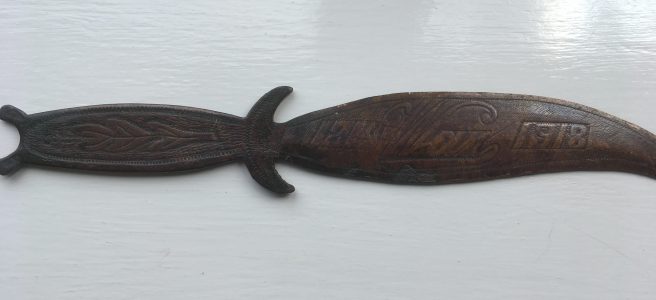
While digging outside one afternoon, my father-in-law struck something solid. Thinking he had found a random piece of scrap metal, he brushed away the dirt, only to reveal something far more intriguing. Lying quietly beneath the surface, waiting to be rediscovered, was a small yet remarkable object: a commemorative knife from the 3rd Battle of Ypres (Passchendaele).
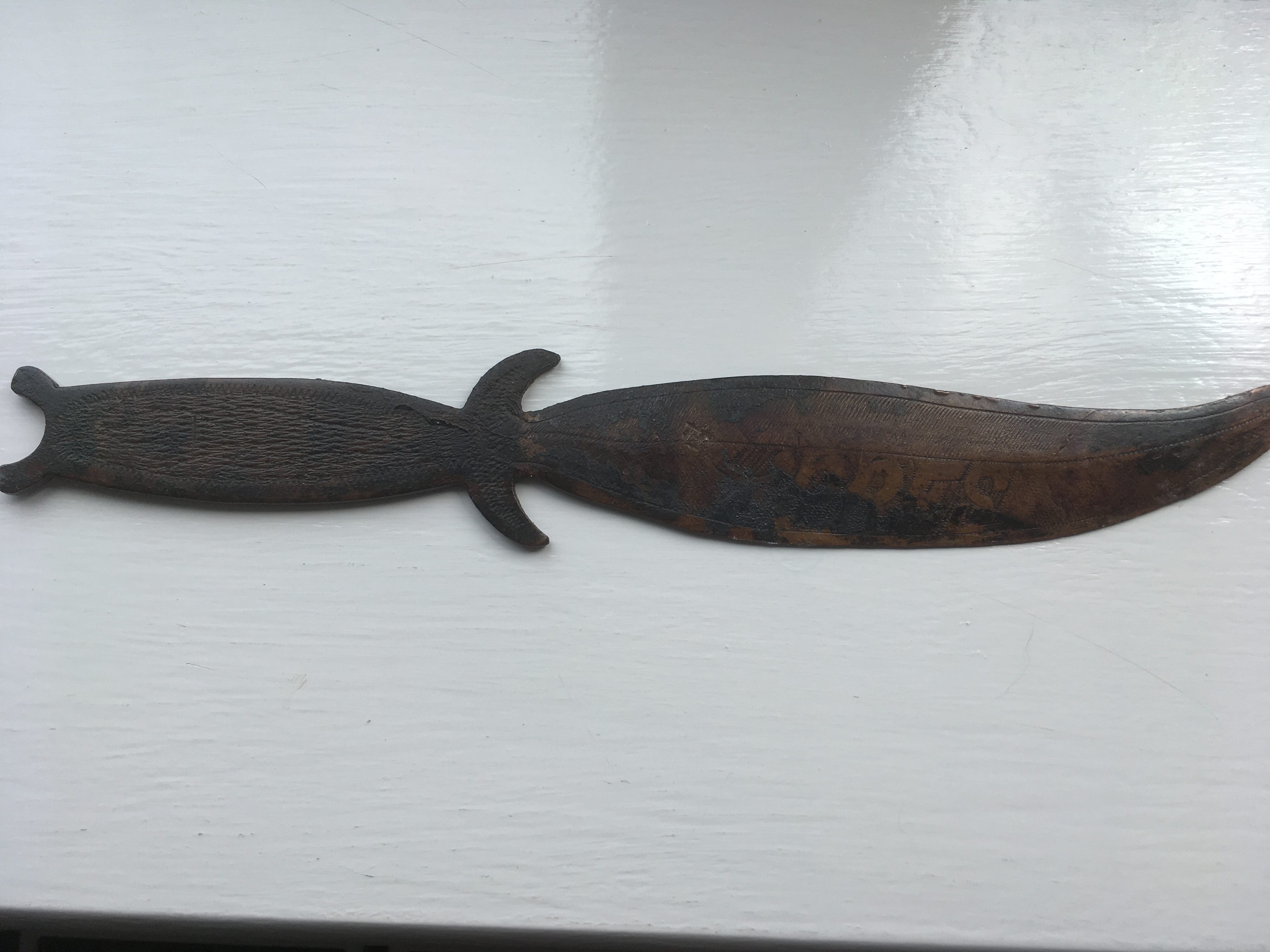
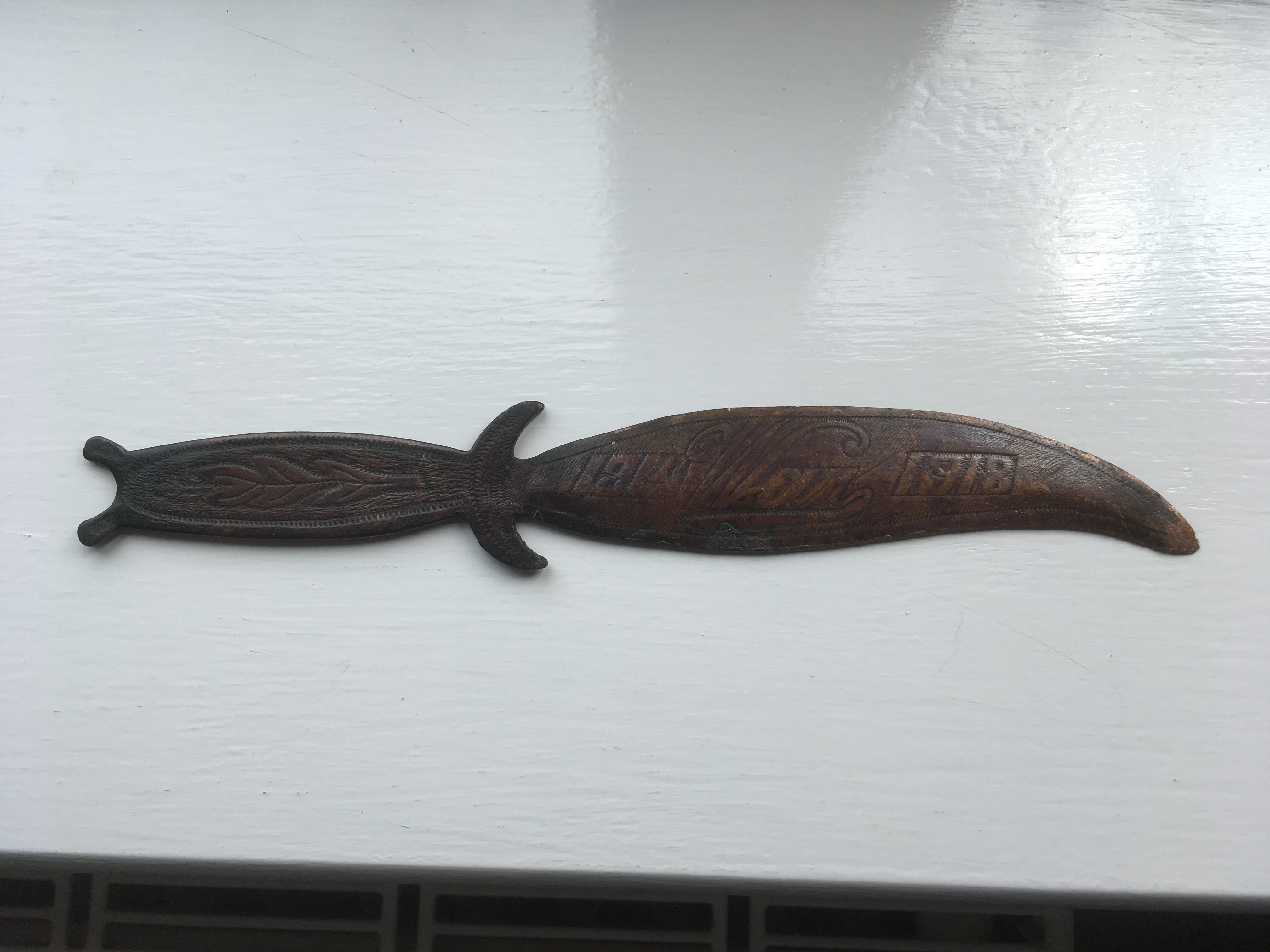
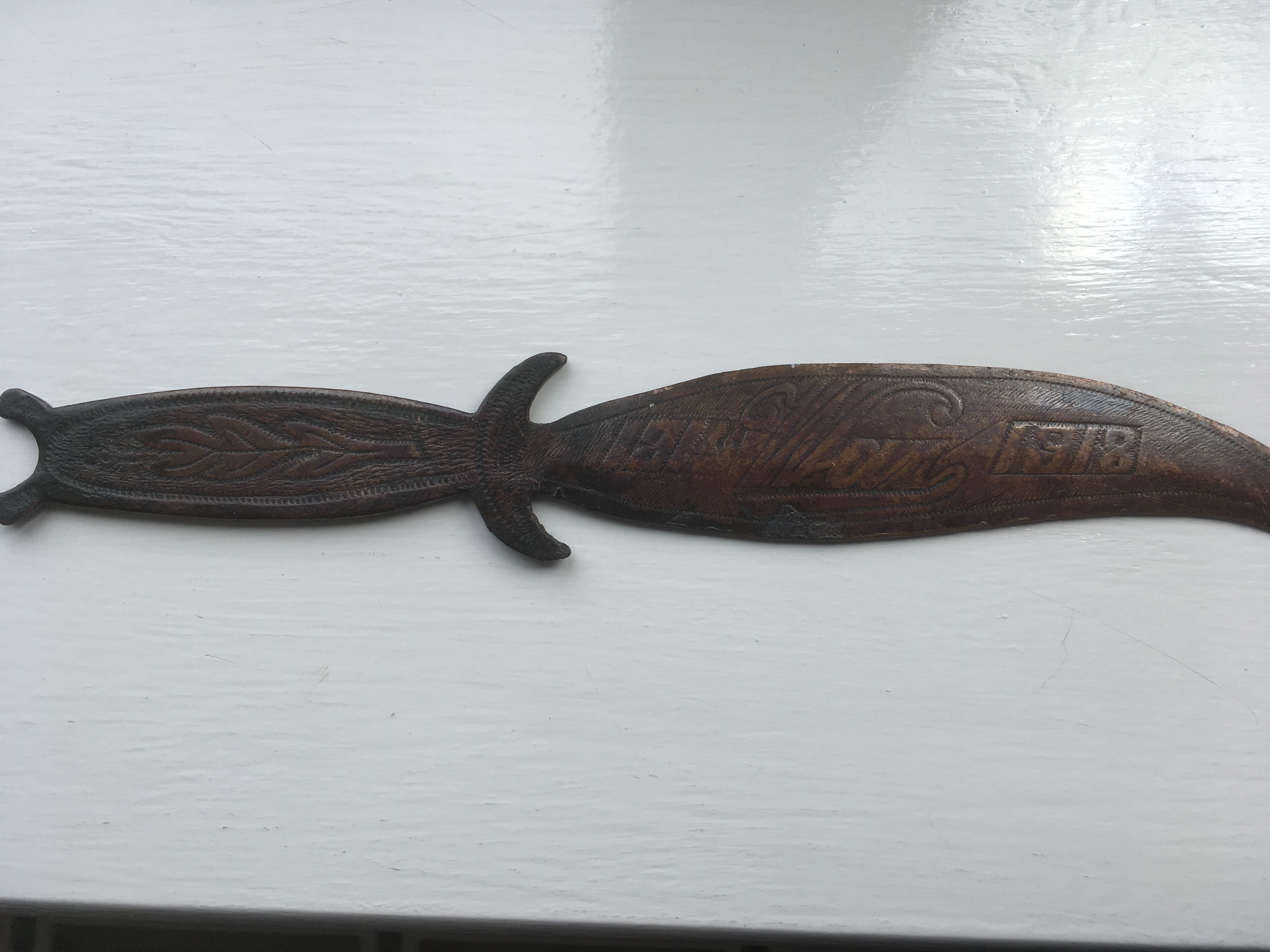
At first glance, it appears to be a letter opener, slender and simple in shape. But its composition tells a more poignant story. The metal bears the unmistakable look and feel of trench art, and I’m fairly certain it has been fashioned from part of a shell casing, possibly a fragment of the very artillery that thundered across the fields of Flanders over a century ago.
It’s sobering to think that this small artefact might have journeyed from the chaos of the Western Front to the quiet peace of an English garden. Who owned it? Was it brought home as a memento by a soldier? Was it gifted to someone as a remembrance? Or perhaps it was lost decades ago and silently waited for someone to bring its story back into the light.
Passchendaele: A Battle Remembered
The Third Battle of Ypres, more commonly known as Passchendaele, has become one of the most haunting symbols of the First World War. Fought in 1917, it is remembered for its relentless, thick, suffocating mud that swallowed equipment, horses, and sometimes even men. The battle lasted more than 100 days and cost hundreds of thousands of lives.
In the years after the war, soldiers and civilians alike turned to trench art and commemorative items as a way of processing the experience, honouring the fallen, and preserving memories. Shell casings, bullet heads, and other remnants of battle were carefully shaped into vases, rings, lighters, and, yes, even letter openers. These handcrafted keepsakes often travelled home in kit bags, treasured reminders of comrades and survival.
A Story Waiting to Be Told
The knife itself is wonderfully crafted, with subtle decorative lines and a worn inscription referencing ‘Ypres’. Its edges have softened with time, suggesting it was handled often, a personal item, not merely decorative. Each mark hints at a story that we can only partially glimpse.
Holding it in your hand, you cannot help but imagine the journey it has taken. Perhaps it sat proudly on someone’s desk, used to open letters from friends or family. Perhaps it was a gift to a loved one, or a quiet reminder of a soldier’s service. And somehow, over the decades, it found its way into the earth, patiently awaiting rediscovery.
Can You Help Identify It?
I would absolutely love to learn more about this intriguing find. Have you ever come across a similar Passchendaele commemorative knife? Do you recognise the design, the metalwork, or the markings? Was this a mass-produced souvenir, or more likely a one-off piece of trench art made by hand?
If you have any knowledge, photographs of comparable items, or suggestions about its origin, please do get in touch. As every family historian knows, even the smallest clue can open the door to an entirely new story.
Sometimes history doesn’t just sit in archives or museums; sometimes it rises right out of the ground, asking to be remembered. And this little knife is a perfect example of just how alive our past can be.
The beauty of sharing this story is that I already have an answer about the origins of the letter opener.
Thanks to FHSC Chair Margaret Roberts, who shared it on social media, Battlefield Tour Guide Paul Reed was able to provide the explanation:
It is a letter opener, commonly sold to battlefield tourists from 1919 into the late 1930s. These were often made from flattened copper driving bands taken from shrapnel shell casings.
It appears to have no direct connection to Passchendaele itself.



I spend a lot of time researching and sharing these family connections, so if this post helped you uncover part of your family story, you can support my ongoing research here:

Why not visit my new website:
All My Blogs For Family Tree Magazine in one handy place
Copyright © 2026 Paul Chiddicks | All rights reserved


How fascinating! I hope one of your readers can add to its provenance.
LikeLiked by 1 person
I hope i can find out some more information about its possible origins Sheree
LikeLike
How extraordinary that this little link to that terrible time should find its way to you, to whom it has real meaning. I am sure it was meant to do so.
On 27 October 2007, I was staying at Varlet Farm, just outside Poperinghe in Belgium, which has a very welcoming guesthouse and which was where the battle in which my great-uncle John Thomas Hopkins was killed began 90 years before. More than 300 Marines of the RMLI were killed that day and a number of relatives of these men arrived at Varlet Farm that day, plus the grandson of the Commanding Officer, who brought with him the faded colours of the battalion, plus the local Mayor and other dignitaries – remembrance is taken seriously there still, as anyone who has attended the Last Post at the Menin Gate will know. Plus there was a re-enactment troop – it was amazing and very moving that these men were so actively remembered ninety years later.
There was a small museum in one of the barns, including many items retrieved from the fields in the course of normal farming – they called it the Iron Harvest. Any munitions were taken away and disposed of on a daily basis during the ploughing season – there were often little piles of shells left on roadsides awaiting collection. And there were heaps of rusting metal around the farmyard – helmets, tools, barbed wire.
When the owner of the farm knew that her visitors were relatives of those killed, she quietly offered us a small memento from this iron harvest, suggesting perhaps a shell cap. But I did not want a part of something which could have killed my great-uncle and instead she gave me part of a rusty trenching tool.
And now I find myself researching – for a different project – a company in the Black Country where my great-uncle was born and which made, amongst many other things, trenching tools for use in the Great War. Perhaps they made mine. Another circle in my life, which I wrote about recently on my blog. Thank you for recommending my blog, by the way, I feel very honoured.
LikeLiked by 1 person
Thank you so much for sharing this. I found your account deeply moving not only because of the history itself, but because of the extraordinary way these connections seem to echo across generations and lives.
Your description of Varlet Farm and the remembrance gathering brought the whole scene vividly to life. The fact that relatives, local people, and even the battalion colours were brought together ninety years later says something profoundly human about memory and respect. I was especially struck by your description of the “Iron Harvest” and by your decision to choose the fragment of trenching tool rather than part of a shell. That felt quietly powerful.
And then to discover, years later, that you are researching a company connected to the making of such tools in the very area where your great-uncle was born really does feel like one of those remarkable circles history sometimes creates for us. Whether coincidence or something more mysterious, it is hard not to feel the weight and meaning of it.
Thank you as well for your kind words about my blog. It genuinely means a great deal to know that something I wrote resonated with someone carrying such a personal connection to these events. I’m very grateful you took the time to share your story with me.
LikeLike
Thank you for this lovely reply. I think I still have lots of photographs somewhere (on one of my back-up drives!) which I would happily share with you if you would be interested but perhaps not on this forum).
I was there for the 100th anniversary in 2017, too and even more people turned up this time, including a Royal Navy honour party of four men who had volunteered to be here for the centenary and who brought a Union flag. So many people had brought some item with them. One had letters home to Wales, another a silk handkerchief which had been sent home, one had brought the exact geo location for the start of the battle at 4am and yes, at 4am, he was at that exact spot, remembering. And, again, there was a totally impromptu commemoration in the farmyard. Some people read extracts from letters, one a poem, one played his bagpipes. And we spoke the traditional heartfelt words – “They shall grow not old, as we that are left grow old.” The naval men, who had arrived by bicycle clad in tshirts and casual civvies from a nearby Belgian Barracks where they had begged bunks, changed at the farm into their immaculate dress uniforms and took their part, presenting the flag to the museum. It was by far the most personal and meaningful Remembrance ceremony I have ever been to and I have been to many as part of my job. Later in the day, we saw so many of the same faces at the Menin Gate, for the Last Post ceremony, including the Navak Honour Guard and the piper who played during the ceremony at the Gate.
My great-uncle has no known grave but is commemorated on Panel 1 at Tyne Cot, (Panel 1 because he was a Marine and therefore part of the Royal Navy and the Navy is ‘the Senior Service’ and they are always listed first!) so we went there and left a poppy for him. And an expert on the Royal Naval Division had told me that the number of unknown Marines buried in the Poelcapelle CWGC Cemetery (barely a mile from Varlet Farm) was a close match to the number of missing marines from that day and it seems likely that my great-uncle is actually buried there. So my daughter, granddaughter and I went there, too to lay a poppy wreath and I found myself patting each headstone for an unknown Marine – I hope one of them was him.
Not forgotten.
LikeLiked by 1 person
This is extraordinarily moving to read. Thank you again for sharing such a personal and powerful remembrance.
The image of people gathering at 4am, standing at the exact point where the battle began a century earlier, carrying letters, keepsakes, family memories and music with them, is incredibly affecting. Your description captures something far beyond formal remembrance. The detail about the naval honour party arriving by bicycle and then changing into full dress uniform at the farm somehow makes it even more meaningful; it speaks of genuine commitment rather than ceremony for its own sake.
I would genuinely be honoured to see the photographs if you would ever like to share them privately. They sound like an important record not only of the commemorations themselves, but of the enduring connections people still feel to those men and that place.
What you wrote about Poelcapelle especially stayed with me. The thought of touching each headstone for the unknown Marines in the hope that one might be your great-uncle is profoundly moving. And yet, in another sense, perhaps they all stood for him and for all those young men whose names and resting places were lost in that devastation.
“Not forgotten” feels exactly right. Reading your words, it is impossible to believe they are forgotten. Through people like you, through your daughter and granddaughter standing there together, they are still remembered with love, dignity and presence more than a hundred years later.
Thank you again for trusting me with these memories.
LikeLike
What a fascinating find.
LikeLiked by 1 person
It’s incredible Jane, I would love to know who it belonged to.
LikeLike
What a little treasure and mystery to fall into your lap! I hope you do learn more.
LikeLiked by 1 person
Thanks Eilene I will be sure to let everyone know if I do!
LikeLiked by 1 person